

There is a konoba I know on an island I will not name, because the last thing it needs is more of us, and one evening last September I watched a woman cross a threshold that no examiner will ever be able to certify. She was from somewhere in the Southern Hemisphere, third generation, and she had spent the whole of the dinner being handled the way we handle guests, which is to say with a gentleness that is also a kind of distance. People slowed down for her. They chose easier words. They translated the punchlines. And then, late, when the plates had been cleared and the second bottle had appeared without anyone asking for it and the talk had loosened into that register I have spent this entire series trying to describe to you, something happened. An old man told a long, circular, filthy story about a priest and a donkey and a wedding in 1974, and at the exact moment the room broke, she broke with it. Not a beat late. Not translated. She laughed inside the joke, from within it, and the man beside her, without turning his head, without ceremony, without the special kindness he had been showing her all night, refilled her glass and said, to no one in particular, naša je — she’s one of ours.
That is the whole of what we have been reaching for, across twelve Saturday letters. Not the grammar. Not the accent. That sentence. Naša je. Said carelessly, in passing, by someone who has stopped keeping track.
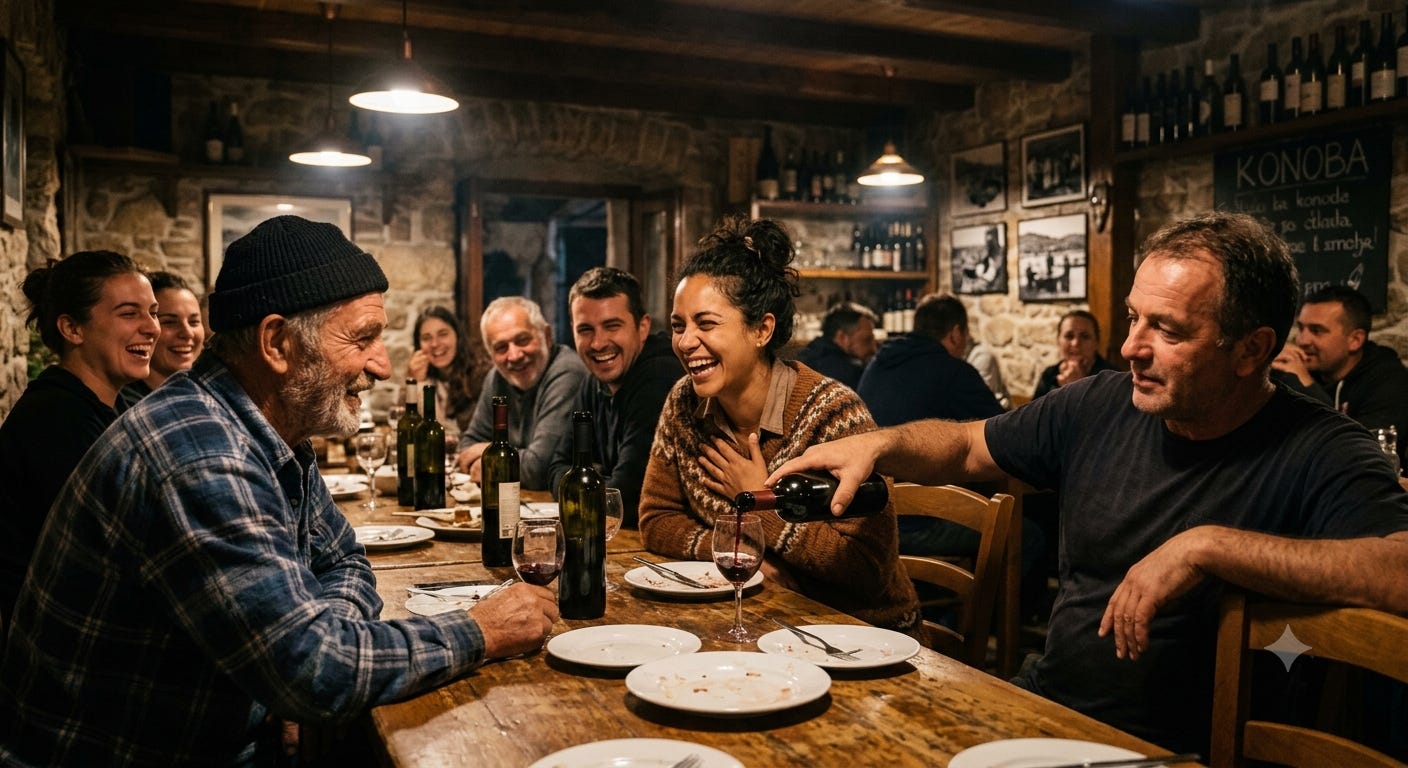
I have been writing to you since May, and I have given you a great deal of linguistics. The four accents and the melody the bakery woman reads in three seconds. The three dialects and where your people sit on the map. Slavonia, the oldest štokavian, hiding in the east. Dalmatia and its Venetian sediment. The country folded inside the word kaj. The small words that give you away, pa and ma and daj. The heritage grammar that is different and not broken. The accent you will never quite close. The six thresholds from the counter to the table. I have quoted phoneticians and dialectologists and heritage-language scholars at you, page number after page number, because I believe the shame so many of you carry is best dissolved by evidence, and because I am a scholar and it is the only way I know how to love a subject.
But this is the last letter in this series – the Konoba series. And in the last letter the linguist has to step back from the microphone, because the thing I actually want to say to you cannot be footnoted, or can only be footnoted at the edges, and I would rather say it plainly and let the citations stand at the back like witnesses.
Here it is. You did not undertake this in order to communicate. If communication were the goal you would have stopped years ago, because you can already communicate — in English, in Spanish, in German, in whatever language now does the heavy lifting of your days. Croatian is not, for you, a tool you lack. It is a room you are locked out of. And the difference between a language as a tool and a language as a room is the difference this whole series has been walking around, and it is time to say it out loud.
The scholars have a way of putting it that I have carried with me for years. When Jasna Čapo Žmegač studied Croats who had been resettled inside Croatia — people with the citizenship, the ethnicity, the passport, every credential belonging is supposed to require — she found that shared nationality was, in her words, “too general and too abstract to bind the two groups” together (Čapo Žmegač 13). They remained strangers. And the thing that gave them away, the thing that kept the door shut, was their speech — their own inherited Croatian, which sounded wrong to local ears, and which “immediately gave them away” as being from elsewhere (Čapo Žmegač 67). She called the book Strangers Either Way. Either way. With the credentials and without them. The passport was never the door. The speech was the door.
And so the ones who were let in, in her fieldwork, were the ones who made a deliberate decision to change how they spoke — not to acquire Croatian, which they already had, but to acquire this Croatian, here, the local variety of the specific place they now stood in (Čapo Žmegač 68). One of them, a man who had lived in Switzerland, said the thing that has stayed with me for a decade: “Just like I had to speak Swiss German there, I knew when I came here that I would have to change my speech. I must behave the way they behave here” (qtd. in Čapo Žmegač 68). He understood, from a life spent at borders, that belonging to a place and belonging to its language are two different acts, and that the second is work the first does not do for you.
This is not cruelty. I want to be careful here, because it would be easy to read all of this as a verdict, as the country standing at its own door with its arms folded, deciding who is Croatian enough. That is not what it is. Caroline Hornstein Tomić and Sarah Scholl-Schneider, studying Croatian returnees, borrowed a phrase from the sociologist Pierre Bourdieu that gets it exactly right: belonging to a place is a game, with rules that are unwritten, assumed, enacted unconsciously by everyone who grew up inside them, and that therefore must be learned, deliberately and from outside, by anyone who arrives (Hornstein Tomić and Scholl-Schneider 314). Coming home, they concluded, is more often “an ‘away match’ than a ‘home game’” (Hornstein Tomić and Scholl-Schneider 314). Nobody is being unkind to you when they hear that you are not from here. They are simply playing the game they have always played, at the speed they have always played it, and waiting — usually with enormous goodwill — to see whether you will learn the rules well enough to be played with rather than around.
The rules are the registers. That is the argument I have been making since the first letter, dressed in a hundred different linguistic costumes. There is the Croatian of the counter and the Croatian of the konoba, and every Croatian alive moves between them without thinking, and what you are learning is not “Croatian” but the movement — the switch from the official person to the konoba person, the thing your grandmother did ten thousand times a day and never once explained, because she could not have. And you learn it in order, one register at a time. The standard first, because it is the door into adult life, the bank and the clinic and the office, the register that lets you be understood by every Croatian regardless of where they are from. And then, slowly, over years, the local variety of your own people, because that is the door into the other thing. The table. The naša je.
I promised you, back in the very first letter, that the second door was not a wall. That it only looked like a wall, and that once you understood its structure it became what it actually was, which is a door, one that opens to the people who keep standing in front of it. I have spent eleven Saturday letters showing you the structure. Now I want to tell you why the door is worth all of this, when the tool you already have would let you order the coffee and read the sign and ask the way to the pharmacy for the rest of your life.
It is worth it because of Oliver.
The summer Oliver Dragojević died, the whole coast sang him down to the sea, and I wrote to you about it in the Saturday letter on accent — the thousands of people on the Riva in Split, the boats, the vowels opening in the same shape at the same time. But I did not tell you, then, the thing I actually think about when I think about Oliver, and it belongs here, at the end, because it is the emotional centre of everything.
Oliver was not, by the measures a conservatory would use, doing anything a hundred other singers could not do. What he had was the thing you cannot be taught and cannot fake and cannot buy: he sounded like the place. When he sang ča je život vengo fantažija — what is life but fantasy, and note the ča, the coastal ča, the word that is the whole of Dalmatia compressed into one syllable — nobody in the country checked his pitch. Nobody graded his vowels. The voice was enough. The rhythm was enough. He opened his mouth and the sea came out, and a whole nation heard, in the first phrase, one of ours, and gave him the thing it gives to almost no one, which is to be believed completely. The phoneticians who have studied the Split accent describe its particular music, that rising-then-falling double lift, as “a prestige and well-liked variety in Croatia, associated with popular music and sporting personalities” — a sound the whole country recognises as coming “from somewhere warm and specific,” and places instantly, and places with affection (Tabain et al. 207).
Here is what I want you to take from that. The ear that placed Oliver in half a phrase, that gave him its whole trust on the strength of a vowel — that ear is not your enemy. It is the same ear that will, one day, place you. Not as Oliver. You will never sound like you are from Split, and I told you that honestly in the Saturday letter on accent, and I meant it. But the ear that rewards the sound of belonging does not, it turns out, require perfection. It requires direction. It rewards the voice that is turned toward the sea rather than away from it. The locals were never going to expect you to sound like them. They were only ever going to listen for whether you were trying to come toward them, rather than asking them to come toward you — and that, in this country, is very nearly the whole of it.
So no. You are not a tourist. A tourist stands outside and photographs the door. You were born on the inside of something and then carried, by an ocean and a century and somebody’s brave decision to leave, to a place where the door had quietly closed, and what you are doing now — with your grammar book, with your grandmother on a video call, with your ridiculous, unglamorous shadowing of Oliver in the kitchen while the pasta boils — is not learning a foreign language. It is walking back in. One register at a time. The long way round.
The table from the first letter is still there. The wine is still open. Only now I am not asking you to come and sit down. I am telling you that the chair was always yours, and that the work of these twelve Saturday letters was never to earn it, but to learn to hear that it was already set.
The room you were already standing in
I want to begin this section of this final letter by taking apart the word tourist properly, because it is the word this whole series has been written against, and the linguistics gives me a cleaner way to dismantle it than sentiment alone can.
A tourist has a phrasebook. What you have is a baština — an inheritance, and the word carries the weight of the thing handed down, the house and the land and the name, not the souvenir. The heritage-language scholars are precise about the difference, and the precision matters because it is the ground the shame stands on, and if you move the ground the shame has nowhere to stand. Jim Hlavac and Diana Stolac, who recorded three hundred Croatian speakers across four continents, found that the Croatian of the diaspora is not broken standard, not a failed copy of the language on the evening news, but a coherent variety with its own internal logic — the specific dialect your family carried out of the country, frozen at the year of leaving, salted for keeping, and layered with the marks of a life lived inside another language (Hlavac and Stolac 47–48). It is a real Croatian. It works perfectly in the room it was built for. The only trouble it has ever had is what happens when that room meets a different room — which is the whole drama of the diaspora, and not, ever, a verdict on the speaker.
The field has fought, in the last decade, over the exact word for what you have, and the fight is worth knowing about because you are its subject. For a long time the term was incomplete acquisition, and it did quiet damage to a great many people who never read the journals it appeared in but somehow absorbed its judgement anyway. Tanja Kupisch and Jason Rothman argued, with real force, that the term is not merely unkind but wrong: a grammar you can think and grieve and love and argue in “is not incomplete, it is just complete and different as a matter of circumstance” (Kupisch and Rothman 564). Different, not deficient. A whole thing organised by a history you did not choose. And Maria Polinsky, who helped build this entire field, put it in the sentence I have copied out and handed to more students than any other line in any book: your inherited Croatian is “a system, not a curio shop of relics” (Polinsky 25). Not a dusty shelf of things your grandmother happened to say. A system. With grammar. With patterns a researcher can predict before you open your mouth. Yours.
Do you feel what that does to the word tourist? A tourist arrives with nothing and buys a map. You arrive carrying a coherent linguistic system that took a hundred years and an ocean to make, and the only thing you lack is the register that migration prevented from growing alongside it — the formal, public, schooled Croatian that was never at the kitchen table because there was no Croatian school and no Croatian street around that table in Rosario or Cleveland or Munich. You are not building a house. You are adding a floor to a house that has been standing, and warm, and inhabited, the whole time.
The shame points the other way
I have watched the shame do its work in a great many faces over twenty years, and I want to speak to it directly now, because this is the last chance I will have in this series to do so.
Jennifer Leeman, whose work on heritage-language identity I keep returning to, gives the feeling its proper name: linguistic insecurity, the gap between how a person actually performs and how frightened they are of performing, and she shows that it is sharpest, always, in the ones who care the most (Leeman 113). If you have felt like a fraud in your own language — understood everything at the table and answered in three careful words and gone home certain that a real Croatian would have exposed you at any moment — you are not weak, and you are not alone, and you are, in fact, exhibiting the single most documented emotion in the entire literature on people like you.
But here is the finding that should turn you around. Leeman also shows that the heritage speaker’s tie to the language is of a fundamentally different kind from the classroom learner’s, because it was formed before the other language arrived — laid down in the body as belonging rather than as study, in the years before you could decide anything (Leeman 104). Sit with the direction of that. The classroom learner builds toward the language from the outside. You are excavating something that was placed in you before memory, under the Spanish or the English or the German, in the strata that the later language grew over but never replaced. The formal registers you lack are learnable, and I have spent this series telling you exactly how. But the thing you have — the early, bodily, unearned belonging to the sound of the language — is the thing the classroom learner cannot buy at any price and cannot build at any age. It is the rarest half of the whole. And you were given it for free, by people who loved you enough to keep speaking their village to you in a country that had no use for it.
This is why I have never been able to accept the accounting that measures you against the standard and finds you low. It is measuring the wrong thing. It is weighing the floor you were not given and ignoring the foundation you were. The linguist Jan Hulstijn’s distinction is the honest one: there is the everyday spoken core of a language, the part every native shares regardless of schooling, and there is the literate, formal, register-heavy language that only school and print and profession build. Your home gave you the first. The exam measures mostly the second. And so on the exam you read as a beginner, while in the one register that all Croatians hold in common — the language of the kitchen, the argument, the joke, the grief — you may be standing much closer to the door than any letter of the alphabet will admit.
What being let in actually is
I told you at the very top of this letter about the woman on the island, and the old man, and naša je. I want to end by telling you what that moment actually was, in the terms this whole series has been built on, because it is the shape of the thing all of you are walking toward, and I would like you to be able to recognise it when it comes.
It was not a test she passed. Nobody in that konoba assessed her. Claire Kramsch, forty years ago, drew the distinction that undoes the whole idea of language as a ladder you climb: proficiency is not the same as interactional competence, the ability to build meaning with another person in real time, to enter someone else’s frame of reference and follow the cultural logic of their talk (Kramsch 366). The counter wants your accuracy. The konoba wants something else entirely — it wants you to have sent your mind out to meet the other person’s, and Kramsch ends her essay on exactly this, with an old saying she could not improve on and neither can I: “not to let a word get in the way of its sentence, nor a sentence get in the way of its intention, but to send your mind out to meet the intention as a guest — that is understanding” (qtd. in Kramsch 372).
To meet the intention as a guest. And then, if you keep coming, as something more than a guest. The woman on the island did not decode that filthy circular story. She met it. She was already inside the old man’s frame before the punchline landed, which is why she broke on the beat and not after it, and the old man felt her there, in the room with him and not translating from outside it, and did the only thing a Croatian does when he feels that — he stopped keeping track of whether she belonged, and simply acted as though she did. Naša je. Kramsch’s own line, the one I think is the truest sentence in her essay, is that interactional competence “begins at home” (Kramsch 370). For you, it began at a kitchen table on the other side of the world, in a language nobody around you needed, and it has been waiting all this time to be finished.
So this is the last thing, and then I will let you go and open the door yourselves.
Language is not a subject you study. I have written it a dozen ways across these letters and I will write it once more, plainly, because it is the argument the whole series was always making underneath the phonetics and the dialect maps and the discourse particles. A language is not a body of knowledge you accumulate until you have enough of it to be admitted. It is a room. It has more than one door, and the doors open in order — the standard first, so that you can handle the adult life of a country, and then, over years, not months, the local variety of your own people, so that eventually, not immediately, maybe not for a long time, someone stops registering your speech as marked and just talks to you. That is the entire journey. From outside the door, to the counter, to the table, to the evening when the plates are cleared and the second bottle appears and somebody refills your glass without looking, because they have forgotten to remember that you came from somewhere else.
You will get there the way everyone gets there. Not by being perfect. Oliver was not perfect; he was from somewhere, and he turned his voice toward it, and it was enough. You will turn your voice toward the place your people are from — through the standard, and then through the music, and the dictionary, and the long dinners, and the going there, and the čežnja, the longing that sits in the body and that English has no word heavy enough to hold. And one evening, on some island or in some Slavonian kitchen or in a flat in Zagreb that smells of somebody’s grandmother, the room will stop hearing you as a guest.
The table has been there the whole time. The chair was always yours. Come the long way round, one register at a time, and sit down.
Tihana Klepač is an Associate Professor at the University of Zagreb’s Department of English and the founder of TalkTime Croatian. This letter belongs to the series The Language You Carry. She teaches the Croatian Quadrant™, a structured, culturally immersive course designed to help learners stop translating and start thinking in Croatian. Find out more at talktimecro.com.
Works Cited
Čapo Žmegač, Jasna. Strangers Either Way: The Lives of Croatian Refugees in Their New Home. Berghahn Books, 2007.
Hlavac, Jim, and Diana Stolac. “Observations on Croatian as a Heritage Language Across Four Continents.” Croatian Studies Review, vol. 16–17, 2020/2021, pp. 45–72.
Hornstein Tomić, Caroline, and Sarah Scholl-Schneider. “An Easy Game? Experiences of ‘Homecoming’ in the Post-Socialist Context of Croatia and the Czech Republic.” Return Migration and Regional Development in Europe: Mobility Against the Stream, edited by Robert Nadler et al., Palgrave Macmillan, 2016, pp. 309–328.
Hulstijn, Jan H. Language Proficiency in Native and Non-Native Speakers: Theory and Research. John Benjamins, 2015.
Kramsch, Claire. “From Language Proficiency to Interactional Competence.” The Modern Language Journal, vol. 70, no. 4, 1986, pp. 366–372.
Kupisch, Tanja, and Jason Rothman. “Terminology Matters! Why Difference Is Not Incompleteness and How Early Child Bilinguals Are Heritage Speakers.” International Journal of Bilingualism, vol. 22, no. 5, 2018, pp. 564–582.
Leeman, Jennifer. “Heritage Language Education and Identity in the United States.” Annual Review of Applied Linguistics, vol. 35, 2015, pp. 100–119.
Polinsky, Maria. Heritage Languages and Their Speakers. Cambridge University Press, 2018.
Tabain, Marija, Mate Kapović, Matthew Gordon, Adele Gregory, and Richard Beare. “A Preliminary Study of Lexical Pitch Accents in the Split Dialect of Croatian.” Proceedings of the 18th Australasian International Conference on Speech Science and Technology, 2022, pp. 206–210.