

There is a man in my building who spent the whole of one summer sanding his windows.
The building is old, the windows are wooden, and the housing council voted to replace them, and somebody at that meeting told him, in the tone people use when they have already stopped listening, that his frames were rotten and there was nothing to be done. So he took them out. All of them, one by one, across July and August, in a courtyard that holds heat like a bread oven. He stripped them, filled them, sanded them, primed them, painted them, and put them back. It cost him more than the new windows would have cost. They still do not close properly on the north side. He is entirely delighted, and eight years later he will still tell you the story, and the story has a shape, and the shape ends with the sentence: iz inata.
Out of inat. Because of inat. And every one of you who grew up around Croatians has just recognised somebody. A grandfather. An aunt. A whole branch of the family that has not spoken to the other branch since 1987 over something nobody can now reconstruct. Possibly yourself, at two in the morning, doing something expensive and pointless with your jaw set, and not being able to explain afterwards why it mattered so much.
I want to take that word apart today. All the way down, as far as it goes, because it goes further than people think, and because the place it ends up is not where the flattering version of this story usually ends up.
First, what English cannot do with it
The dictionary defines inat as deliberate action against another person’s wishes, out of pride, arrogance or self-regard, and offers prkos, defiance, as the synonym (Hrvatski jezični portal, “inat”).
That is accurate and it is nowhere near sufficient, and the insufficiency is exactly where the interesting thing lives.
English reaches first for spite, and spite is wrong, because spite is aimed outward. Spite wants the other person to suffer. The whole strangeness of inat is that the suffering very often lands on the person doing it, and lands there knowingly, and that this is not a miscalculation, but something closer to the proof of the thing. A man who repaints his own rotten windows at three times the cost has not damaged the housing council. He has damaged only himself, and in doing so he has demonstrated something he considers more important than money, which is that he is not a person who can be told.
The nearest English comes is a proverb. To cut off your nose to spite your face. And look at what that proverb is doing. It is a warning. It is disapproving. It exists to name a folly so that sensible people can avoid it, and it is a phrase and not a word, which means English has never needed to file this behaviour as a thing that a person can have.
Croatian has the noun. And then it has the verb, inatiti se. And the verbal noun, inaćenje. And the agent noun, inadžija, a person who does this habitually, which is not entirely an insult. And then it has the whole prepositional apparatus: za inat, u inat, iz inata, na inat, tjerati inat, to drive inat, the way you would drive cattle.
The title says it before I can. Inati se, Slavonijo — be defiant, Slavonijo, let your beauty ache — Krunoslav Kićo Slabinac addressing the whole region the way you'd address a stubborn person, because in this case it is one.
Anna Wierzbicka’s test for whether a word is carrying serious cultural weight has three parts. Is it common. Does it sit at the centre of a whole phraseological cluster. Does it turn up in proverbs, sayings, songs and titles (Understanding Cultures 15–16). Inat passes all three before you have finished breakfast. That is not a curiosity. That is a language that has needed to talk about this a great deal.
The anatomy
If you take the situations apart, the same three components turn up every time, and I have never found a case that works without all three.
Somebody, first, has to have expressed an expectation. Not necessarily a command. Often it is milder and worse than a command: it is the assumption, spoken in passing, that of course you will do the sensible thing, that of course you cannot manage it, that of course you will come round. Inat is triggered less by force than by being taken for granted.
Second, the response is not resistance to the content. It is resistance to the presumption. This is what people outside the culture consistently misread. The man with the windows did not have a view about windows. He had a view about being told, at a meeting, in that tone, that there was nothing to be done.
And third, it has to cost. This is the part that makes inat untranslatable rather than merely unfamiliar, and it is the part that makes people laugh when they recognise it. The cost is not an unfortunate side effect. The cost is the argument. If the act were free, it would prove nothing. Precisely because it is expensive, it demonstrates that the person doing it cannot be bought, predicted, managed, or reasoned into line, and in a certain kind of history that demonstration has been worth a great deal more than a set of windows.
There is a fourth thing, which is not a component but a condition. Inat wants a witness. Even when nobody is watching, there is an imagined audience, the person who said the thing, the neighbour who will hear about it later, the dead father in whose voice the presumption originally arrived. This is a public emotion. It is performed. Which is why it makes such good stories, and why the stories last for decades.
Now the part that complicates the flattering version
We like to say that inat is ours. It gets called a national trait, a Croatian organ, the thing that explains us. I have heard it said at conferences, and I have heard it said in kitchens, and I have said it myself in a lazy moment.
So let us look at where the word came from.
Inat is a Turkism. It came into Croatian from Turkish inat, and the Turkish word came from Arabic ʿinād, obstinacy (Hrvatski jezični portal, “inat”). The word we use for our refusal to be ruled by anybody arrived here in the luggage of the empire that ruled a great deal of this region for centuries. Slavonia alone spent nearly two hundred years under Ottoman administration, and the linguistic sediment of that is not a curiosity at the edges of the vocabulary, it is one of the largest layers of borrowed lexicon in the rural speech of the whole area (Andrić 17).
And it gets better, or worse, depending on your appetite.
Marta Andrić went through the great village monographs of Slavonia, Josip Lovretić on Otok near Vinkovci and Luka Lukić on Varoš near Slavonski Brod, both compiled at the turn of the twentieth century, both recording ordinary speech as ordinary people actually used it. She sorted the Turkisms by what they were for. And she found that the borrowed terms adopted for naming interpersonal relations and personal qualities were introduced almost exclusively for describing unfavourable and disorderly situations (Andrić 22).
Inat appears in her list. Not among the words for virtues. It sits in the section headed Pogrde, insults, in the company of galama, uproar, jagma, scramble, kavga, quarrel, and zulum, violence and tyranny. She quotes Petar Skok’s flat observation that the words for turmoil, quarrel and noise in the Balkans really are of Turkish origin (qtd. in Andrić 22).
So here is the actual history of this word, as far as we can reconstruct it. It arrived from the language of an occupying administration. For a long time it named something bad, something you accused a person of, filed alongside the words for brawling and extortion. And then, at some point in the last hundred years or so, mostly in the century when this region was busy assembling its national self-descriptions, it was quietly promoted. The insult became a characteristic. The characteristic became a virtue. The virtue became a national organ.
That promotion is the real subject of this letter, and I find it far more interesting than the flattering version, because a people that takes the word its rulers used for troublemaking and turns it into the name of its own soul is telling you something true about itself. Just not the thing it thinks it is telling you.
Which is why I want to be careful about the word “national”
I have a rule about this, and it comes out of the same research tradition I have been drawing on all series.
Cliff Goddard and Anna Wierzbicka developed a technique for writing out the unwritten rules of a culture, and they are scrupulous about what such a description does and does not claim. Cultural scripts, they insist, capture background norms and templates for ways of thinking, speaking and feeling, and “while they explain a great deal about speech practices, they are not descriptions of behaviour as such” (157). Societies are heterogeneous. Not every member of a culture endorses a given script. What the script claims is only that everyone in that culture is familiar with it, that it forms part of the interpretative backdrop against which people read each other (157).
Hold inat up against that and the honest claim becomes both smaller and much more interesting than the kitsch version.
It is not true that Croatians are stubborn. Some are, some are not, in roughly the proportions you find anywhere. What is true, and demonstrably true, is that every Croatian has a ready-made frame for reading a certain kind of expensive, self-defeating act as meaningful rather than mad. The man with the windows is not, in this country, a lunatic. He is a recognisable type performing a recognisable manoeuvre, and the whole building knows how to read him, and some of them admire him, and the ones who do not admire him still know exactly what he is doing and why.
That is a fact about a shared interpretative backdrop. It is not a fact about anybody’s blood, and I would ask you to be as suspicious as I am of anybody who tells you otherwise, including anybody Croatian, including me on a bad day.
And there is one more piece of evidence that should settle it. The word is not ours. Goddard and Wierzbicka note that several contiguous languages in a single speech area can share the same cultural scripts, or variants of them, which is why they talk about areal scripts rather than national ones (158). Inat is areal in exactly that sense. Bosnians have it. Serbs have it. Bulgarians and Macedonians have it. The Turks, who gave it to all of us, still have it. If inat is a national organ, then four or five nations are sharing the organ, and the sharing follows the borders of an empire rather than the borders of a people.
The building that proves it
If you want the evidence in stone rather than in argument, it is not in Zagreb. It is in Sarajevo, on the wrong bank of the Miljacka, and it is a restaurant.
The story, as everybody tells it, is that when the Austro-Hungarian authorities were clearing the ground for the City Hall, an old man called Benderija refused to let his house be demolished. He held out until they agreed to his terms, and then the house was taken apart and moved, stone by stone, across the river and put back together on the other side, and he is said to have sat on the Šeher-Ćehaja bridge through the whole operation, smoking, watching them work. The building is called Inat kuća, the Spite House, and it carries an inscription written in the first person, as though the house itself were speaking. Bila sam na onoj strani, ali pređoh ‘vamo, iz inata. I was on that side, but I crossed over here, out of inat.
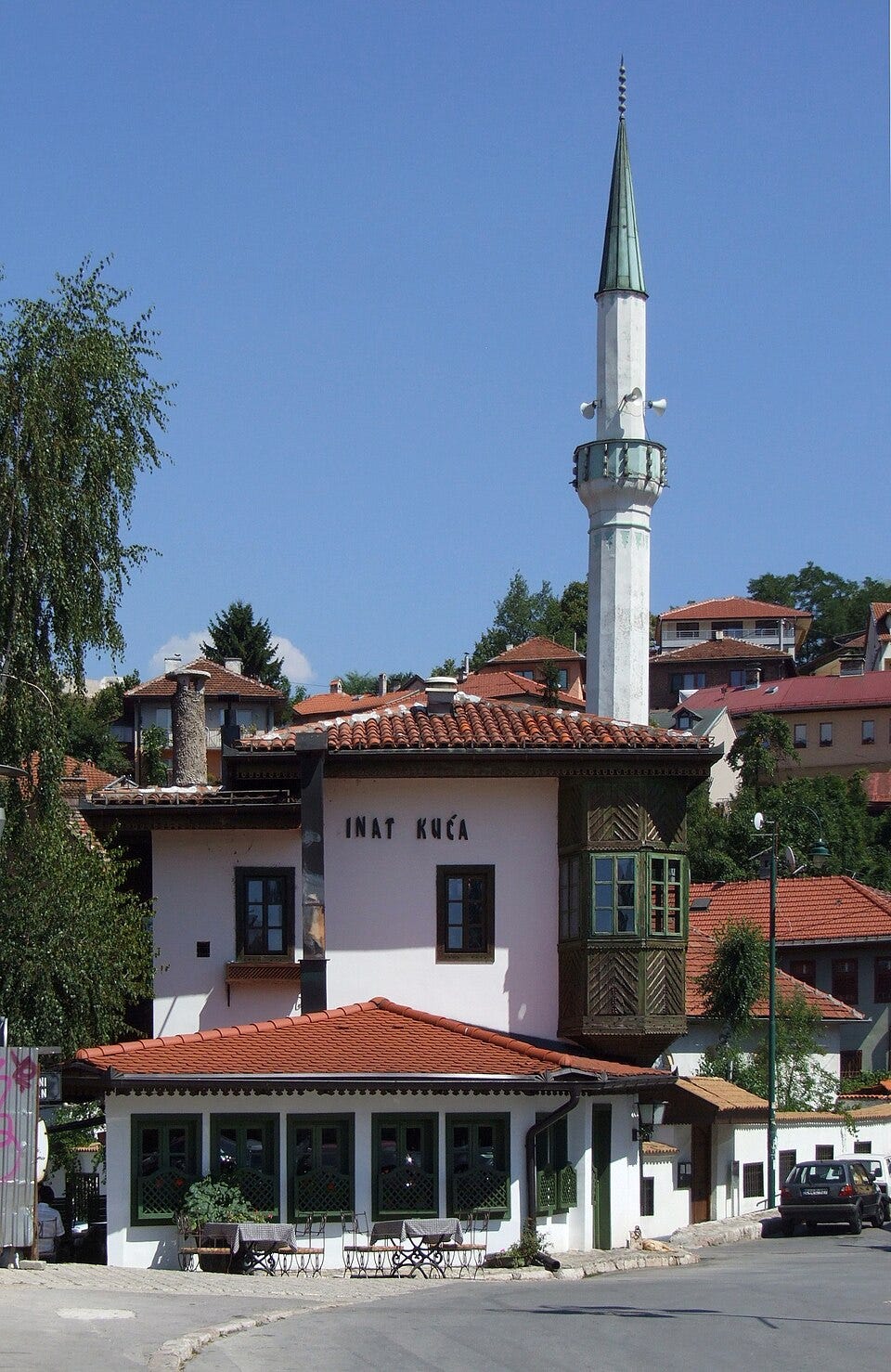
Inat kuća, Sarajevo Source: Wikipedia
Historians of the city have been picking at this for years, and the picking is instructive. The house stood upstream of the bridge, which means it was never in the way of the City Hall, which was built downstream. It appears on the survey maps of the eighteen-nineties still standing in its original place after the City Hall was finished. The relocation, when it happened, was most likely occasioned by the tram line rather than by the great imperial building, which removes the entire romantic confrontation at the centre of the legend (”Između romantizirane legende”).
And I want to say clearly that this does not weaken anything. It is the strongest evidence in this letter.
A people that invents this particular story about itself, and puts it on a building, and writes the inscription in the voice of the house, is telling you what it wishes were true, which is a more reliable guide to a culture than what actually happened. The legend is not a record of an event. It is a self-portrait. And the self-portrait was painted in Sarajevo, which should settle the question of whose organ this is.
The word we already had
Here is the detail I find loveliest, and it is the kind of thing you only see if you read dictionaries for pleasure, which I do, and which I recommend.
Croatian already had a word. Prkos, defiance, a good Slavic word, connected to prijek, meaning contrary, athwart. And the dictionary defines prkos as deliberate action against somebody’s will or opinion, passionate unyieldingness, stubbornness. And then it gives, as its final synonym, inat (Hrvatski jezični portal, “prkos”).
Look at what has happened. Each word is defined by the other. The dictionary cannot separate them.
And yet no speaker of Croatian would ever confuse them, and every one of you who has the language in your body knows this without being able to say why. Prkos can be noble. Prkos is what a child has, and what a small nation has under occupation, and what you write in a poem. It scales upward toward dignity. Inat does not scale upward. Inat keeps its feet in the mud, it is domestic and petty and expensive, and it is very often funny, and there is real affection in the way we say it.
Two words for what looks like one thing, and the difference between them is the difference between a virtue and a habit you cannot quite defend but would not give up.
What it is actually for
Now let me say what I think inat does, because I do not think it is an ornament.
If you cannot win, you can still refuse to be predicted. That is the whole of it. A person with no power over an outcome retains one small, absolute power, which is the power to make the outcome cost the other party something, or at minimum to make themselves illegible. That is not irrationality. That is the last available move on a board where the other moves have been taken away, and it flourishes, unsurprisingly, among populations who spent several centuries being administered by somebody who did not ask them.
Read the history of this region as a long sequence of administrations arriving with plans, and inat stops looking like a personality quirk and starts looking like an adaptation.
And now I have to say the other half, because I promised at the start of this series that I would not sell you a flattering country.
The same reflex that keeps a person from being governed keeps them from being helped. I have watched inat wreck a family business, end a marriage that both parties wanted to keep, and put an old man in a hospital bed because a doctor made the mistake of telling him what he must do rather than asking him what he thought. I have watched it hold up a village road for eleven years. It is not only charming. A defence mechanism that outlives the thing it was defending against becomes, in the end, just a mechanism, running on nothing, wearing out the person it lives in.
Both of these are true, and I will not resolve them, because they do not resolve. That is the country.
Which brings me to you
I think many of you are about to recognise something, so let me put it as plainly as I can.
There is a decent chance that the reason you exist where you exist is inat.
Somebody in your family was told they would never manage it. Somebody was passed over, or humiliated at a counter, or told by a brother-in-law that they did not have it in them, and the leaving was the answer to that sentence. Not economics. Not even ambition. An answer to a sentence, delivered by getting on a boat and never coming back and sending photographs. If you have ever wondered why the story of the emigration in your family is told with such heat, seventy years later, by people who were not born yet, that is why. It was never only about work.
And here is the part that I have been building toward all letter, and that I would like you to sit with.
Your Croatian may have survived out of inat.
Think about the households that kept speaking it. Very often, the trigger was not love of the homeland. It was somebody in the new country making a face. It was a teacher telling a mother to stop confusing the child. It was a neighbour saying, kindly, that the children would do better if they only spoke English. And the mother, who might have let it slide, who was tired, who had every practical reason to let it slide, looked at that neighbour and something set in her jaw, and Croatian went on being spoken in that kitchen for another forty years.
Love would not always have been enough. Love is tender and it gives way. Inat does not give way, and inat is why a language with no economic value and no institutional support and nothing at all to recommend it survived in three thousand kitchens on four continents, purely because somebody was told it would not.
If you have any Croatian at all, some part of it was probably carried by that.
So the next time somebody tells you, gently, in that reasonable voice, that it is too late for you to learn this properly, that you are too old, that your accent will never be right, that there is no point at your age, I would like you to notice what rises in you. Do not talk yourself out of it. That thing has been keeping this language alive for a hundred years, and it has never once needed permission.
The family around the word
Inat does not live alone. It belongs to a small group of words that came into this language by the same road, at roughly the same time, from the same empire, and that together do something that no amount of standard Croatian can do.
I want to take them one at a time, because each has a root that will surprise you, and because the pattern only becomes visible once all four are on the table.
Ćeif
The dictionary marks it regional and gives two senses: will, inclination, what one feels like, as in ćeif mi je; and good humour, ease, contentment. There is one set phrase: biti po ćeifu, to be as one wishes. The etymology runs from Turkish keyif, from Arabic kayf (Hrvatski jezični portal, “ćeif”).
Notice what that word is fusing. English separates mood from will. What I feel like is one thing, an internal weather report. What I am entitled to is another, a matter of rights and reasons. Ćeif is both at once, and the fusion is the meaning. To say nije mi ćeif is not to report a mood. It is to close a subject. The state of your inclination is offered as sufficient grounds, and the astonishing thing, to anyone raised in a culture of justification, is that it is generally accepted as sufficient grounds.
A man drinking his coffee slowly, in the right chair, at the right hour, with nobody hurrying him, is not indulging himself. He is exercising ćeif, and the word grants him standing.
Merak
Regional again, and the entry is remarkable, because it contains three senses that ought not to belong to the same word. First, desire for something, pleasure taken in something, usually a food or a drink. Second, marked rare and literary, rapture, passion, longing, melancholy. And third, also rare and literary, obsessive worry, anxiety. The phraseology gives you piti s merakom, jesti s merakom, to consume something with relish and slowly. And the etymology comes through Turkish from an Arabic root glossed, in our dictionary, as hypochondria (Hrvatski jezični portal, “merak”).
Sit with that entry for a moment.
One word covers the pleasure of drinking a coffee properly and the condition of not being able to stop worrying. The delight and the dread are the same substance. And the ancestral meaning is a medical one, an excess of preoccupation, a mind circling something it cannot leave alone.
Which tells you exactly what merak actually is, and why English has nothing for it. Merak is not enjoyment. Enjoyment is light. Merak is the total occupation of a person by one small thing. The same faculty, pointed at a cup of coffee, produces a man in a state of unhurried bliss, and pointed at a worry, produces a man who cannot sleep. It is one capacity with two exits.
Sevdah
Regional, literary, expressive, and the dictionary gives it as love, amorous longing, rapture. The etymology comes through Turkish sevda, love, and lands on Arabic sawdāʾ, which means black bile, the entry explaining the connection through the medieval theory of the humours (Hrvatski jezični portal, “sevdah”).
Black bile. Melancholia, in the old physiological sense, one of the four humours, the one whose excess made a person heavy, brooding and inward.
So the word for love, in the whole musical tradition of this region, is genealogically a word for an illness. Not a metaphor for illness. A classification. Love was filed, by the medicine that produced the word, as a disorder of the bodily fluids, and the language carried that filing across two other languages and several centuries and handed it to a man with a saz in Sarajevo, who used it to mean the thing you feel at three in the morning when the song is in its fourth verse and nobody is going home.
And this is why sevdalinka cannot be translated as “love song” without something going out of it. A love song is about love. A sevdalinka is about the condition, and the condition, if you follow the word back far enough, was always understood to be something that happens to your body against your will.
Dert
And the last one, which is my favourite dictionary entry in the whole language.
Regional and expressive, and the definition runs: spiritual, usually amorous pain, and the public showing of that pain, often prompted by drink. Sorrow, worry, torment. The phrase given is pasti u dert, to fall into dert. The etymology comes through Turkish from Persian derd (Hrvatski jezični portal, “dert”).
Read the definition again. And the public showing of that pain.
The word contains its own performance. English has no such word, not one, because English keeps the feeling and the display of the feeling in separate compartments and morally prefers the compartment where the display is kept small. We have grief and we have theatre, and we are suspicious of anybody who mixes them. Here is a language in which the mixing is lexicalised, in which the showing is not an addition to the sorrow but part of what the sorrow is, and in which you can fall into it the way you fall into water.
What the cluster is telling you
Put the four of them on the table together, alongside inat, and a grammar appears. Not a grammar of endings. A grammar of how feeling is supposed to behave.
The first thing all five share is direction. These states are not properties of a person. They arrive. Uhvatio ga je inat, pao je u dert. You are the place where the thing happens, not the author of it, and this is doing serious moral work, because a state that seizes you is not a state you can be straightforwardly blamed for. A whole apparatus of dignity is built into that grammar.
The second is that pleasure and suffering are not opposites here. Merak covers both with one word. Sevdah is delight built out of black bile. Dert is pain you fall into the way other people fall into bed. Anyone who has sat through a long evening on this coast, or in Slavonia, and watched a table go from laughter to weeping to laughter again inside forty minutes without anybody finding it strange, has watched this grammar in operation. It is not instability. It is a culture in which the two things are understood to be made of the same material at different temperatures.
The third is that inner states are meant to be shown. Dert says so in its dictionary definition. Inat requires a witness. This region does not, on the whole, admire the person who feels a great deal and shows nothing, which is a genuinely different moral aesthetic from the northern European one, and it is worth knowing if you have spent your life in Melbourne or Munich wondering why your relatives are like that at funerals.
And the fourth thing, which I keep coming back to and cannot make comfortable, is that the entire vocabulary is borrowed. Every single one of these words came from Turkish, and behind Turkish from Arabic or Persian. The emotional self-description of this region, the words we reach for when we want to say what we are actually like, is written in the language of the empire that ruled us. There is no getting round this and I do not think we should try. It is simply what four centuries of a border does. The words for administration were rejected. The words for feeling were kept, because they were more useful than the ones we had.
And here is the part that concerns you directly
Go back and look at how the dictionary marks these words. Ćeif: regional. Merak: regional. Sevdah: regional, literary, expressive. Dert: regional, expressive.
Regional. Every one of them.
That marking is not neutral and it is not an accident. The standard language that was built in this country across the twentieth century had a strong purist streak, and Turkisms were among the first things it treated as impurities to be cleaned out. What that process actually removed, when you look at what survived and what did not, was disproportionately the vocabulary of feeling. The administrative Turkisms went, which nobody misses. But the words for what a person is doing when they sit with a coffee for two hours, or fall apart at a wedding, or refuse to be told, went to the margins with them, and were replaced by nothing, because there was nothing to replace them with.
Which means, and I want to be very direct about this, that if you learn Croatian from a textbook you will learn a language with the feelings taken out.
You will be able to conduct your business at the bank. You will be correct. And you will not have a single word for what your grandmother was doing on that particular afternoon, and you will reach for the standard vocabulary and find it polite and thin, and you will conclude that you are still not fluent enough, when what has actually happened is that the register carrying the emotional life of this culture was quietly moved out of the standard and into the dialects, the songs, and the speech of the old.
This is not an argument against learning the standard. I have spent an entire previous series arguing that the standard comes first and I have not changed my mind. It is an argument about what the standard is for, and about the fact that finishing it is not arriving.
How to use these words without sounding like a tourist
Three things, and then I will let you go.
The first is a register rule, and it is absolute. Every one of these words belongs to intimacy. None of them belongs at a counter. Saying merak to a shop assistant is like saying “my beloved” to a bus driver: the word is real, your usage is not, and everybody will hear the seam. Use them at tables, with people who have already fed you.
The second is that you should hear them long before you say them. These words live in music more reliably than they live in speech now, which is a gift, because music is repeatable. Sevdah and dert are all through the sevdalinka repertoire. Merak and ćeif run through the Slavonian and Bosnian songs and through the way old men talk about coffee. Listen for the situations they attach to. Collect the occasions, not the definitions.
And the third is the one that will actually teach you. Ask the oldest person in your family when they last saw somebody in inat. Not what it means. When they last saw it. You will get a story, the story will have a shape, and the shape is the meaning. This is a better method than any dictionary, and it has the additional advantage of being the reason they have been waiting for somebody to ask.
One last thing
I opened with a man sanding his windows in a hot courtyard, and I have spent this whole letter arguing that the word for what he was doing came from an empire, entered our language as an insult, was promoted to a virtue by people assembling a national story, and is shared with every neighbour we have.
All of that is true, and none of it touched him for one second in that courtyard.
That is the thing about a word like this. Its history belongs to scholars, and its meaning belongs to whoever is currently using it, and the two have almost nothing to do with each other. He was not enacting four hundred years of Ottoman administration. He was answering a man who used a particular tone at a meeting. And when he tells the story, which he will, the sentence at the end of it will do exactly what it has always done, which is to take an act that looks like foolishness from the outside and give it, in one syllable, the shape of a refusal.
Your family has that sentence too. Somebody in it did something expensive and unnecessary, and the family still tells the story, and the story still ends the same way.
Ask for it while there is still somebody to ask.
Next week: the letter I have been putting off, about the words that stopped being passed down, and what is actually lost in a family when a language goes quiet for one generation.
Tihana Klepač is an Associate Professor at the University of Zagreb’s Department of English and the founder of TalkTime Croatian. This letter belongs to the series The Language You Carry. She teaches the Croatian Quadrant™, a structured, culturally immersive course designed to help learners stop translating and start thinking in Croatian. Find out more at talktimecro.com.
Works Cited
Andrić, Marta. “Turcizmi u seoskom govoru Slavonije.” Migracijske i etničke teme, vol. 19, no. 1, 2003, pp. 17–27.
Goddard, Cliff, and Anna Wierzbicka. “Cultural Scripts: What Are They and What Are They Good For?” Intercultural Pragmatics, vol. 1, no. 2, 2004, pp. 153–66.
Hrvatski jezični portal. Novi Liber and Srce, hjp.znanje.hr. Entries “ćeif,” “dert,” “inat,” “merak,” “prkos,” and “sevdah.” Accessed 15 Aug. 2026.
“Između romantizirane legende i historijskih činjenica o Inat kući.” Impuls, impulsportal.net. Accessed 15 Aug. 2026.
Skok, Petar. Etimologijski rječnik hrvatskoga ili srpskoga jezika. Vol. 1, JAZU, 1971. Quoted in Andrić, p. 22.
Wierzbicka, Anna. Understanding Cultures through Their Key Words: English, Russian, Polish, German, Japanese. Oxford UP, 1997.