

In a great many of those houses there was a sound, and if you grew up inside one you will know it before I have finished the sentence.
A woman at a stove, talking. She turns her head towards her husband and the sentence comes out in Croatian. She turns her head towards you, in the same breath, without a pause, and the next sentence is in English.
Stop there for a moment, because what is happening in that doorway is not nothing.
For eighteen years the language was in that room. Every day. At volume. Fluent, fast, unhesitating, full of jokes you could hear landing. And in eighteen years, almost none of it was ever aimed at you.
That is not neglect. Nobody sat down and decided it. There was no meeting, no vote, no evening where the family agreed that Croatian would go to the adults and English would go to the children. And yet it ran that house for two decades with the consistency of legislation.
I want to give it its proper name today, because the name changes what you are allowed to feel about it. That was a language policy. And the reason you can or cannot speak Croatian now has almost nothing to do with how much anybody in your family loved Croatia.
The one link that decides it
Start with the man who spent his life on this question.
Joshua Fishman built a scale of eight stages describing how badly a language has been disrupted and, therefore, where the work of saving it has to begin. Stage eight is a language kept alive by a handful of elderly speakers. Stage one is a language with full cultural autonomy, its own schools, its own government offices, its own upper reaches.
And sitting in the middle, at stage six, is this: the family, the neighbourhood, the community. The ordinary daily business of one generation speaking to the next.
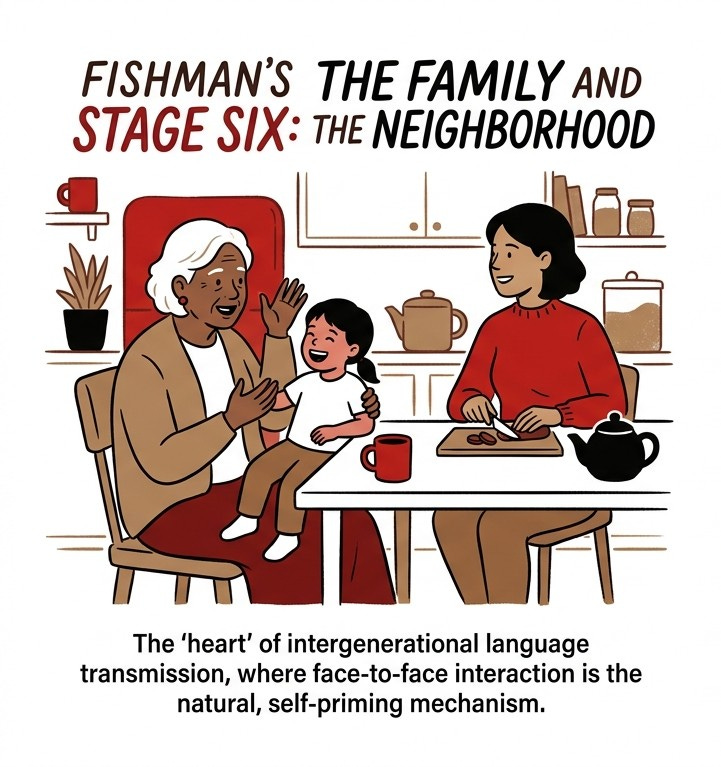
Fishman does not describe it as one stage among eight. He describes it as “the heart of the entire RLS venture,” and the reason he gives is worth quoting properly, because it is the whole argument in one sentence:
it is inescapably true that the bulk of language socialisation, identity socialisation and commitment socialisation generally takes place through intergenerationally proximate, face-to-face interaction and generally takes place relatively early at that. (Fishman 20)
Now the part that is harder to hear. Fishman’s claim is not that stage six is important. His claim is that without it nothing else counts:
if this stage is not satisfied, all else can amount to little more than biding time, at best generation by generation, without a natural, self-priming social mechanism having been engendered thereby. (21)
Biding time. That is the phrase for everything that happens above the family when the family link is broken.
What this says about the Saturday school
I want to be careful here, because I am about to say something that could sound cruel about a great many well-meaning institutions, including some that people gave their weekends to for thirty years.
Fishman is unsparing about the stage just below the family, which he calls stage seven: the endless public events, the concerts, the lectures, the courses, the folklore evenings, the anniversaries, the radio programmes. He calls them, without malice, rallies of the last Mohicans. They enthuse the already enthusiastic. And then:
It is hard for a thousand ‘old-timers’ who attend an absolutely first rate ‘pageant for Xish’ to believe that on the morning after Xish is still no better off than it was on the night before. (Fishman 20)
He says the same about media and official recognition, and his line on it is the one I would put above the desk of anyone running a diaspora organisation:
It is doubtlessly harder to build Xish neighbourhoods and to assist Xish-speaking families than to broadcast in Xish on the television. (25)
And about schools, he is blunter still, warning against the academic reflex of treating education as the universal solution, and adding that “The Irish experience alone should disabuse us of that fallacy” (24).
None of this means the folklor group was a waste, or the Croatian Saturday school, or the parish, or the tamburica. I do not think that and neither did he. What it means is narrower and more useful. Those things can carry a language forward only if there is already a house somewhere in which the language is being spoken to a child on an ordinary Tuesday, for no occasion at all.
The pageant cannot do the Tuesday’s work. Nothing can do the Tuesday’s work except the Tuesday.
Then the children go to school
So the whole thing rests on the home. Which brings us to the finding that explains what actually happened in yours.
In the late 1980s, Lily Wong Fillmore ran a study with no funding at all, which she called, drily, the No-Cost Study on Families. Volunteers across the United States interviewed around eleven hundred language-minority families. She analysed a thousand and one of them, and asked a simple question: had the language of the home changed since the children started preschool, and in which direction?
Just over half the families, 50.6 per cent, reported a negative change, meaning a shift away from the home language and into English. In her comparison group, whose children had attended preschools conducted entirely in the home language, the figure was 10.8 per cent (Wong Fillmore 333).
Break it down further and it gets sharper. Among families whose children were in English-only preschools, 64.4 per cent reported the shift. Among those whose children were in home-language programmes, 26.3 per cent. And positive change, meaning the home language actually strengthening, was reported by 42.1 per cent of the home-language families and by 2.8 per cent of the English-only ones (333).
Fifteen times more often.
And there is a detail in that table which I think is the most important number in the whole study, and which is not what the reader expects. Bilingual programmes, the ones designed precisely to protect the first language, only partly did. Nearly half those families, 47.2 per cent, still reported the shift. Wong Fillmore writes it plainly: “Sad to say, bilingual education does not appear to offer children enough protection from language shift” (333).
Even the good version was not enough. That is not a story about anyone’s choices. That is a story about the size of the force.
Why the child does it
Here is where the blame you have been carrying, or aiming at your parents, should start to come apart.
The shift almost never begins with the parents. It begins with the child, and Wong Fillmore’s account of why is the least sentimental and most humane thing I have read on the subject:
Language-minority children are aware that they are different the moment they step out of their homes and into the world of school. They do not even have to step out of the house. They have only to turn on the television and they can see that they are different in language, in appearance, and in behavior, and they come to regard these differences as undesirable. They discover quickly that if they are to participate in the world outside the home, something has to change. (342)
And then the sentence that dissolves the moral framework entirely:
Although young children neither know nor care about prestige and status, they do care about belonging and acceptance. (342)
Nobody is choosing against Croatian. A four-year-old has no position on Croatia. A four-year-old has worked out, in about a fortnight, that there is a room they want to be inside, and a password for getting in, and that the password is not the language their mother uses at the stove. Fifty years ago Robert Gardner and Wallace Lambert gave a name to the desire to become like the people who speak a language, and called it integrative motivation, and treated it as the great engine of language learning (Gardner and Lambert). It is. It is also, pointed the other way, the great engine of language loss.
Wong Fillmore notes that children reach this conclusion “whether they are in all-English classes or bilingual classes” (342). They are not reading the timetable. They are reading the room.
What actually gets lost
And now the passage. I have read a great deal for this series and this is the one I keep coming back to, and I am going to give it to you whole:
What is lost is no less than the means by which parents socialize their children: When parents are unable to talk to their children, they cannot easily convey to them their values, beliefs, understandings, or wisdom about how to cope with their experiences. They cannot teach them about the meaning of work, or about personal responsibility, or what it means to be a moral or ethical person in a world with too many choices and too few guideposts to follow. What is lost are the bits of advice, the consejos parents should be able to offer children in their everyday interactions with them. Talk is a crucial link between parents and children: It is how parents impart their cultures to their children and enable them to become the kind of men and women they want them to be. When parents lose the means for socializing and influencing their children, rifts develop and families lose the intimacy that comes from shared beliefs and understandings. (Wong Fillmore 343)
She has a phrase elsewhere for what a parent is reduced to when the shared language thins out. They learn enough of the new language, she says, “to deal with, if not communicate with, the children” (338).
If you have ever watched a grandparent and a grandchild manage each other politely across a kitchen table with about forty words between them, you have seen it. Nobody is unkind. Nothing is wrong. And there is a whole person on each side of that table who cannot get to the other one.
The forces on your parents
So why did they not just hold the line?
Some of them did, and I will come to that. But look honestly at what was pressing on the ones who did not.
Fishman, who spent his career among minority communities and had no illusions about them, writes that “The social meaning of being a minority is that one is forced to spend almost all of one’s resources on damage control, i.e. on merely staying alive within a reality that is not of one’s own making and not even under one’s own substantial ability to influence” (31). He notes that the traditional family itself “has been eroded by the very same universalising macro-forces that erode small languages and caring neighbourhoods” (29). And he observes, without judgement, that language shift spreads because it works, because it has “proved itself to be rewarding,” and that “People cannot be tricked into supporting” the alternative (18).
But the sharpest part is this, and it is the part almost nobody in the diaspora knows.
They were told to do it.
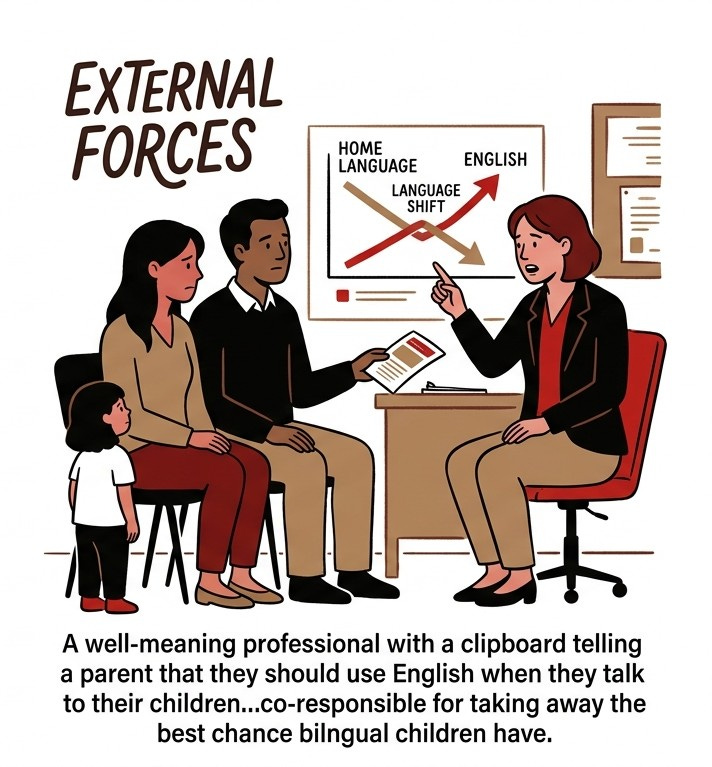
Wong Fillmore ends her article with a warning aimed directly at the profession: “Teachers should be aware of the harm they can do when they tell parents that they should encourage their children to speak English at home, and that they themselves should try to use English when they talk to their children” (345–46).
That advice was given, constantly, for decades, by teachers, by speech therapists, by paediatricians, to frightened immigrant parents who had every reason to believe that people with qualifications knew more than they did about raising a child in a country they had just arrived in. Annick De Houwer, writing thirty years later, is not gentle about it. She calls such advice “ethically reprehensible and legally unacceptable” (De Houwer 76–77), and says that professionals who give it are “co-responsible for taking away the best chance bilingual children have to grow up harmoniously: Supportive and rich language input from expert speakers who love them” (77).
Read that last phrase again. Expert speakers who love them. That is what your grandmother was, and somebody in a school office told her to stop.
So when you go looking for the moment Croatian left your family, do not look for a failure of loyalty. Look for a parents’ evening. Look for a doctor’s appointment where somebody worried aloud about the child’s English. Look for a well-meaning professional with a clipboard telling a woman who spoke four dialects of Croatian that she was holding her son back.
Mixed marriages, shame, and the one who held the line
Three more forces, and then I will turn.
The mixed marriage is the commonest, and it is rarely anybody’s fault either. When one parent does not speak Croatian, the household language becomes the language both adults share, because that is the only sentence everybody at the table can be inside. And there is a line quoted by Elizabeth Lanza, from a handbook for bilingual families, that has stayed with me since I first read it. When a family fails to establish the minority language, “someone will lose their linguistic identity, and it is usually the mother” (qtd. in Lanza 46).
Usually the mother. Sit with that.
Then shame, which does not need much explanation to this readership. Croatian carried, in many places and many decades, an accent and a set of assumptions that a parent had spent years learning to shed and had no intention of hanging around their child’s neck.
And then, in some families, there was the one who held the line. A baka who simply would not do it, who answered English with molim? until you gave up, who was regarded by the rest of the family as slightly difficult about this one subject. If your Croatian exists at all, it very often comes from exactly one person, and that person was usually considered a bit stubborn at the time.
You might, at some point today, work out who yours was.
Four pillars, and where transmission actually lives
A word about the method, because this letter locates itself in it very precisely.
Grammar, vocabulary, pronunciation, culture. The four faces of the one object, and on all four together stands what I call the Croatian Mind.
Transmission is not one of the four. Transmission is the floor. It is the condition under which any of the four can be handed to anybody, and when it goes, all four go together and in the same generation.
But notice which pillar it most resembles. Not grammar and not vocabulary, which is why the Saturday school could not save it. Culture. Because passing a language on is not a teaching act at all. It is a room where the language is used for real purposes by people who are not thinking about the language. Fishman knew this and said it better than I can, listing what it is that the family actually transmits: “conversation, games, stories, songs, proverbs and felicitous expressions, verbalised emotion, verbal ritual and verbal play” (29).
Nobody can put that on a syllabus. That is the whole difficulty, and it is also, if you are still in a position to build one, the whole opportunity.
The number, and the mercy
I will close the open half with two things from De Houwer.
The first is a number that should be better known than it is. In a survey of 2,250 families in Flanders, covering 5,335 children who heard a home language from one or both parents, a quarter of those children did not speak it. They only spoke the societal language. The same proportion turns up again in Australia, in Canada, and among adolescents in the United States (De Houwer 75).
A quarter. Of children who had the language spoken to them, at home, by a parent, every day.
Which tells you that hearing it is not enough, and never was, and that whatever happened in your house was happening in a quarter of the houses on that street.
And the second thing is the sentence she ends on, and it applies to more people reading this than she could have imagined:
The good news is that Harmonious Bilingualism is possible even after families have had negative experiences. (De Houwer 79)
Not that the lost years come back. They do not. But that the relationship between a family and its language is not settled once, in 1974, in a kitchen, by a decision nobody knew they were making.
It can be reopened. Which is what the rest of this letter is about.
Convergent and divergent
Here is the distinction that organises everything else.
In any conversation between a parent and a child, the two of them are either using the same language or they are not. De Houwer calls the first pattern convergent and the second divergent (75), and the divergent one has a very particular shape in immigrant families: the parent speaks the home language, the child answers in the societal language, and both of them understand each other perfectly.
That arrangement feels like a reasonable compromise. Everybody is communicating. Nobody is being forced. The parent gets to keep speaking Croatian and the child gets to keep speaking English and family life continues.
It is the single most reliable predictor of the language ending with that child.
De Houwer’s summary is flat and worth memorising: “The pattern whereby children speak the societal language and parents the home language does not serve family members well” (75).
And it is extremely common. In those Flanders figures, and in the Australian, Canadian and American replications, roughly a quarter of children in exactly this arrangement never became speakers of the home language at all.
So if you take one thing from this half of the letter, take this. The question is not whether you speak Croatian to your child. The question is what language your child answers in. Those are different questions, and only the second one predicts anything.
What actually separated the happy families
There is one study I know of that asked mothers directly how satisfied they were with their bilingual family life, and then looked at what the satisfied ones had in common. Anja Leist-Villis interviewed a hundred mothers in Greece and Germany. Fifty-seven were very satisfied. Twenty were somewhere in the middle. Twenty-three were not satisfied, and of those, twelve reported that they felt they had utterly failed to pass on their language, and felt very bad about it (reported in De Houwer 71).
Twelve women in a hundred, carrying that.
The mothers who were highly satisfied had five things in common, and I am going to list them because they are, in effect, a family language policy that somebody has already tested:
Their children spoke the home language. They themselves spoke only the home language to their children, regardless of the situation. Their children attended a school that used the home language, at least partly. Their spouse could speak the home language reasonably well. And they had other speakers of the home language in their social network (De Houwer 71).
Look at the second one, because it is the one that is entirely within your control and the one almost everybody breaks. Only the home language. Regardless of the situation. Not at home but not in the supermarket. Not with your child alone but not in front of their friends. Regardless.
That is a hard rule and I am not going to pretend it is comfortable. Children get embarrassed. De Houwer notes that older children very commonly tell their mothers to stop speaking the home language in public, and that in most cases the mothers comply and switch (73). Which is understandable, and is also the moment the policy quietly ends.
The five things you can say
Now the mechanism, and this is the most practical thing in the entire series so far.
Your child answers you in English. You have about a second and a half. What you do in that second and a half is the entire ballgame, and Elizabeth Lanza has mapped the options into five, arranged along a line from most to least likely to get Croatian back (Lanza 56).
The minimal grasp. You indicate that you have not understood. That is all. No explanation, no lecture, no request. In Croatian this is one word and you already have it: molim?
The expressed guess. You ask a yes-or-no question in Croatian that translates what the child said. Hoćeš vode?
The adult repetition. You repeat what the child said, in Croatian, as a statement. No question, no demand for a response.
The move on. You simply continue the conversation. You have understood, they know you have understood, and the exchange proceeds.
The code-switch. You answer in English.
Those five run from a conversation that is functionally monolingual Croatian at one end to a fully bilingual one at the other. And the finding that matters is this: in Susanne Döpke’s study of bilingual families in Australia, only the children who were met with the high-constraint strategies at the top of that list, the ones that genuinely refuse to move on, ended up as active speakers of the minority language (reported in Lanza 54). Kasuya found the same in Japanese-English families: the parents who made their preference explicit had the highest success rate (54–55).
Here is what the minimal grasp actually looks like, from a real transcript of a German-speaking mother in Rome and her two-year-old daughter, who is speaking Italian at her:
G: Mami aple. M: Wie bitte? G: Mami aple. M: Wie bitte? G: Mami aple. M: Wie? G: APLEEEEEEE! M: (covers her ears) Wie bitte? G: Aufmachen? (Lanza 57)
Five refusals. A toddler shouting. A mother covering her ears rather than giving in. And then the German.
That is what it costs, and I am not going to make it sound charming. The mother in that transcript is doing something that would look, to anyone watching from across a room, like being deliberately obtuse with a small child who is asking her to open something.
Two things make it survivable.
First, it is molim? and nothing else. No speech about the importance of Croatian. No visible disappointment. The strategy works precisely because it is boring and impersonal, a small mechanical hitch in the conversation rather than a referendum on the relationship.
Second, and this genuinely matters: Döpke’s other major finding was that the parents whose children became active bilinguals were the ones whose interaction was most child-centred, and that in this work “quality is more important than quantity” (Lanza 54). Insisting is not the same as being cold. A group study in the United States found that parents who used insisting strategies showed no reduction at all in the warmth they expressed towards their children (reported in De Houwer 73).
You can hold the line and be warm. In fact you have to do both, because either one alone fails.
The one-parent-one-language myth
You have been told, probably more than once, that the way to do this is one parent one language. Mother speaks Croatian, father speaks English, the child sorts them out.
The evidence is not kind to it.
Masayo Yamamoto studied families in Japan and found that what predicted a child actually using the minority language was not the tidy separation at all. It was the sheer quantity of the minority language in the house, plus how rarely the minority-language parent used the majority language with the child. She concluded that one-parent-one-language “does not provide the most optimal linguistic environment” for this, and that it did not guarantee anything even when families did adopt it (qtd. in Lanza 50).
De Houwer’s own large Flanders survey pointed the same way. What was strongly associated with children actively using the home languages was both parents using them. And the presence of the majority language in the parental input was strongly associated with the children not doing so (reported in Lanza 49–50).
There is a further, slightly uncomfortable finding. When Naomi Goodz actually recorded families who said they were doing one-parent-one-language, she found they were not. They were using both languages and did not know it (Lanza 53).
So the practical version is this. One-parent-one-language is not wrong, it is just weak on its own. What is strong is volume and consistency: as much Croatian as the household can carry, from as many people as possible, with as little English mixed into the Croatian-speaking adult’s own speech as they can manage.
And if you do not have children
Most of you do not, or your children are grown, and I am not going to spend a paid letter talking past you.
Three things.
If you have a partner who speaks no Croatian. That fourth item on the Leist-Villis list, the spouse who can speak the home language reasonably well, is doing more work than it appears to. It is not about the spouse becoming fluent. It is about whether Croatian in that house is a private channel between one parent and the children, which the other adult is outside of, or a language the household is in. The first arrangement is fragile and quietly resented. Getting a partner to a hundred words of Croatian is worth more than getting yourself another thousand.
If you have teenagers. The research here is unusually consistent and it is not about language at all. Adolescents who do not speak the same home language as their parents report feeling more emotionally distant from them, and are less likely to have conversations with them. Teenagers more fluent in the home language rate the communication with their parents more highly and report more respect for them. And in the study that looked hardest at it, the teenagers reporting the most depressive symptoms and rating their parents as least supportive were the ones with low home-language proficiency living with parents who had low societal-language proficiency (all reported in De Houwer 70–71).
The finding underneath all of these is not that Croatian is good for teenagers. It is that what damages a family is the mismatch. Any shared language in full working order will do. If you are the parent in that pair with the better range, the repair is yours to start.
If your parents are elderly. Then you have the resource everybody else in this letter is trying to construct, and a deadline on it. A grandparent who does not speak English is, from your child’s point of view, the single most powerful language-learning environment that money cannot buy, because it removes the option. One of Leist-Villis’s mothers had her own mother stay six months a year, and the grandmother’s lack of German was precisely what moved the boy into Greek (reported in De Houwer 78).
If that is available to you in any form, a summer, a visit, a standing video call at the same time every week, take it now. Not eventually.
The ledger
What this will not do. It will not undo a transmission that has already closed. If your children are adults who do not speak Croatian, no strategy in this letter reaches them, and I am not going to pretend otherwise; what reaches them is their own decision, later, probably in their thirties, probably after a funeral.
It will not be comfortable. The minimal grasp is genuinely awkward for the first several months and there will be an afternoon when you feel like a tyrant over a glass of water.
And it will not work at all without volume. Strategies redirect input. They do not create it. A family with fifteen minutes of Croatian a day and perfect discipline will lose to a family with three hours and none.
What it will do is change the odds, and the odds are the only thing on offer. A quarter of children who hear a home language never speak it. That quarter is not randomly assigned. It is heavily populated by exactly the arrangement described at the top of this section, the parent in one language and the child answering in the other, for years, comfortably, while everybody understands each other perfectly and nobody notices the door closing.
One last thing.
De Houwer has a term for the belief that a parent can actually influence how their child’s languages turn out. She calls it an impact belief, and she reports that many parents simply do not have one. They assume it will happen or it will not, that some children take to it and some do not, that it is a matter of temperament (De Houwer 77; Lanza 52).
It is not temperament. It is the second and a half after your child answers you in English, repeated across about four thousand days.
Your parents did not know that. Nobody told them, and several people with qualifications told them the opposite. You do know it. That is the only difference between their position and yours, and it is a much larger difference than it sounds.
Tihana Klepač is an Associate Professor at the University of Zagreb’s Department of English and the founder of TalkTime Croatian. This letter belongs to the series The Language You Carry. She teaches the Croatian Quadrant™, a structured, culturally immersive course designed to help learners stop translating and start thinking in Croatian. Find out more at talktimecro.com.
Works Cited
De Houwer, Annick. “Harmonious Bilingualism: Well-being for Families in Bilingual Settings.” Handbook of Home Language Maintenance and Development: Social and Affective Factors, edited by Andrea C. Schalley and Susana A. Eisenchlas, De Gruyter Mouton, 2020, pp. 63–83.
Fishman, Joshua A. “What Is Reversing Language Shift (RLS) and How Can It Succeed?” Journal of Multilingual and Multicultural Development, vol. 11, nos. 1–2, 1990, pp. 5–36.
---. Reversing Language Shift: Theoretical and Empirical Foundations of Assistance to Threatened Languages. Multilingual Matters, 1991.
Gardner, Robert C., and Wallace E. Lambert. “Motivational Variables in Second-Language Acquisition.” Canadian Journal of Psychology, vol. 13, no. 4, 1959, pp. 266–272.
Lambert, Wallace E. “Culture and Language as Factors in Learning and Education.” Education of Immigrant Students, edited by Aaron Wolfgang, Ontario Institute for Studies in Education, 1975, pp. 55–83.
Lanza, Elizabeth. “Multilingualism and the Family.” Handbook of Multilingualism and Multilingual Communication, edited by Peter Auer and Li Wei, Mouton de Gruyter, 2007, pp. 45–67.
Wong Fillmore, Lily. “When Learning a Second Language Means Losing the First.” Early Childhood Research Quarterly, vol. 6, no. 3, 1991, pp. 323–346.