

Sram te bilo.
If those words were ever said to you in a kitchen, by someone who had the standing to say them, you did not read that line a moment ago. You flinched at it, somewhere under the ribs, and only afterwards did you read it.
Look at what the phrase is actually doing, because it is stranger than its translation. Sram is a noun, shame, sitting there as the subject of its own sentence, a thing with weight and volume. Te is you, in the accusative, the one the shame is being done to. And bilo is what is left of a verb of being, neuter and past, dangling at the end with nobody to agree with. There is no wish-word anywhere in it, no let, no may, and yet a wish is exactly what it is. It does not say you ought to feel ashamed. It says: let shame be upon you. English hands you shame on you and drops most of it on the floor on the way.
Last week I closed a series about rooms, about the counter and the market and the table and the konoba at the far end of the house, and I told you that you are not a tourist in your own language. Today I want to start somewhere else entirely, and go down instead of across. Not which Croatian you need. What Croatian does to you, and why, and whether the thing you have felt your whole life and never had a name for is sentiment or fact.
It is fact. And it has been measured.
The skin knows before you do
In 2003, three researchers, two of them in Boston and one in Istanbul, sat thirty-two Turkish–English bilinguals down, taped electrodes to their fingertips, and asked them to rate a long list of words and phrases for pleasantness, once in Turkish and once in English. The electrodes were not interested in the ratings. They were measuring skin conductance, the small involuntary shift in the electrical resistance of the skin that happens when the sympathetic nervous system is startled, the same signal a polygraph reads. It is not a thing a person can decide to produce, or decide to withhold.
The stimuli included ordinary neutral words, positive words, negative words, taboo words, and one category the researchers had thought to include and which is the reason I am telling you any of this: childhood reprimands. Shame on you. Don’t do that. The kind of sentence that is said to a person who is four.
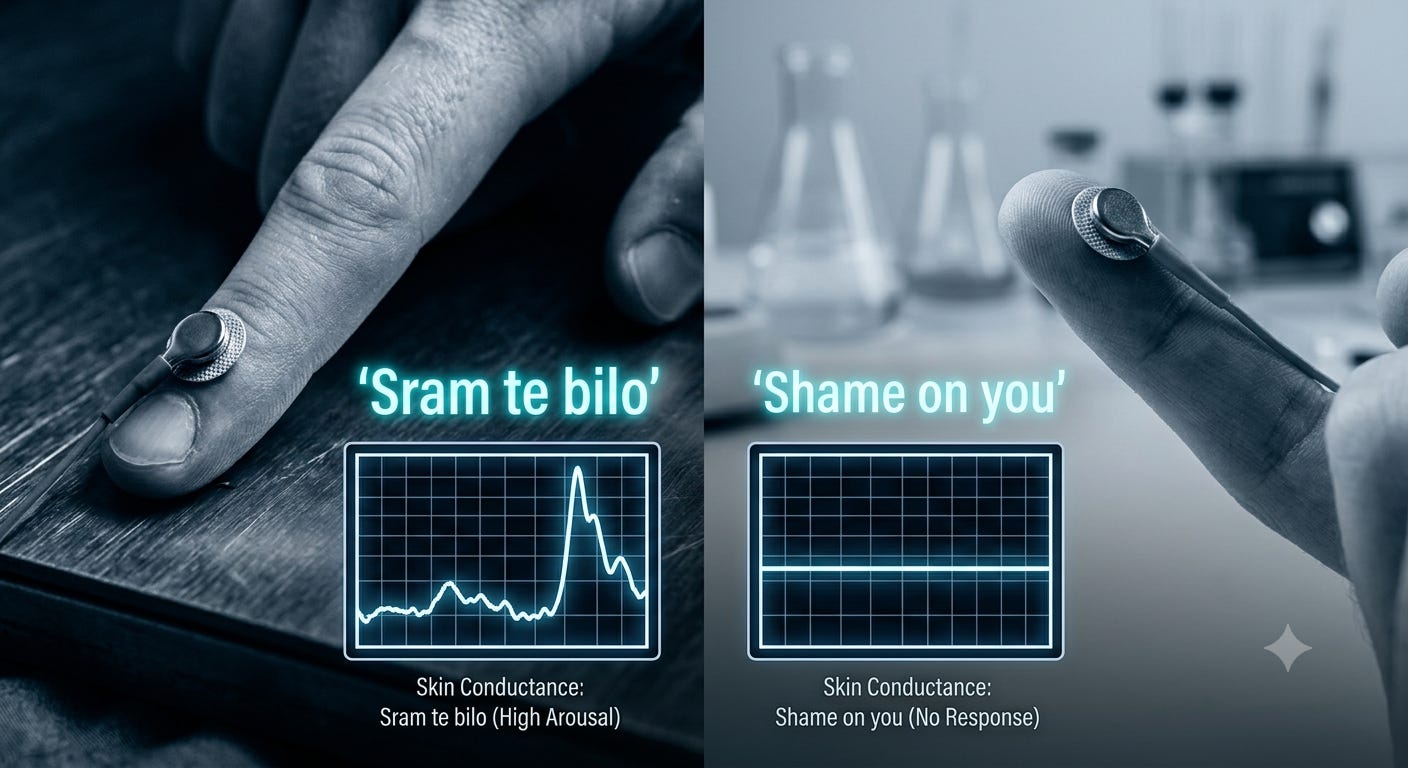
The reprimands, in Turkish, produced a measurable jolt. The same reprimands in English, said to the same people, who were entirely competent in English, did not (Harris, Ayçiçeği, and Gleason 561–79). The words were understood equally well in both languages. Only one set of them was believed by the body.
I want you to sit with the ordinariness of that finding for a second, because the ordinariness is the point. Nobody in that room was moved. Nobody wept or reported a flood of memory. They rated words on a scale, politely, for an hour. And underneath the politeness, in a channel none of them had access to, their nervous systems were sorting the two languages into a language that could still frighten them and a language that could not.
Your mother’s reprimand still lands hardest in the language she scolded you in. This is why. Not because you love Croatian more, not because you are sentimental about the old country, not because you are performing an attachment you think you are supposed to have. Because a sentence that arrived when you were four arrived with your whole body attached to it, and the sentence you learned at nineteen in a classroom did not.
Two words, and everything inside them
Now take the other end of the same phenomenon.
Volim te.
Two words where English needs three, and the difference is not economy. In English the I stands out in front, separate, a small pillar holding up the sentence, and you can hear it doing its work. In Croatian there is no ja. The I is inside the verb, folded into the -m at the end of volim, inseparable from the loving. The sentence does not have a speaker standing next to an act. It has an act with a person already dissolved in it.
And then te, which is you, unstressed, leaning on the verb the way clitics do, unable to stand at the head of a sentence or to be said alone. It is grammatically incapable of independence. There is a whole theory of love in that, and no Croatian ever had to be taught it.
This is what I mean when I say that Croatian grammar is not a set of rules but a way of perceiving. Nobody sat a Croatian child down and explained that in this language the lover and the loving are the same word and the beloved cannot stand alone. The child simply grew up inside a sentence shaped that way, and the shape became the furniture of the mind.
Volim is also, and this is where it gets difficult, the ordinary verb for liking. Volim kavu, I like coffee. Volim more, I love the sea. The same word carries the coffee and the marriage, which means that volim te has to do its work by context and by weight and by the small pause before it, and never by vocabulary. There is an older, warmer, more southern option in ljubim te, which also means I kiss you, and which people still sign at the bottom of letters, so that the kiss and the love arrive in the same breath and neither is a metaphor for the other.
Jean-Marc Dewaele asked something close to fifteen hundred multilingual people which of their languages carried the greatest emotional weight when they said I love you in it. The answers, taken together, did what you would expect: the first language, overwhelmingly, was the one that weighed the most (Dewaele 1753–80). But the answers also did something you would not expect, and I will come back to it later in this letter, because it is the hinge on which everything else turns.
The tune arrives before the words
Something else was in that Boston room, and it is the part people leave out of every account of this that I have ever read.
A reprimand does not work by vocabulary. You can be scolded in a language you have never studied, by a stranger, in a country you are passing through, and know exactly what is being done to you, because the scolding is carried in the melody and the length and the fall of the voice long before a single word is parsed. Infants sort the tunes of speech before they sort the words. And then they keep the tunes.
Croatian is unusually loaded here, because it is one of the few languages in Europe that still keeps pitch inside the word itself, four accents, rising and falling, long and short, so that the melody is not an ornament laid over the meaning, but one of the materials the meaning is made from. A great many of you grew up hearing this and have more of it than you have any idea of. It is why your Croatian, on the rare occasions you let it out, often sounds better than you think it has any right to, and why a klapa can take you apart in a stone doorway in eleven seconds while a poem on the page leaves you cold.
The sound is not the surface of the language. For you, it may be the deepest thing you still hold.
The disembodied language
Aneta Pavlenko, who has spent a career on this and whose two books sit open on my desk as I write, has a term for the other side of it. She asks, in the title of one of her papers, whether affective processing in a later language is disembodied cognition (Pavlenko, “Affective Processing” 405–28). The word is exact and it is worth pausing on. Not absent. Not weaker. Disembodied. The meaning arrives intact. The body does not come with it.
You can watch this happen in the laboratory too. When researchers measured how automatically bilinguals register the emotional charge of a word, the interference effect for emotionally loaded words was significantly smaller in the second language than in the first, and, importantly, this had nothing to do with how good the speaker’s general vocabulary access was in that language. Feeling a word and knowing a word turned out to be separate skills, and they do not arrive together (Pavlenko, Bilingual Mind 286).
There is a strange freedom in this, and I do not want to hide it from you, because half of my readers have already discovered it and felt guilty about it. The disembodied language is easier to be brave in. People swear more freely in it, say the unsayable thing in it, tell the doctor the truth in it. Researchers have shown that people make measurably different financial decisions in a foreign language than in their own, taking bets they would not take, unmoved by framings that would move them in their mother tongue, precisely because the emotional weight has been stripped out of the words (Pavlenko, Bilingual Mind 293). English is where a great many of you conduct your difficult conversations, and it is not a betrayal that you do. It is anaesthetic. It works.
But there is a bill for it, and the bill comes at funerals.
Why the weaker language is often the one holding the feeling
Here is the part that I think will be new to most of you, and it is the reason I wanted to open this series with this letter rather than any of the others.
The obvious explanation for everything above is age. First language, more feeling; later language, less. Simple, tidy, and not quite what the evidence says.
Catherine Caldwell-Harris, one of the Boston researchers, has argued for something more useful, which has come to be called the emotional contexts of learning hypothesis. Emotional resonance is not distributed by birth order. It is distributed by the kinds of situations a language was learned and lived in. A language acquired in the arms of people who fed you and frightened you and sang to you and shamed you gets bound to emotion because those are emotional rooms. A language acquired in a classroom from a book, however thoroughly, however grammatically, gets bound to the classroom (Caldwell-Harris).
Pavlenko’s own long case study of Chagall makes the same argument from the other direction, and more beautifully than any experiment could. Chagall’s French, acquired at twenty-four, was a language he loved and lived inside for decades, and it never once gave him access to his own feeling; he could not write his poetry in it. His Russian, acquired in adolescence, not from his mother, not at the breast, did. It became the language of his inner speech, of his marriage, of his parenting, and, as an eyewitness recorded, of his shouting (Pavlenko, Bilingual Mind 295). Adolescence was late enough that no theory of a critical window would have promised it. And it still took.
Now turn that on your own life.
If you grew up with Croatian at the edges, if it was the language of the kitchen and the grandmother and the Sunday and the reprimand and the endearment and the funeral, and English or Spanish or German was the language of school and work and everything with a form to fill in, then here is what you are carrying. Your Croatian is your smallest language and your hottest one. Your English is your largest language and your coolest one. The vocabulary went one way. The body went the other.
And so, when you find you cannot say the thing to your dying father in English, or that the English words for it come out smooth and correct and dead, you are not being dramatic. You are running into a real dissociation, one that has been documented directly: a shift in language dominance changes how often a person uses a language for emotional expression, and it does not change how emotional that language feels to them (Pavlenko, Bilingual Mind 293). Read that again if you need to. The feeling did not go anywhere. Only the access did.
That is not a small thing to be told. That is the difference between believing you have lost something and knowing it is behind a door you have stopped opening.
The memory lives where it was made
There is one more layer, and it is the one that costs the most.
In the late 1990s, Robert Schrauf and David Rubin worked with older immigrants who had come to the United States as adults from Spanish-speaking countries and had then spent thirty years or more inside English. They gave them word cues and asked for memories. Everything was done in Spanish on one day and in English on another, and then they asked the participants the question the whole study turns on, which was in which language the memory had arrived internally, before anybody reported it.
Events from before the migration came back in Spanish. Events from after it came back in English (Schrauf and Rubin 437–57). The memory was filed in the language it happened in.
Think about what this means for a family like yours. Your grandmother’s account of her own childhood is not a story that exists in some language-free warehouse behind her eyes, waiting to be issued in whichever language is convenient. It was laid down in Croatian, in the dialect of one specific place, and Croatian is the key that fits it. When she tells it to you in her hesitant English, she is not translating. She is retrieving something in one language and rebuilding a smaller, flatter object in another, and both of you can feel the loss, and neither of you knows what to call it.
And it runs the other way too. If your first four years happened in Croatian, then a section of your own life is filed in a language you may no longer speak well. Not lost. Filed. Under a name you have stopped using.
So are you a different person?
Which brings me to the question in the title, and to the place where I have to be careful, because this is exactly the territory where people overclaim and I am not going to do it to you.
The observation is old. In 1964, Susan Ervin ran a simple and elegant study: she showed the same bilinguals the same pictures and asked them to tell a story about each one, in one language on one occasion and the other language on a second occasion, weeks apart. Same people. Same pictures. The stories changed. Themes of achievement rose in one language; themes of aggression toward peers and of withdrawal from other people rose in the other (Ervin 500–07). Nobody had been asked to change. The content shifted with the language, inside one person.
Pavlenko later put the question directly to more than a thousand bilinguals and multilinguals, and a great many of them said yes, they feel like a different person when they switch, and then went on to describe what they meant with far more precision than the question deserved (Pavlenko, “Bilingual Selves” 1–33).
Here is the careful version, and it is hers, not mine. This is not two souls in one skull. Nobody has ever found a second self in there. What there is, in each language, is a different set of things available to be said, and a different set of people you learned to be in front of. The Croatian you have was given to you by particular people in particular rooms, and it carries their register, their tenderness, their standards, their way of complaining. So when you speak it, you have access to those, and not to others. In one study of second-generation speakers, the young women sounded like educated urban professionals in one of their languages and like their own emigrant parents and village relatives in the other, because those were the repertoires each language had handed them (Pavlenko, Bilingual Mind 197).
You are not two people. You are one person with two unequal inheritances, and the smaller inheritance came with the feelings pre-installed.
Four pillars, and which two you were given
I teach with a method I call the four pillars, and I want to put it here, in the middle of the argument rather than at the end of it, because this letter has spent three thousand words describing the thing the method was built to explain.
Grammar, vocabulary, pronunciation, culture. Not four subjects on a syllabus. Four faces of one object. The grammar is how Croatians perceive. The vocabulary is what they feel. The pronunciation is how they are heard and how they hear each other. And the culture is the room the other three were learned in, and the only thing that explains any of them. Standing on all four, and on no one of them alone, is what I call the Croatian Mind, which is not fluency and is not a performance. It is Croatian as a way of being.

The picture I use for it is the little white church of the Holy Cross at Nin, ninth century, four-cornered, standing alone in a field, holding up its own roof for eleven hundred years.
Now look at what has actually happened to you.
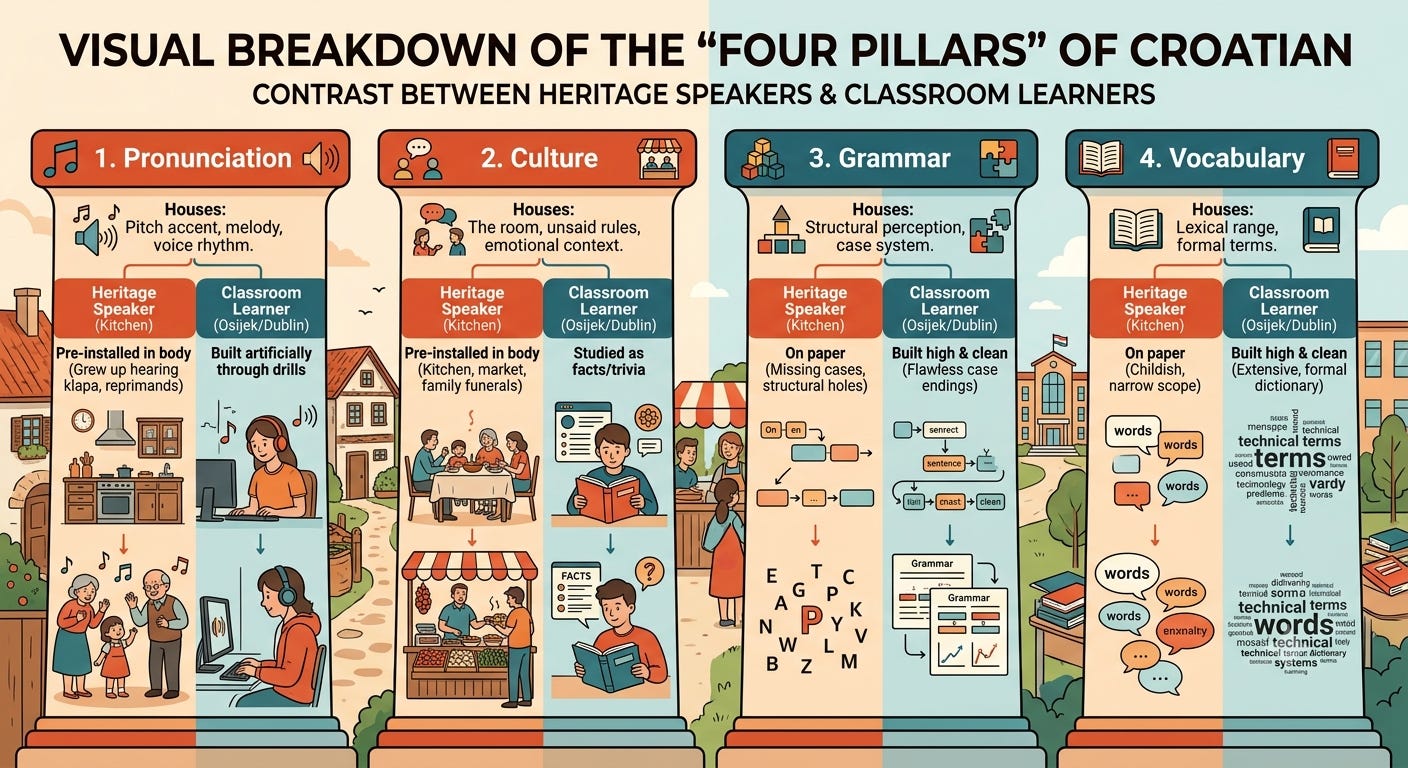
The reprimand that still works on your nervous system is pronunciation and culture. The endearment your grandmother used is pronunciation and culture. The klapa in the doorway is pronunciation, and the reason it takes you apart is culture. The refused third rakija, the fluent complaint at the market, the silence before someone says the important thing: culture, every one of them, and none of it available in a textbook.
The bank form is grammar and vocabulary. The phone call from the school is grammar and vocabulary. The word on the tax document is vocabulary and nothing else.
You were given two pillars in the body and two on paper, and the two you were given in the body are the two that cannot be studied into existence at any price.
The diligent adult learner in Osijek or Dublin has the opposite distribution, and this is why the two of you fail in mirror image. She has grammar and vocabulary built high and clean, and she stands at the table with her cases in perfect order and cannot hear what is funny. You have the sound and the room, and you stand at the counter with all your feeling intact and cannot produce the word for a standing order.
Neither of you has four pillars. Both of you have been told the missing ones are the whole building.
What this is actually for
I could stop at the science, and it would already be worth your Saturday. But I want to name what I think it does.
Most of you carry a quiet verdict about your Croatian, and the verdict is that it is not enough. Too small, too full of holes, too childish, too much your grandmother’s and not enough your own. And most of you have simultaneously had the experience of being undone by it, at a funeral, at a wedding, in a car with the radio on in a country nobody in that car was born in, and you have quietly filed the experience under nostalgia, which is the word we keep for feelings we have decided not to take seriously.
Nostalgia is the wrong file. What went through you in the car was the only language you have in which the words are still attached to your body, doing the exact thing it was built to do. That it is also the language you are ashamed of is one of the crueller arrangements I know of, and it is worth saying plainly: the shame and the resonance have the same source. They both come from the kitchen. You were given a language that was warm and narrow, and then you were asked to measure it with a ruler built for the wide and cool one.
Volim te weighs more than I love you for the same reason sram te bilo still makes you small. Somebody who mattered enormously said both of them to you before you were old enough to defend yourself against either.
That is what you inherited. It is not much and it is not nothing. It is, in fact, the only part of a language that cannot be bought, studied, or faked, and you already have it.
The question is what you do with it now.
The finding nobody quotes
Everything in the free half of this letter could be read as a sentence of life imprisonment. Emotion goes to the early language, the early language is the one you did not get enough of, therefore the door is shut. That reading is wrong, and the evidence against it is specific.
In 2012, Juliane Degner and her colleagues ran an affective priming study with German–French and French–German bilinguals living in Germany. Priming is a way of catching the mind before it has time to be polite: you flash a word, then another, and you measure whether the first one has already coloured the second. Semantic priming, the recognition of what a word means, showed up in both languages in both groups, as you would expect from competent speakers.
Affective priming, the automatic registration of what a word feels like, did not behave the same way. It appeared reliably in the first language. And in the second language it appeared only in some people. When the researchers went looking for what those people had in common, it was not age of acquisition. It was not proficiency. It was how much they used the language. Participants who used their second language frequently showed affective priming in it, whichever language it happened to be, and participants who used it rarely showed none at all (Degner, Doycheva, and Wentura 181–89; discussed in Pavlenko, Bilingual Mind 286).
The conclusion Pavlenko draws from it is one sentence long and I would like it hung on a wall somewhere: frequent use may increase the automaticity of affective processing in a later language (Bilingual Mind 286).
Emotional resonance is not a birthright that was distributed once and cannot be topped up. It is a function of living inside a language. Which is exactly what the emotional contexts of learning hypothesis predicts, and exactly what Chagall’s Russian demonstrates, and exactly the opening you have been looking for.
And you begin from a better position than any of Degner’s participants, because you are not building resonance from zero. You have the deposit already. The reprimand still works on you. What has decayed is not the emotional connection, it is the habit of routing feeling through the language, and the two have been shown to come apart (Pavlenko, Bilingual Mind 293). The wiring is intact. The traffic stopped.
Four questions
Before the practice, a diagnostic, and it is not a quiz. These four questions are the ones that researchers in this field have found most revealing about where a person’s emotional life is actually lodged, as distinct from where their vocabulary is. Answer them honestly and quickly, without deciding first what the right answer would be.
Which language do you swear in when you drop something heavy on your foot, alone, with nobody to perform for. Which language do you talk to an animal in, or to a baby, when nobody is listening. Which language do you count in, and which do you do arithmetic in. And which language do you pray in, if you pray, or which language did the prayers come to you in, if they did.
Now look at your four answers. If any of them is Croatian, you have a live wire. That is not a metaphor. An involuntary swear, an endearment aimed at a creature that cannot judge you, the numbers, and the prayer are four of the most automatised, least deliberate uses of language a person has, and they do not follow proficiency. They follow the room the language was learned in. Whichever of them came back in Croatian is a place where the language is still doing work below the level of your decision-making, and that is where the practice should be built, because you will be pushing on a door that is already ajar rather than one that is locked.
If none of them came back Croatian, that tells you something too, and it is not a verdict. It tells you that the routing has gone further than you thought, and that you should start with the most formulaic material of all, which is the third section below.
Where to start, and why in this order
Three doors, and notice as you go that they are not three exercises. They are the pillars you already own, switched back on one at a time. The vocabulary of tenderness. The pronunciation stored inside a prayer. The culture that a funeral runs on. Grammar is the one pillar not on this list, and that is deliberate: it comes later in this particular work, and when it comes it comes faster, because by then it will have somewhere to live. A case ending learned in order to say something you actually feel behaves quite differently from a case ending learned in order to complete an exercise.
First, endearments
Not because they are easy. Because they are the highest-frequency emotional act in an ordinary life, and because Croatian’s machinery for them is unusually developed, and because they are the one register in which you are almost certainly better than you think.
Croatian tenderness works largely by two mechanisms. The first is the vocative, the case that exists for no other purpose than calling someone by name, so that duša, soul, becomes dušo when you are actually speaking to the person, and ljubav, love, becomes ljubavi. The second is the diminutive, the endless machinery of -ica and -ić that shrinks a thing as a way of loving it. Both of these are systems, and systems can be learned, which is why this is the right first door.
The practice is narrow and I want you to keep it narrow. Choose one relationship. One. A partner, a child, a parent, an animal. Move the endearments in that one relationship entirely into Croatian and leave everything else alone. Dušo. Srce moje. Zlato. Mila. You will feel absurd for about nine days. Then something else happens, which is that the English ones start to sound thin to you, and that is the sound of the routing changing.
Do not spread this across your whole life. Frequency inside one relationship beats breadth across five, because what you are training is automaticity, and automaticity is built by repetition in a fixed context, which is precisely the mechanism Degner’s study exposed.
Second, the memorised and the formulaic
Prayer, if you have it. The Očenaš. The Zdravo Marijo. The rosary if it was in your house. And if you have no prayer, then whatever else was said in your family in fixed unchanging words: the grace before a meal, the toast, the thing said at a door, the thing said over a grave.
I put this second because formulaic language has a property nothing else has. It requires no composition. There is no sentence to build, no case to choose, no aspect to get wrong. The entire utterance is a single stored object, and if it was ever stored, it is still stored, and the retrieval is often startling. I have watched people who insisted they had no Croatian at all produce the whole of the Očenaš without a stumble, and then sit there afterwards not knowing what to do with their face.
The practice: find the ones that were in your family, not the ones on the internet. Say them out loud rather than reading them. And if there is an elder who still has them, record the elder saying them, now, in their own accent, because the accent is half of it and it is the half that dies first.
Third, grief
Last, because it is the hardest, and because the two doors above are what make it survivable.
Croatian grief has forms, and this is the thing nobody tells the diaspora before they arrive at their first funeral in the old country and stand there mute. There is a vocabulary for condolence and it is fixed, and being unable to produce it is one of the loneliest experiences a heritage speaker can have, made worse by the fact that everyone around them is fluent in a script they were never given.
The practice is unglamorous. Learn the fixed condolence forms the way you would learn a prayer, as stored objects rather than as sentences to be built. Learn what is said and what is not said. Learn that Croatian care is very often spoken as worry and as feeding rather than as declaration, and that jesi li jeo can be a whole sentence about love.
And then, while there is still time, do the thing that only you can do, which is to ask the elders the questions in Croatian. Not in English. This is not sentimentality, it is a retrieval strategy, and Schrauf and Rubin’s finding is the reason: a memory laid down in Croatian comes back more fully when it is asked for in Croatian. Ask in the wrong language and you will get a summary. Ask in the right one and you may get the thing itself.
The ledger
Now the honest part, because I am not going to sell you a transformation.
Here is what this will not do. It will not make you cry in Croatian on a schedule. It will not give you the Croatian you would have had if the transmission had never broken, and no practice of any kind will, and any programme that tells you otherwise is lying to you. It will not be fast; affective automaticity was built in Degner’s frequent users over years of ordinary life, not over a season of exercises. And it will not remove the disembodied quality from your English, which you may find you miss, because as I said, the anaesthetic is useful and you have been relying on it.
Here is what it will do. It will narrow the distance between what you feel and what you can say you feel, which is the actual gap, and which is not the same gap as the one between your Croatian and a dictionary. It will make the language you already flinch at into a language you can also reach for. And it will change what is available to you in the rooms where Croatian is not optional, which are, in the end, the rooms with the people you belong to in them.
One more thing, and then I will let you go.
You have spent a long time treating the emotional weight of Croatian as the leftover, the sentimental residue, the part that does not count because it is not proficiency. Turn that around. Two of the four pillars can be built by anyone with a year and some discipline, and the diligent learner in Dublin will outrun you on both of them inside eighteen months. The other two cannot be built at all, only laid down, and only early, and only by people who were there. Nobody can go back and be shamed in Croatian at the right age, or sung to in it, or fed in it, or teased in it by someone who loved them. You were handed the two pillars that cannot be bought, and you have spent your adult life apologising for the two that can.
Go and find something you have only ever said in English to someone who would understand it in Croatian. Say it badly. Say it in the wrong case. The body is not listening for the case.
Tihana Klepač is an Associate Professor at the University of Zagreb’s Department of English and the founder of TalkTime Croatian. This letter belongs to the series The Language You Carry. She teaches the Croatian Quadrant™, a structured, culturally immersive course designed to help learners stop translating and start thinking in Croatian. Find out more at talktimecro.com.
Works Cited
Caldwell-Harris, Catherine L. “Emotionality Differences between a Native and Foreign Language: Theoretical Implications.” Frontiers in Psychology, vol. 5, 2014, article 1055.
Degner, Juliane, Carina Doycheva, and Dirk Wentura. “It Matters How Much You Talk: On the Automaticity of Affective Connotations of First and Second Language Words.” Bilingualism: Language and Cognition, vol. 15, no. 1, 2012, pp. 181–189.
Dewaele, Jean-Marc. “The Emotional Weight of I love you in Multilinguals’ Languages.” Journal of Pragmatics, vol. 40, no. 10, 2008, pp. 1753–1780.
Ervin, Susan M. “Language and TAT Content in Bilinguals.” Journal of Abnormal and Social Psychology, vol. 68, no. 5, 1964, pp. 500–507.
Harris, Catherine L., Ayşe Ayçiçeği, and Jean Berko Gleason. “Taboo Words and Reprimands Elicit Greater Autonomic Reactivity in a First Language than in a Second Language.” Applied Psycholinguistics, vol. 24, no. 4, 2003, pp. 561–579.
Pavlenko, Aneta. “Affective Processing in Bilingual Speakers: Disembodied Cognition?” International Journal of Psychology, vol. 47, no. 6, 2012, pp. 405–428.
---. “Bilingual Selves.” Bilingual Minds: Emotional Experience, Expression, and Representation, edited by Aneta Pavlenko, Multilingual Matters, 2006, pp. 1–33.
---. Emotions and Multilingualism. Cambridge University Press, 2005.
---. The Bilingual Mind: And What It Tells Us about Language and Thought. Cambridge University Press, 2014.
Schrauf, Robert W., and David C. Rubin. “Bilingual Autobiographical Memory in Older Adult Immigrants: A Test of Cognitive Explanations of the Reminiscence Bump and the Linguistic Encoding of Memories.” Journal of Memory and Language, vol. 39, no. 3, 1998, pp. 437–457.