

A woman wrote to me last month and asked me to tell her what level she was. She had studied for three years, faithfully, on her own, from a good textbook and a worse app, and she wanted a letter of the alphabet to put in the box. A2, she guessed. Maybe B1 on a generous day. She wanted me to confirm or correct the guess, the way a doctor confirms a temperature, so that she would finally know the size of the thing she was carrying.
And I could answer it, at least in the way she meant the question on its surface. I have a placement test of my own, the one I give everyone who comes to the Quadrant, and it leans on that same ladder, because for what a placement test is for, the ladder works. I read her sentences and I could see it plainly, a solid A2, a B1 on her better days, and I told her so. What I could not do was answer the question underneath the question. The letter told me where to begin teaching her. It told her almost nothing about the thing she actually wanted to know, which was never a level at all but a distance, the distance still between her and the table she was trying to reach. That gap, between the number I could give her and the answer she was really asking for, is the whole of what I want to write to you about today.
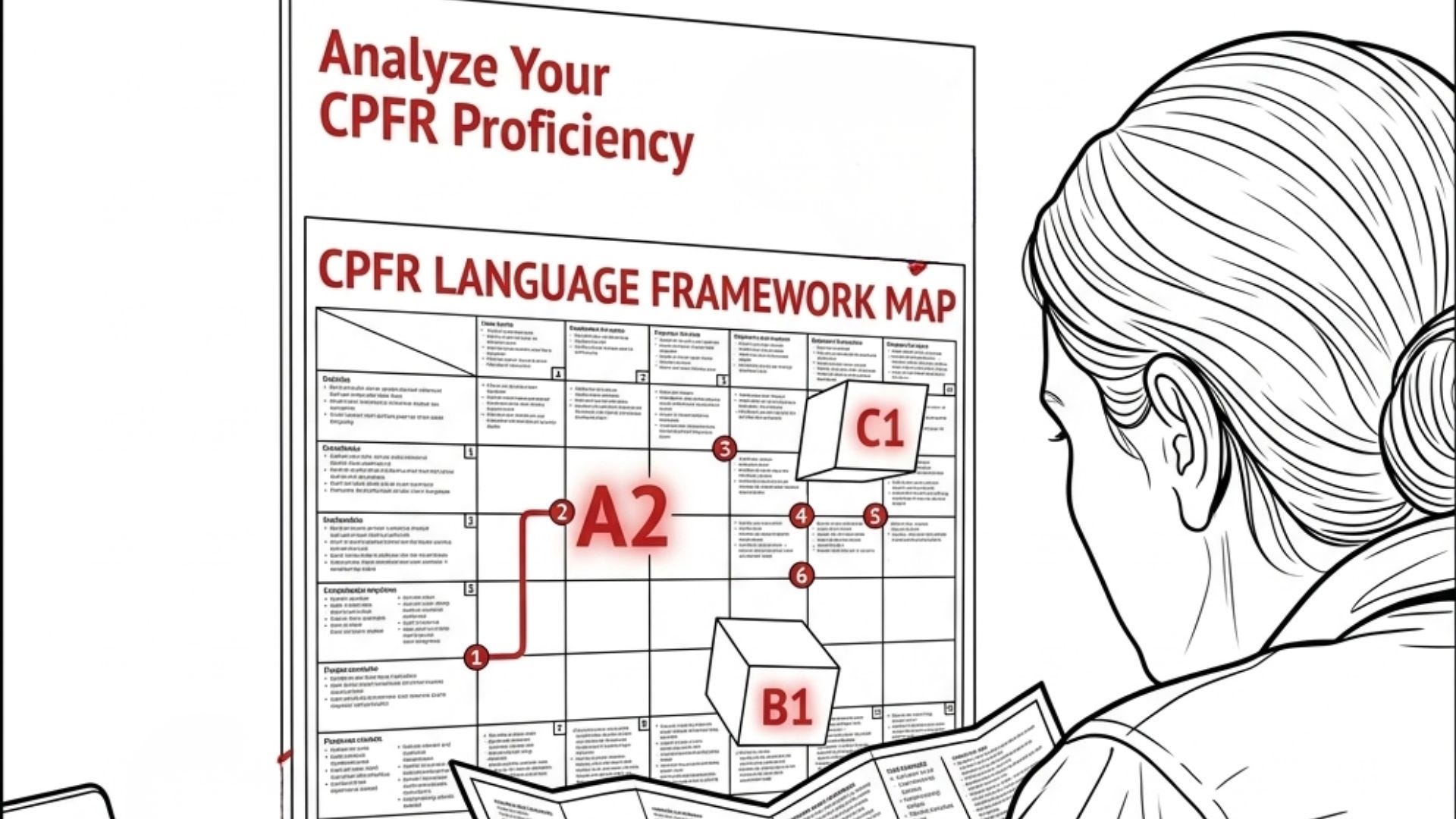
You have probably reached for the same instrument, the self-assessment grid of the Common European Framework of Reference for Languages, the CEFR, the six-rung ladder that runs A1, A2, B1, B2, C1, C2, from the beginner who can order a coffee to the near-native who can follow a philosophy seminar and catch the joke in it (Council of Europe). I use it, so I will not mock it. Inside a course it does something real. It tells me which grammar to start you on, so that I neither bore the learner who already has her cases nor drown the one who does not, and it lets a teacher in Osijek and an examiner in Dublin mean roughly the same thing by the same letter. That is an honest use, and a narrow one. The trouble begins only when you take a tool built to place a learner in a syllabus and turn it on yourself, alone, late, as a verdict on your whole Croatian. Then it gives back something untrue.
Here is the first crack in the mirror. When Michael Canale and Merrill Swain sat down in 1980 to describe what it actually means to know a language, they found that it was not one thing but four, four separate competences that can grow at wildly different rates in the same person (Canale and Swain 29–30). There is grammatical competence, the endings and the aspects and the seven cases, the machinery. There is sociolinguistic competence, knowing that what you say to the clerk is not what you say to your cousin. There is discourse competence, the ability to hold a long stretch of talk together so it hangs as one thing and not a heap of correct sentences. And there is strategic competence, what you do when the word will not come and you have to get across the river anyway, on whatever stones are to hand. The CEFR letter measures mostly the first of these. The grammar. The machinery. And the machinery, though it is real and worth building, is the one part of the language you can improve alone in a room, which is exactly why it is the part the textbooks sell and the part learners overbuild while the other three stay thin.
The second crack was named forty years ago by Claire Kramsch, in an essay whose title is almost the argument of this whole letter, “From Language Proficiency to Interactional Competence.” Kramsch watched the proficiency movement line language up into neat ascending levels and objected that this linearity was a fiction, that neither the functions nor the notions of a language are acquired in any tidy cumulative order (Kramsch 367). Proficiency, she wrote, is not the same thing as interactional competence, the ability to build meaning with another person in real time, to enter someone else’s frame of reference and follow the cultural logic of their talk (Kramsch 366). The ladder measures accuracy. It cannot measure the thing that matters most in a Croatian kitchen, which is what happens in the space between two people, and that thing is not a height at all.
So the letter is a compression, and like all compressions it throws away exactly the information you most need. What you actually live in is not a stairwell but a set of rooms, and moving between them is not climbing. Sociolinguists have a word for those rooms. Joshua Fishman called them domains, the home, the workplace, the school, the public square, the church, each one a cluster of place and relationship and topic that quietly fixes which language, and which register of it, is the right one (Fishman 441). The whole point of a domain is that the same person is a different speaker in each. You can be sure-footed in one room and struck dumb in the next, and no single letter can hold that, because a letter reports a height and a domain reports a place.
And for you, for the person who grew up with Croatian at the edges, the ladder does something worse than compress. It lies.
Let me be careful here, because this is the heart of it. When Maria Polinsky and Gregory Scontras describe what a heritage language actually is, they do not describe a weak version of the standard. They describe the weaker language in an asymmetric pair, the tongue that lost the daily fight for your attention when the school and the street and the friendships all came in the other language (Polinsky and Scontras 5). And the thing that makes heritage Croatian its own creature is the question of the baseline, the thing you are measured against. The classroom learner is measured against the standard, the polished monolingual ideal in the grammar book. But you were never given that ideal as input. Jim Hlavac and Diana Stolac, who recorded three hundred Croatian speakers across four continents, put it plainly: the model your family carried out of the country, the Croatian poured into you across the kitchen table, was almost never the standard. It was a regional variety, a dialect, a particular village’s way of speaking, frozen at the moment of departure and salted for keeping (Hlavac and Stolac 51). Your grandmother did not speak A1 through C2. She spoke Sinj, or Vrgorac, or a corner of Zagorje, and she spoke it whole.
There is a piece of theory that turns this from a wound into a map, and it belongs to Jan Hulstijn. He splits what we lazily call proficiency into two very different things. There is Basic Language Cognition, the everyday spoken core of a language, the part every single native speaker commands regardless of whether they left school at fourteen or teach at a university, the language of the kitchen and the street and the argument. And there is Higher Language Cognition, the literate, formal, register-heavy language of print and bureaucracy and the professions, the part in which native speakers differ from one another enormously, because it is built by schooling and reading and work, and it has no ceiling (Hulstijn 21). The CEFR ladder, look closely, is mostly measuring Higher Language Cognition. And your home gave you the other thing. It gave you Basic Language Cognition, or a good part of it, the exact part that every Croatian shares and no exam foregrounds. So on the ladder you read as low, while in the one register that all native speakers hold in common you may be standing much closer to home than the letter will ever admit.
This is why the number I gave the woman who wrote to me was true and useless in the same breath. She is a high A2, yes, and she is also, at the very same time, someone who follows her mother’s whole story and cannot open a bank account, uneven across several rooms, near to some doors and far from others. The letter was the right answer to a question she was not really asking. The honest question was never how high she had climbed. It was which doors already open when she approaches, and which ones still go quiet.
That is what the rest of this letter is. A map of six thresholds, from the municipal counter to the konoba, the last and warmest door. I will walk you through all six now, in the open, because they are the shareable heart of this whole series and I want you to be able to send them to the cousin who needs them. For each one I tell you what it truly tests and how to know which side of it you are standing on. And there is a small thing you can actually use, a Konoba Test, that walks you through the six and hands you back not a score but a picture of your own doors. It is linked below, and it is free. Take it before you read on, or after. Either way, come to it honestly, because the map is only worth anything if you do.
The First Threshold: The Counter
Šalter. The window with a person behind it and a queue behind you. The bank, the post office, the desk at the matični ured where they keep the records of who you are, the receptionist at the clinic who needs your date of birth and your patience. This is the threshold people fear most, and it is, I promise you, the lowest one. It only feels the highest because it comes with an audience and a stopwatch.
What the counter tests is narrow. It tests grammatical competence, the machinery, in the formal register, with Vi, under a little pressure. Higher Language Cognition, in Hulstijn’s terms, exactly the part the home did not give you. The exchange is scripted, the vocabulary small and repeating, and the clerk has heard every version of your sentence ten thousand times and needs only the nouns. This is why the heritage learner’s terror here is a kind of cruel joke. The counter asks for precisely the register that was never at your kitchen table, and asks for it in front of people. The fear is real. The difficulty is not.
You are standing inside this threshold if you can complete a transaction you did not rehearse, adjust when the clerk goes off-script, and, above all, stay in Croatian when they hear your slight foreignness and offer to switch. That offer is the test. The moment they say možemo na engleskom and you answer, gently, ne treba, hvala, može hrvatski, and hold the ground. The person who can hold the counter after being offered the exit has crossed it, whatever their letter.
The Second Threshold: The Telephone
The phone is the counter with the face removed, and that is why it is harder, and why it deserves its own door. No lips to read, no hands, no shopfront to point at, no way to soften a misunderstanding with a look. The bank calls about a card. The landlord calls about the boiler. The school calls about your child, fast, and does not know you are not from here.
This is a room of what Jim Cummins called context-reduced language, the kind where no shared reality can be assumed and every meaning must be carried by the words alone (Kramsch 368). Polinsky and Scontras name the cost of it, the plain fact that operating in your weaker language burns more fuel per second, so that when the pace climbs the weaker language is the first thing to buckle (Polinsky and Scontras 6). On the phone the pace is not yours to set. That is the whole difficulty. Not that your Croatian is poor, but that it is being asked to run at someone else’s speed with nothing to lean on.
You are inside this threshold when you can take an unexpected institutional call and get the essential facts, who, what, when, what they need from you, without asking them to move to English, and without your heart going through the floor when the phone lights up with a number you do not know.
The Third Threshold: The Market
Pijaca. The vendor with the tomatoes and the strong opinions, the woman who has sold your teta eggs for twenty years and will tell you the weather is a scandal and the government worse. This threshold is the first one whose true business is not the errand but the contact riding on top of it, the phatic layer, the greeting that is not a question, the complaint that is an offering.
The linguist Nada Ivanetić spent a career mapping the Croatian repertoire of these small acts, the greetings and well-wishings and companionable grievances that hold ordinary encounters together (Ivanetić, Govorni činovi). At the market you meet the most Croatian of them, jadanje, the friendly lament, the answer to kako ste that is not dobro, hvala but a fond and fluent catalogue of everything currently wrong, the heat, the prices, the knees, the times. To an English ear this reads as complaint or oversharing. It is neither. It is intimacy offered across a crate of peppers. And the learner who answers with a bright, sealed dobro has not been rude, only, very slightly, has kept the door shut.
You are inside this threshold when you can do the talk that surrounds the buying, receive a stranger’s jadanje without flinching and give a little of your own back, and let an exchange run three sentences past the point the business required.
The Fourth Threshold: The Table
Stol. The family meal, mid-story, three people talking at once, someone’s uncle already telling it over the top of someone’s aunt, the dialect thick, the pace merciless, the laughter arriving half a beat before you have understood why. This is the threshold the whole series has been walking toward, and it is the one that separates the person who knows Croatian from the person who can be inside it. Here is Cummins’s other pole, context-embedded language, where a shared reality carries so much of the meaning that the words can travel light (Kramsch 368). Everything the counter let you avoid is here at full volume.
Here the small words rule, the ones I gave you a whole letter about, pa and ma and daj and eto and joj, the discourse markers that Deborah Schiffrin first set apart as the tissue that steers talk rather than carries it (Schiffrin). Jim Hlavac’s recordings catch the exact sound of standing in this doorway with one foot outside, the speaker who says znaš and you know in the same breath, the Croatian word offered almost as proof of belonging while the English one arrives first (Hlavac, “Bilingual Discourse Markers” 1890). At the table the small words are the password. A ma daj dropped at the right half-second places you better than a paragraph of clean grammar, because it cannot be studied to that precision, only felt. And here is the ritual I have described before, the refused third rakija, the ne that is not a refusal but the opening line of a negotiation everyone already knows the shape of.
You are inside this threshold when you can follow overlapping talk in the local variety without needing it slowed, catch the joke while it is still warm, and put in a pa or a ma that nobody notices, which is the highest praise a small word can earn.
The Fifth Threshold: The Joke
There is a threshold past the table, and it is made of laughter and old stories, and almost no course will get you across it, because it asks for the two things that come last in any language, humour and cultural memory. Can you follow a Dalmatian comedian at full speed, the wordplay, the deadpan, the joke that turns on a single Venetian loanword? Can you follow your baka‘s long story to its end, the one with four cousins and a goat and a grudge from 1971, and laugh in the right place, not because you decoded it but because it was funny?
This is receptive mastery of the marked local variety, and it rests on layers the standard cannot give you. On the coast it is the Venetian and Italian sediment that Keith Langston and Milan Moguš describe in the čakavian, the špiža and the šufit and the kantat (Langston; Moguš). In Slavonia it is the Turkish and Hungarian layer and the flat music of the long vowels. In the Zagreb of your relatives it is the kajkavian underneath the city speech that Mijo Lončarić mapped, the kaj and everything that trails it (Lončarić). Humour lives down in that sediment, because a joke is the fastest thing a language does, and to catch it you must already be standing where the language stands.
You are inside this threshold when you can watch something made for Croatians and not for learners and laugh before you have finished thinking. You do not need to produce any of this. You will likely never tell the joke back in the dialect. You need only to receive it, whole, in real time, which is its own kind of arrival.
The Sixth Threshold: The Konoba
And then there is the last door, and it is not a skill, and you cannot walk through it by trying. The konoba is a room others let you into, and the crossing is not something you do. It is something done to you, when the people already inside stop hearing your speech as marked and simply talk to you as one of their own.
You cannot assess this one, because it is not yours to assess. But it has signs. Someone corrects your Croatian the way they would correct a local’s, carelessly, in passing, without the special gentleness reserved for foreigners. Someone tells you a thing they would not tell an outsider. Nobody switches to English for your comfort, and nobody switches to the standard either, which is the subtler tell, because the standard is the polite distance Croatians keep from people not quite in. And then, the surest sign of all, someone teases you. Teasing is the diploma. You do not mock a guest. You mock your own.
Here is the mercy the whole map has been building toward. This deepest door is often the one the heritage learner stands closest to, closer than to the counter, because your baseline was always the kitchen and never the office, and the kitchen is exactly where Basic Language Cognition and the intimate domain live. Fishman noticed, studying communities losing a language over generations, that the home is the last domain the old tongue holds (Fishman 445). Jennifer Leeman writes that the heritage speaker’s tie to the language was formed before the foreign one arrived, laid down in the body as belonging and not as study (Leeman 104). That early layer, the baština you thought too thin to count, is the currency the konoba accepts. The formal registers you lack are for the counter. The konoba was never asking for those.
Look at your six doors now and notice what the ladder could never show you. They are not a staircase. You do not climb them in order. The classroom learner comes up from the bottom, strong at the counter, helpless at the table, exactly the shape the CEFR predicts. But you, if you grew up with the language at the edges, may find your own map turned upside down, at ease where the textbook student is drowning and frozen where they are fluent, understanding your grandmother’s whole story and unable to open a bank account without your palms going wet. This is not brokenness. It is a different distribution of the same language, and it has a shape worth reading closely.
Click the button below and take the Konoba Test, linked with this letter. It walks you through the six doors and hands you back your own map, which door is open, which is ajar, which still goes quiet. It takes three minutes and it is free.
Reading Your Map: The Five Profiles
A map with six doors on it can take many shapes, but in twenty years of teaching I have watched the same five recur, again and again, and I can almost name them at the door now. Find yourself here. Not to be filed, but to be seen, and to know which work is yours.
The Inverted Map. Fluent at the table, mute at the counter. You follow the dinner, you catch most of the joke, the konoba half-opens for you, and yet a phone call from the bank can ruin your afternoon. On the ladder you read as a low intermediate and it feels like a slander, because it is one. What has happened is exactly what Hulstijn’s theory predicts. Your home gave you Basic Language Cognition, the shared spoken core, and gave it generously, but it could not give you Higher Language Cognition, the formal and literate register that only school and print and office ever build (Hulstijn 21). You are not low. You are uneven, and uneven in the kindest possible direction, because you already hold the part that takes years to fake and lack the part that can be studied alone in a room. This is the most common heritage profile there is, and it is the one the CEFR insults most.
The Receptive Giant. You understand everything and say almost nothing. You follow the news, the film, the argument between your aunts, and when they turn to you the sentence dies in your throat. This is the single most documented fact about heritage speakers, that comprehension runs far ahead of production, sometimes by years (Polinsky and Scontras 6). It is not a flaw in your Croatian. It is the ordinary shape of a language received but rarely spoken. The giant is real. He has simply never been asked to walk, and the walking is a separate skill from the understanding, learned separately, later, and with more discomfort.
The Classroom Climber. You did it the textbook way, from the bottom, and you did it well. Your cases are clean, you hold the counter, you can write an email to an office. And then you sit at the table and the dialect closes over your head like water. You have built Higher Language Cognition without the Basic core underneath it, the reverse of the Inverted Map, and it is the profile the CEFR flatters and the konoba keeps at arm’s length. Your grammar is not the problem. What you are missing is interactional competence, the thing Kramsch says you cannot get from accuracy at all, only from the messy real-time work of meaning-making with other people (Kramsch 366).
The Sunday-Croatian Plateau. Your Croatian is wide in one domain and blank in all the others. You have the food words, the endearments, the prayers, the things said at the table on the day the family gathered, and the language stopped growing at the edge of that room because that was the only room it ever lived in. Fishman would recognise you instantly. Your language is bound to a single domain, the intimate one, and it froze there, lovely and complete and unable to follow you to a pharmacy or an argument (Fishman 441). The plateau is not a low level. It is a language that was never asked to leave the house.
The Even Intermediate. Rare, and usually the mark of an adult who came to the work deliberately and spread it wide. You are roughly the same at every door, competent and slightly effortful across the board, none of the doors slammed and none of them wide. This is the one profile the CEFR letter actually fits, which is why it is the profile heritage learners almost never have. If this is you, your work is not repair but depth, pushing one or two doors from competent to easy, from getting through to being at home.
If your map is a blend of these, that is normal, most are. What matters is the top note, the loudest thing the map is telling you, because that is where the next season of work should go. And here is the through-line under all five. Tanja Kupisch and Jason Rothman gave the field the sentence I want you to keep, that difference is not incompleteness, that the heritage speaker’s grammar is genuinely different from the monolingual’s and that different and incomplete are not the same word (Kupisch and Rothman 564). The whole practical project of teaching from that premise, of assessing a heritage learner on her own terms rather than against a monolingual yardstick, is the work Marta Fairclough and Sara Beaudrie collect in their guide for the heritage classroom (Fairclough and Beaudrie). Your map is not a diagnosis of what is broken. It is a picture of where the language already lives in you, and where it has not yet been invited.
The Training: Move One Door in a Season
You cannot train all six doors at once, and you should not try. Pick the one door your map says is nearest to opening, the ajar one, not the slammed one, and give it a season. The regimen depends less on which door it is than on which kind of gap it is, and there are three.
If the gap is register, the formal room you never entered. This is the Inverted Map’s counter and phone, the Sunday plateau’s whole outer world. The good news is that this is the one gap you can close largely alone, because Higher Language Cognition is built the way everyone builds it, through deliberate contact with formal language. Read formal Croatian aloud, ten minutes a day, a news article, an official letter, a page of a serious book, until the shape of the written register lives in your mouth. Keep a phrase bank for the counters you actually face, not full dialogues, which shatter the moment the clerk improvises, but openers and repair phrases drilled to reflex: trebam, htio bih, htjela bih, oprostite, možete li ponoviti, ne razumijem, možete li sporije. The opener launches you and the repair phrase catches you when you fall. Shadow the news, a sentence behind the newsreader, to teach your mouth the formal rhythm your kitchen never did.
If the gap is production, the understanding that will not become speech. This is the Receptive Giant. The only cure for silence is speech, and the trick is to make it low-stakes enough that you will actually do it. Every day, play thirty seconds of native audio, then say aloud, in Croatian, what it was about. Not translated, summarised, in your own words, to nobody. Send yourself voice notes and let them be bad. Answer kako si out loud, alone, with a true and slightly troubled sentence, until the machinery of your own speech stops rusting shut. The giant does not need more input. He needs to be made to walk, a little, every day, in a place where falling costs nothing.
If the gap is interaction, the room that will not open however good your grammar. This is the Classroom Climber’s table, and it is the hardest, because Kramsch is right that it cannot be drilled alone. Interactional competence is built only in the collaborative, unpredictable work of meaning-making with another person (Kramsch 366). So the regimen is not a worksheet. It is exposure and presence. Watch one thing made for natives, above your comfort, three times, the first for shape, the second for words, the third for the joke. Sit in fast, sticky conversation and do not try to speak, only track it, counting the pas and mas going by like mile markers, until the small words fall out of you on their own rather than being placed. And then the part that is not a technique at all: stay in the room past the point where you would normally leave, because the table only opens to the ones still there when the official sentences are spent and the real ones begin.
Here is the ninety-day shape of it. Choose one door. Name the gap, register or production or interaction. Give it three sessions a week, twenty minutes each, plus one longer weekly immersion in real Croatian at real speed, the messier the better. At the end of the season, take the Konoba Test again and watch that one door move. Not all six. One. That is how a house is entered, room by room, and it is the only way I have ever seen it done.
There is an old line Kramsch quotes at the end of her essay, a Chinese saying about what understanding really is: not to let a word get in the way of its sentence, nor a sentence get in the way of its intention, but to send your mind out to meet the intention as a guest (Kramsch 372). That is the whole of it. The counter wants your accuracy. The konoba wants your mind sent out to meet the other person’s, as a guest, and then, slowly, as something more than a guest.
We began this whole series outside a door, you and I, learning the standard so we could handle the adult life of a country, and then the dialects so we could handle its love. The map I have drawn you today is the same building seen from inside. The counter near the entrance. The konoba at the far end, warm, loud, with the people you belong to already at the table, waiting to see whether you will come far enough in to be teased. You are closer than the ladder ever let you believe. Stand in the doorway of the one room that is nearest. See which one goes quiet, and which one, already, just talks to you.
Tihana Klepač is an Associate Professor at the University of Zagreb’s Department of English and the founder of TalkTime Croatian. This letter belongs to the series The Language You Carry. She teaches the Croatian Quadrant™, a structured, culturally immersive course designed to help learners stop translating and start thinking in Croatian. Find out more at talktimecro.com.
Works Cited
Canale, Michael, and Merrill Swain. “Theoretical Bases of Communicative Approaches to Second Language Teaching and Testing.” Applied Linguistics, vol. 1, no. 1, 1980, pp. 1–47.
Council of Europe. Common European Framework of Reference for Languages: Learning, Teaching, Assessment. Cambridge University Press, 2001.
Fairclough, Marta, and Sara M. Beaudrie, editors. Innovative Strategies for Heritage Language Teaching: A Practical Guide for the Classroom. Georgetown University Press, 2016.
Fishman, Joshua A. “Domains and the Relationship between Micro- and Macrosociolinguistics.” Directions in Sociolinguistics: The Ethnography of Communication, edited by John J. Gumperz and Dell Hymes, Holt, Rinehart and Winston, 1972, pp. 435–453.
Hlavac, Jim. “Bilingual Discourse Markers: Evidence from Croatian–English Code-Switching.” Journal of Pragmatics, vol. 38, no. 11, 2006, pp. 1870–1900.
Hlavac, Jim, and Diana Stolac. “Observations on Croatian as a Heritage Language Across Four Continents.” Croatian Studies Review, vol. 16–17, 2020/2021, pp. 45–72.
Hulstijn, Jan H. Language Proficiency in Native and Non-Native Speakers: Theory and Research. John Benjamins, 2015.
Ivanetić, Nada. Govorni činovi. Zavod za lingvistiku Filozofskoga fakulteta Sveučilišta u Zagrebu, 1995.
Kramsch, Claire. “From Language Proficiency to Interactional Competence.” The Modern Language Journal, vol. 70, no. 4, 1986, pp. 366–372.
Kupisch, Tanja, and Jason Rothman. “Terminology Matters! Why Difference Is Not Incompleteness and How Early Child Bilinguals Are Heritage Speakers.” International Journal of Bilingualism, vol. 22, no. 5, 2018, pp. 564–582.
Langston, Keith. Čakavian Prosody: The Accentual Patterns of the Čakavian Dialects of Croatian. Slavica, 2006.
Leeman, Jennifer. “Heritage Language Education and Identity in the United States.” Annual Review of Applied Linguistics, vol. 35, 2015, pp. 100–119.
Lončarić, Mijo. Kajkavsko narječje. Školska knjiga, 1996.
Moguš, Milan. Čakavsko narječje. Školska knjiga, 1977.
Polinsky, Maria, and Gregory Scontras. “Understanding Heritage Languages.” Bilingualism: Language and Cognition, vol. 23, no. 1, 2020, pp. 4–20.
Schiffrin, Deborah. Discourse Markers. Cambridge University Press, 1987.