

There is a particular kind of silence that settles over a people when their own language is excluded from the rooms where power operates — when the laws are written in someone else’s tongue, the courts conducted in it, the schools taught in it, and the language you actually speak at home is treated as if it were not quite serious enough for public life.
I have been thinking about this all week, since a colleague sent me a Substack interview with the journalist Sanne Breimer, in which she asks a question so simple it stopped me mid-sentence: “Who gets to speak, and who is silenced?” She was talking about decolonial storytelling, about the structures that decide whose version of reality becomes the official one and whose gets folded into the margins. She was talking, mostly, about the Global South, about the afterlives of European empire in Africa and Asia and the Caribbean. But I sat with that question in my apartment in Zagreb and I thought: she is also, whether she knows it or not, talking about us.
I know. Croatia does not appear in most postcolonial syllabi. We were not colonised in the way that Nigeria was colonised, or India, or Jamaica. There were no plantations, no Middle Passage, no formal apparatus of racial subjugation. To place Croatia alongside the great wounds of European empire without care would be irresponsible, and I want to be precise about that from the start.
But I am not the first to think this way. Nikola Petković, who teaches at the University of Rijeka and served two terms as president of the Croatian Writers’ Society, has spent much of his career arguing that postcolonial theory has something essential to say about Central Europe and Croatia specifically. His book Srednja Europa: mit, zbilja, utopija — published in English as A Central Europe of Our Own: Postmodernism, Postcolonialism, Postcommunism and The Absence of Authenticity (Adamić, 2003; 2nd ed. Dibido, 2009) — makes exactly this case. Marijan Bobinac, writing from the University of Zagreb, has analysed the cultural relationship between Croatia and the German-speaking centre of the Habsburg Empire explicitly through a postcolonial lens, in a volume whose title says it plainly: (Post-)Colonialism across Europe (Aisthesis Verlag, 2014). The question is not whether Croatia was colonised in the same way as Nigeria. It was not. The question is whether the structures that postcolonial theory describes — the imposition of a dominant language, the marginalisation of local culture, the crisis of identity that follows centuries of political subordination — have anything to say about what happened here. Petković and Bobinac, among others, believe they do. So do I.
And yet — and this matters — Croatia’s position was always more ambiguous than that of a classical colony, and the ambiguity is itself part of the story.
Croatia spent the better part of a millennium under the political authority of other states. From the personal union with the Hungarian crown in 1102 through to independence in 1991, Croatia was governed successively within the frameworks of the Hungarian kingdom, the Habsburg monarchy from 1527, the Ottoman Empire which held much of Slavonia and the borderlands from the sixteenth century, the Venetian Republic which controlled Dalmatia, the Austro-Hungarian Dual Monarchy from 1867, the Kingdom of Serbs, Croats and Slovenes from 1918, and the Socialist Federal Republic of Yugoslavia under Tito. Throughout much of this period, the languages of public administration, law, and education in Croatian lands were Latin, Italian, German, or Hungarian — not Croatian. Latin remained the official administrative language in Croatia until 1847, when the Croatian Sabor voted to replace it with Croatian. But that hard-won victory was almost immediately overturned. During Bach’s absolutism, from 1851 to 1860, the Austrian government imposed German as the language of administration across the empire, including Croatia — despite Croatia having fought loyally on Austria’s side during the 1848 revolution. Rather than rewarding Croatian loyalty with the promised unification of the Slavic regions, the emperor suspended the constitution and imposed centralised absolutist rule accompanied by systematic Germanization (see Goldstein, Croatia: A History, 1999; Seton-Watson, The Southern Slav Question and the Habsburg Monarchy, 1911). In the Military Frontier — the vast zone carved from Croatian territory and administered directly from Vienna — German was the mandatory language of instruction in schools from the early eighteenth century onward, with the explicit purpose of training a population to serve the imperial military apparatus. After the Austro-Hungarian Compromise of 1867, Croatia fell under Hungarian jurisdiction, and Magyarization policies intensified: the Railway Servants Act of 1907 forced all railway workers in Croatia to speak Hungarian, provoking boycotts and unrest.
Throughout this entire period, Croatian was the language people spoke at home, at the plac, in the konoba — a language of warmth, of intimacy, of family. But it was not, for most of these centuries, the language in which laws were written, courts conducted, or schools primarily taught.
This is not the same as what happened in the Congo or the Punjab. But it is a version — a quieter, European version — of the same structural question that postcolonial theory has been asking for decades. And because I teach at a university where I read this theory every day, and because I also teach Croatian to the children and grandchildren of people who carried that language across oceans in suitcases and kitchen drawers, I find myself unable to keep these two parts of my life separate any longer.
So this letter is about storytelling. About who controls the narrative of a people, and what happens when the story is told — or not told — in the wrong language. About what postcolonial literary theory, a discipline most people associate with Africa and South Asia, has to say to a small country on the Adriatic that has been telling itself its own story, stubbornly, in its own tongue, for a very long time.
Let me start with a name most of my readers will not know, and a book that changed the way I think about everything I do.
In 1989, Bill Ashcroft, Gareth Griffiths, and Helen Tiffin published The Empire Writes Back, the first systematic account of how literatures emerging from formerly colonised societies create their own voice. The title is a provocation — a play on The Empire Strikes Back — suggesting that the colonised do not simply accept the cultural authority of the centre but write against it, through it, around it. The book’s central argument is about language. Ashcroft and his co-authors describe two processes by which postcolonial writers reclaim the languages imposed on them. The first is what they call abrogation — defined as “a refusal of the categories of the imperial culture, its aesthetic, its illusory standard of normative or ‘correct’ usage” (Ashcroft, Griffiths and Tiffin, The Empire Writes Back, 2nd ed., 2002, p. 38). The second is appropriation — taking the colonial language and reshaping it, bending its grammar and rhythm to carry the weight of a different experience, a different way of seeing the world. They describe this as the process of capturing and remoulding the language of the centre to new usages, marking a separation from the site of colonial privilege.
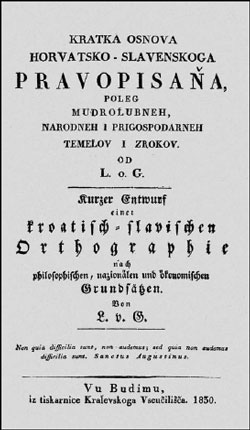
Title page of Ljudevit Gaj's Kratka osnova horvatsko-slavenskoga pravopisanja (Buda, 1830) — the pamphlet that first standardised Croatian orthography. Note the bilingual title: Croatian above, German below. The language had to announce itself in the language of empire in order to be heard. Image: Wikimedia Commons, public domain.
These two movements — the refusal and the reshaping — describe something I recognise instantly in the Croatian context, even though Ashcroft was not writing about Croatia. When Ljudevit Gaj published his Kratka osnova hrvatsko-slavenskoga pravopisanja in 1830 — the text that first standardised Croatian orthography — he was performing an act of abrogation so radical that the Habsburg authorities eventually banned the very word Illyrian from public use, by royal order of Chancellor Metternich on 11 January 1843. The Illyrian movement was not just a linguistic project. It was, in Ashcroft’s terms, a seizure of the means of communication. It said: we will no longer conduct our intellectual and civic life in your language. We will build our own.
And what followed — the decades of literary revival, of Matica hrvatska founded in 1842, of poets and essayists writing deliberately in Croatian rather than in the prestigious languages of empire — was appropriation in the deepest sense. Not borrowing someone else’s language and bending it, as Achebe did with English or as Ngũgĩ debated doing with Gikuyu, but reclaiming a language that had been pushed to the margins of its own homeland. Croatian writers in the nineteenth century were not writing back against English. They were writing back against the entire apparatus of cultural subordination that had made their own mother tongue seem provincial, unfit for serious thought, a language for peasants and priests. As Marijan Bobinac has argued in his study of cultural transfer in the Habsburg Empire, the asymmetry between Croatia and the German-speaking centre was felt painfully by small nations in the Monarchy, and the effort to overcome that position was emphatic.
Benedict Anderson would have understood this. His Imagined Communities, first published in 1983, remains one of the most important books ever written about how nations come into being, and at its heart is a claim about language. Anderson argued that nations are not natural or eternal. They are, in his famous formulation, “an imagined political community — and imagined as both inherently limited and sovereign” (Anderson, Imagined Communities, rev. ed., Verso, 2006, p. 6). Not imagined in the sense of being fake, but in the sense of being willed into existence through shared acts of narration. People who will never meet one another come to feel themselves part of the same community because they read the same newspapers, tell the same stories, recognise the same references. And the medium through which this imagining happens, the infrastructure of it, is language — specifically, Anderson argued, it was print-capitalism, the mass production of books and newspapers in vernacular languages rather than in Latin or other sacred tongues, that made modern nations thinkable.
The Croatian case fits Anderson’s framework almost too neatly. Before the Illyrian movement, Croatia’s educated classes wrote in Latin. Its towns were culturally German or Italian or Hungarian. The Croatian peasantry spoke Croatian, but there was no single standardised literary language, no national press, no shared textual culture that could bind the scattered Croatian lands into something that felt like a coherent nation. When Gaj and his colleagues created a standard orthography, when they founded Croatian-language newspapers and literary journals, when they insisted that Croatian could be a language of philosophy and science and not just of folk song, they were doing exactly what Anderson describes: building the print infrastructure through which a national community could begin to imagine itself.
But here is where Anderson alone is not enough, and where Ernest Gellner’s harder-edged analysis becomes necessary. Gellner, whose Nations and Nationalism also appeared in 1983, was less interested in the romantic dimensions of nation-building and more interested in the functional ones. For Gellner, nationalism arises because industrial modernity requires a culturally homogeneous workforce — people who share a common language, a common education, a common set of cultural references — and the state becomes the instrument that produces this homogeneity. Gellner defined nationalism as “primarily a political principle which holds that the political and the national unit should be congruent” (Nations and Nationalism, 1983, p. 1), and he described its cultural logic bluntly: “the general imposition of a high culture on society, where previously low cultures had taken up the lives of the majority, and in some cases the totality, of the population” (p. 57).
Apply this to Croatia and something uncomfortable emerges. Because Croatia was not just the victim of other people’s high cultures. It was also, in its own nation-building process, engaged in the very homogenisation Gellner describes. The choice of the štokavski dialect as the basis for standard Croatian was itself a political act that marginalised other Croatian dialects — kajkavski in the Zagreb region, čakavski along the Dalmatian coast and the islands. A nation was being narrated into existence, and that narration required, as all narrations do, certain silencings. Certain voices were amplified. Others were asked to conform.
I do not say this to diminish the Croatian national project, which was in many ways an extraordinary act of cultural survival against enormous odds. I say it because the postcolonial lens teaches us to hold two truths at once: that resistance to imperial power is necessary and admirable, and that the process of resistance can reproduce, in miniature, some of the very structures it opposed.
This is where Chinua Achebe walks into the conversation, and where the question shifts from the political to the existential.
Achebe’s Anthills of the Savannah (1987), his final novel, is set in the fictional West African nation of Kangan, a country struggling with the aftermath of colonial rule, with the corruption and violence that fill the vacuum when one form of power replaces another. The novel is about politics, yes, but at its deepest level it is about the power of stories. There is a scene — one of the most important passages in all of postcolonial literature — in which an elder from the province of Abazon addresses a gathering and explains why the storyteller matters more than the warrior. The sounding of the battle-drum is important, he says, and the waging of war is important, but if you ask him which of these takes the eagle-feather, he will say boldly: the story. And then:
“It is only the story that can continue beyond the war and the warrior. It is the story that outlives the sound of war-drums and the exploits of brave fighters. It is the story … that saves our progeny from blundering like blind beggars into the spikes of the cactus fence. The story is our escort; without it, we are blind. Does the blind man own his escort? No, neither do we the story; rather it is the story that owns us and directs us.” (Achebe, Anthills of the Savannah, 1987, Ch. 9)
I have carried that passage around for twenty years, and I have never found a better description of what happens when a language lives inside a people. The Croatian language is not something Croatians possess the way they possess a house or a passport. It possesses them. It shapes the way they perceive time, space, relationship, loss. When a diaspora child sits in my classroom and begins, haltingly, to find the genitive case — to feel how nema bake carries not just the information that grandmother is absent but the whole grammar of absence, the weight of what is gone — that child is not acquiring a skill. They are being claimed by a story that has been waiting for them.
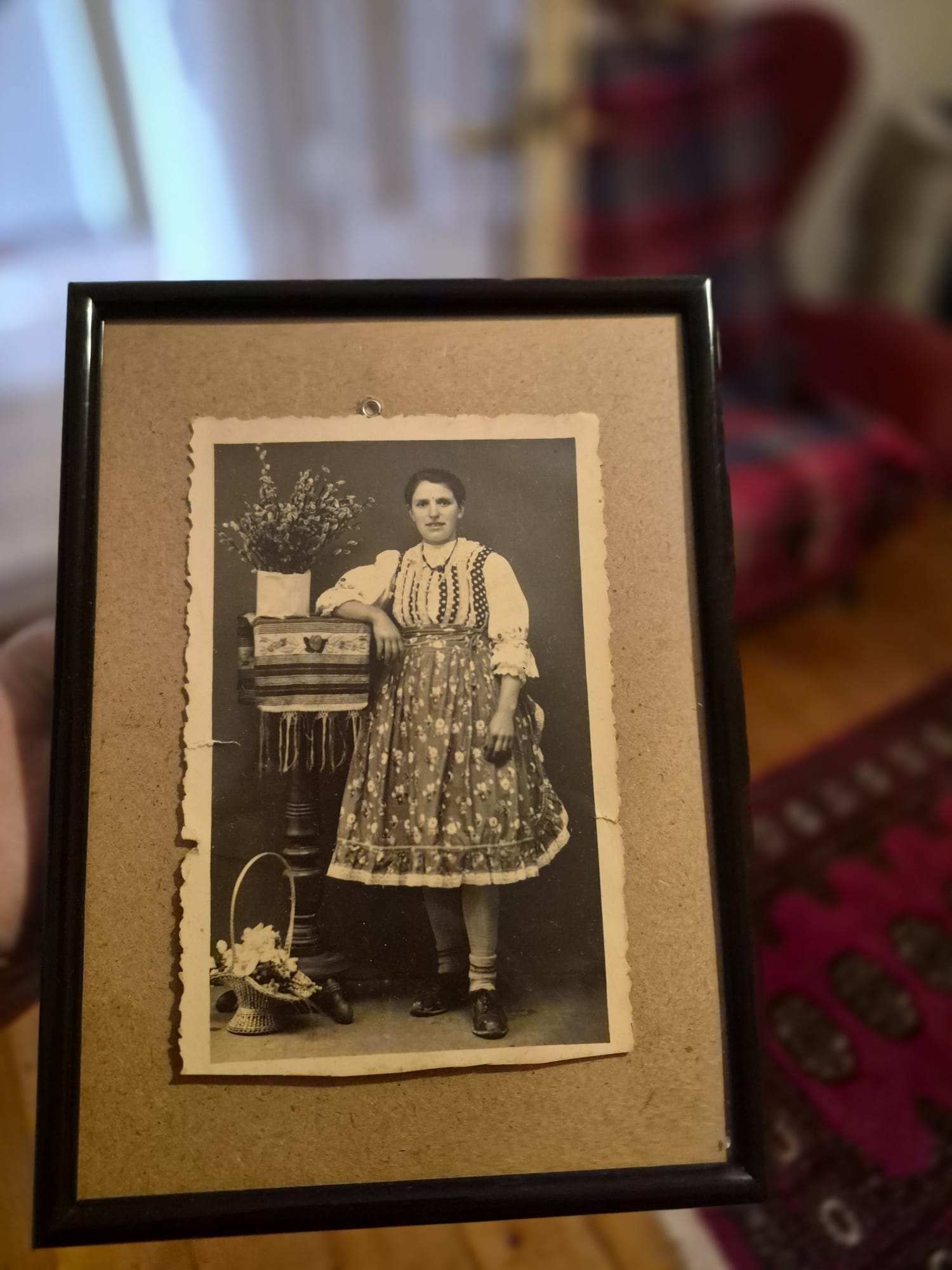
Moja baka. Sometime in the 1930s, in her best clothes for the photographer. She was a farmer. She gave birth to my father in 1942. They are both gone now. The language remains.
Achebe understood this. He understood that storytellers are dangerous precisely because they refuse to let the official version of reality stand unchallenged. As he wrote elsewhere in the same novel: “Storytellers are a threat. They threaten all champions of control, they frighten usurpers of the right-to-freedom of the human spirit — in state, in church or mosque, in party congress, in the university or wherever” (Anthills of the Savannah, 1987). And as he put it in a different context, in what has become perhaps his most quoted line: until the lions have their own historians, the history of the hunt will always glorify the hunter.
This is what Breimer was asking about in that interview. Who gets to speak? Who is silenced? And I want to extend the question, gently, into the space my readers inhabit. Because for the Croatian diaspora, the silencing has often been quiet and internal. It was not a colonial administrator who forbade your grandmother from speaking Croatian — though in fact, throughout the eighteenth and nineteenth centuries, imperial administrators did precisely that, in schools, in courts, in the machinery of public life. What happened in the twentieth century, in Melbourne and Hamilton and Chicago, was different but structurally rhyming. It was the ordinary pressure of assimilation — the well-meaning school that encouraged English only, the workplace where a foreign name was a liability, the slow, imperceptible erosion of a language that had no institutional support in the new country. The story did not disappear in a single act of violence. It thinned, generation by generation, until what was left was a handful of words, a melody, a feeling without a grammar to hold it.
Ashcroft, Griffiths, and Tiffin write about something they call the crisis of self-image that displacement produces — the way that being removed from the cultural centre of one’s language creates a particular kind of alienation, a sense of being not quite at home in any tongue. They note, remarkably, that this alienation is found not only among the enslaved and the forcibly colonised but among free settlers, among people who chose to leave. The displacement itself is enough. The new place does not carry the old meanings, and the old language, cut off from its living context, begins to fossilise or fade.
I see this in my students every single week. The diaspora student who knows štrukli but not the genitive, who can sing Moja diridika but cannot conjugate the verb voljeti, who carries the sound of Croatian in their body like a kind of phantom limb — present in sensation, absent in function. They are living inside a postcolonial condition that nobody ever named for them, because the word postcolonial was busy being used for other histories, other wounds, other geographies.
But the condition is real. And the remedy, I have come to believe, is the same remedy Achebe prescribed: reclaim the story. Not the grammar table. Not the vocabulary list. The story.
This is why I teach the way I teach. Not because I am sentimental about Croatia, though I love it with a fierceness that sometimes surprises me. But because the research and the theory and the literature all converge on the same point: that a language is not a communication tool. It is an architecture of selfhood. It is, as Achebe’s elder says, our escort. Without it, we are blind.
And you are not blind. You are here, reading this letter from Zagreb on a Saturday morning, and the fact that you are here means the story has not finished with you yet. It means the thinning was not complete. Something survived — a word, a longing, a sense that there is a version of yourself that speaks differently, thinks differently, sits differently at the table.
I want to end with something Anderson wrote that I think about often. He said that “regardless of the actual inequality and exploitation that may prevail in each, the nation is always conceived as a deep, horizontal comradeship” (Imagined Communities, rev. ed., 2006, p. 7).
I do not think Croatia needs to be imagined as a nation. It already is one, robustly, sometimes noisily. But I think the Croatian diaspora needs to be imagined as a community — a community of people scattered across the world who share not a geography but a grammar, not a government but a baština, a heritage that is also an obligation. And I think that community is built, like all communities, through stories. Through the act of sitting down, as Achebe’s elder sits down, and saying: let me tell you what I remember. Let me tell you what the words sound like when they are spoken the way they were meant to be spoken.
The story is our escort. It has been waiting. Come, sit at the table.
Tihana
References
Achebe, Chinua. Anthills of the Savannah. Heinemann, 1987.
Achebe, Chinua. Home and Exile. Oxford UP, 2000.
Achebe, Chinua. “The Art of Fiction No. 139.” Interview by Jerome Brooks. The Paris Review, no. 133, Winter 1994.
Anderson, Benedict. Imagined Communities: Reflections on the Origin and Spread of Nationalism. Rev. ed., Verso, 2006.
Ashcroft, Bill, Gareth Griffiths, and Helen Tiffin. The Empire Writes Back: Theory and Practice in Post-Colonial Literatures. 2nd ed., Routledge, 2002.
Bobinac, Marijan. “Cultural Transfer in the Habsburg Empire: Croatia and German-Language Culture from a Postcolonial Perspective.” (Post-)Colonialism across Europe: Transcultural History and National Memory, Aisthesis Verlag, 2014.
Breimer, Sanne. “Who Gets to Speak and Who Is Silenced.” Interview. The Power of Storytelling, 2 Mar. 2026.
Gellner, Ernest. Nations and Nationalism. Blackwell, 1983.
Goldstein, Ivo. Croatia: A History. Hurst & Company, 1999.
Langston, Keith, and Anita Peti-Stantić. Language Planning and National Identity in Croatia. Palgrave Macmillan, 2014.
Novosel, Zrinko, and Vlasta Švoger. “The Age of Neo-Absolutism.” Hrvatski institut za povijest.
Petković, Nikola. Srednja Europa: mit, zbilja, utopija / A Central Europe of Our Own: Postmodernism, Postcolonialism, Postcommunism and The Absence of Authenticity. Adamić, 2003. 2nd ed., Central European Library / Dibido Publishers, 2009.
Petković, Nikola. Identitet i granica, hibridnost i jezik, kultura i građanstvo 21. stoljeća. Jesenski i Turk, 2010.
Seton-Watson, R.W. The Southern Slav Question and the Habsburg Monarchy. Constable, 1911.
Skenderović, Robert. “’German Schools’: Croatian-Slavonian Military Border.” Hrvatski institut za povijest.
Tihana Klepač is an Associate Professor at the University of Zagreb’s Department of English and the founder of TalkTime Croatian. She teaches the Croatian Quadrant™ — a structured, culturally immersive course designed to help learners stop translating and start thinking in Croatian. Find out more at talktimecro.com.
Ovo pitanje tko ima pravo ispričati priču vrijedi i za arhitekturu. Putujući kroz bivšu Jugoslaviju primijetili smo koliko ista zgrada može imati potpuno različito značenje arhitektu, stanovniku, turistu ili nekome tko je odrastao uz nju. Možda je najzanimljivije upravo kad sve te priče mogu postojati istodobno.
Bok Tihana, pozdrav iz istre. I would also like to thank you for writing this although I think I probably grasp only the first layers. I’m not an academic and it’s been a very long time since I delighted in the writings of Achebe, but you’re sparking something here for me that’s been waiting long for the warmth of spring. What is the story of this land and these people that I’m slowly slowly learning to speak with?
As a habitual resident of inter zones and a gweilo who has found a strange welcome in the Lakota lodge, I understand oppression and erasure of a people and an entire reality through suppression of their language.
For Croatia, where did it begin? Who are the originals? In the America’s that’s an easier question to answer, but here? Were the Slavs themselves not the colonizers also at the time of their arrival? Who did they replace and silence? What frame of reference is in the center when most or possibly all nations are a manufactured collection of chosen geographies and histories selected by usually men and usually white? Much to consider, I’m looking forward to more. Hvala puno.