

The worst moment of the week, for a great many people who have just moved here, happens at a counter.
Not at the ministry, where you expect it. At a counter. The bakery, the pharmacy, the post office. Somewhere with a queue behind you and a person in front of you who is busy and perfectly pleasant and waiting.
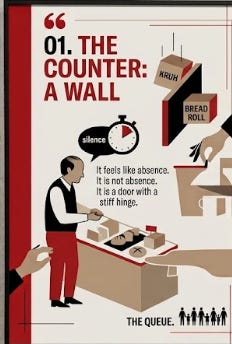
And what happens is that you know the word. You have known it your whole life. You knew it before you knew any English. And it does not come. And there is a silence of two seconds that feels like forty, and then you say it in English or you point, and the transaction completes, and you walk out into the street and something in you is on fire with humiliation, because you are forty-three years old and you have a professional life and a mortgage and you have just been beaten by a bread roll.
I have had this described to me by so many people, in such similar words, that I have stopped treating it as a personal experience and started treating it as a symptom.
And this week I want to tell you what the symptom is a symptom of, because it is not what it feels like. It feels like absence. It is not absence. And the difference between those two things is the difference between a wall and a door with a stiff hinge.
First, how many of you there are
Because I do not think most of you know, and the numbers have moved sharply.
In 2025, according to the Croatian Bureau of Statistics, 56,665 people moved to Croatia from abroad and 37,485 left, giving a positive migration balance of 19,180 (”Migracija stanovništva ... u 2025.”). Of those who came, 16,843 were Croatian citizens.
Set that against the previous year. In 2024, 70,391 people arrived and 38,997 left, and Croatian citizens made up 18.9 per cent of the arrivals, which comes to roughly 13,300 people (”Migracija stanovništva ... u 2024.”).
So the picture is this. Total immigration fell substantially between those two years. And the number of Croatian citizens coming home rose by about a quarter, from something over thirteen thousand to nearly seventeen thousand.
I will not pretend this is a triumphant story, because I promised you at the start of this series that I would not sell you a flattering country. In 2024 more than twenty thousand Croatian citizens emigrated, which is well above the number who came back, and the overall positive balance is driven by foreign arrivals rather than by returning Croats (”Migracija stanovništva ... u 2024.”).
Both things are true. The country is still losing its own people. And the stream of people coming home is growing, faster than anything else in the figures, and if you are one of them you are not eccentric and you are not alone.
And the state has noticed
This is the part I did not expect to be writing, and I want to lay it out plainly because a lot of you do not know it exists.
Since the Law on Foreigners came into force on 15 March 2025, there is a certificate, the Potvrda za hrvatske iseljenike, issued to Croatian emigrants, to their descendants and to their family members who do not hold Croatian citizenship. It opens a route to temporary residence for the purpose of resettlement and return, it permits employment, self-employment and study, and it carries a five-year income tax exemption. Applicants are not required to produce proof of means of support or health insurance, which is the ordinary hurdle for everybody else. After three years of approved temporary residence it converts to permanent residence, and citizenship can be applied for from inside the country (”Izdavanje Potvrde”).
And there is money for the language. The Ministry of Demography and Immigration runs an annual scholarship scheme for Croatian emigrants, their descendants and their family members, to come and study Croatian here. For the academic year 2025/2026 it covers the course, subsidised meals, a monthly stipend of four hundred euros, raised from three hundred, and subsidised student accommodation where available. The courses run at the faculties in Zagreb, Split, Rijeka, Osijek, Pula and Zadar. The budget for that year is 1,072,000 euros, and the ministry notes that recipients come predominantly from the countries of South America (”Stipendije za učenje hrvatskog jezika”).
Read that last sentence again if your family went to Argentina or Chile. The largest group of people currently being paid by the Croatian state to come and learn Croatian is your group.
I am not in the business of promoting government schemes and I have no connection to any of this. I am telling you because I meet people every year who have spent thousands of euros doing privately and awkwardly a thing the state would have paid them four hundred euros a month to do properly.
Now the counter
So you come. And within about a fortnight you hit the thing I described at the top of this letter, and it is worse than you were prepared for, and it is worse in a particular pattern that I want to name, because the pattern is the clue.
Your Croatian is not evenly distributed. It comes rushing back in some rooms and stays locked in others, and the rooms are not random.
The kitchen is open. Food, weather, the body, family, affection, complaint, the whole vocabulary of a house comes back fast, sometimes within days, and often with an accent and a dialect that surprise you, because it is your grandmother’s and you did not know you had it.
The counter is half open. Transactional speech is short, it is under time pressure, and it uses a set of formulas you may never have learned because nobody in your family was ever standing at a Croatian counter while you were in the room.
And the office is shut. The bank, the ministry, the doctor’s referral, the contract, the school enrolment. That register was never in your house, in any language, when you were four. It was never in your house in Croatian at any age.
That is not a proficiency curve. That is a map of the rooms you were in as a child, and the rooms you were not in.
What the ethnography says, before the psychology
Jasna Čapo Žmegač, whose fieldwork among people resettled inside Croatia I have quoted before, found that what marked them out was not their documents and not their origins. It was their speech, which sounded wrong to local ears and immediately gave them away (Čapo Žmegač 67).
And she found that the ones who were let in were the ones who made a deliberate decision to change how they spoke, not to acquire Croatian, which they already had, but to acquire this Croatian, of this specific place (68).
I bring that up here for one reason. It tells you that the work is real and that it is doable, and that it is not the work you think it is. It is not remedial. It is not going back to the beginning. It is a targeted adjustment made by an adult who already has the language, which is a completely different project from learning one.
And that brings me to the science, which is the reason I wanted to write this letter at all.
Your language is not missing. It is inhibited
Here is the model that explains the counter, and once you have it you cannot un-see it.
The Activation Threshold Hypothesis, developed by Michel Paradis and set out clearly by Monika Schmid and Merel Keijzer, says that how easily you can reach any item in either of your languages, a word, a rule, a sound, depends on two things only. How often it has been called upon. And how long ago it was last activated (Schmid and Keijzer 86).
Frequency and recency. That is the whole mechanism. Notice what is not in it. Talent is not in it. Intelligence is not in it. Whether you deserve the language is not in it.
But the model has a second half, and the second half is the one that explains why coming home feels so violent.
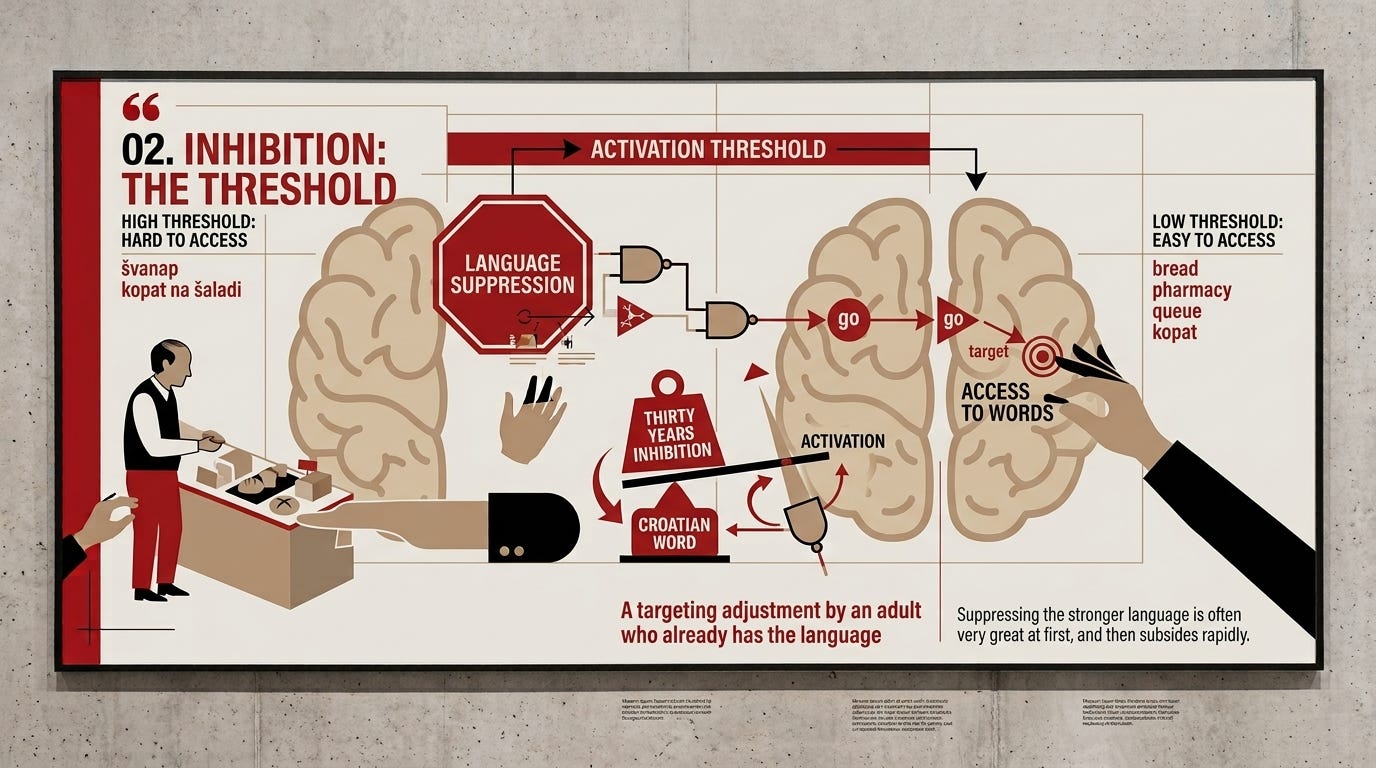
When you reach for a word, all the similar items in your head compete, and for the right one to surface, the others have to be actively pushed down. That suppression is not free. Inhibiting an item raises its threshold, which makes it harder to reach next time (Schmid and Keijzer 87).
Which means that every day for thirty years, in Melbourne or Munich or Rosario, when you reached for the word for bread, some part of your mind was holding down the Croatian one. Not neglecting it. Holding it down, thousands of times a day, because that is the only way to be fluent in the language you actually needed.
And now you have moved, and the whole machinery has to reverse, and the thing you spent three decades suppressing has to be brought back up while the thing you spent three decades building has to be pushed down. In the middle of a bakery. With a queue behind you.
Of course it fails. It would be astonishing if it did not.
And here is the sentence in that paper which I would like every returnee in this country to have read. Describing what happens when anyone tries to speak a language they have not used for a long time, Schmid and Keijzer write that the effort needed to suppress the stronger language is often very great at first, and then subsides rapidly (87).
Very great at first. Then subsides rapidly.
That is not a promise about mastery. It is a much more specific and more useful claim than that. It says the worst part is the first part, that the difficulty you are experiencing in month one is not the baseline you will be operating from in month six, and that what feels like the discovery of an absence is actually the sound of a threshold being lowered.
And the language really is still in there
There is a second body of research that I find almost unreasonably moving, and it concerns people who have far less than you do.
Jeffrey Bowers, Sven Mattys and Suzanne Gage took adults who had been exposed to Hindi or Zulu in early childhood and had then lost all contact with it, so completely that they had no explicit memory of the language whatsoever. Native English speakers who would tell you, truthfully, that they did not know a word.
They tested whether these adults could learn subtle sound contrasts from those languages, contrasts that English does not use and that English speakers ordinarily cannot hear. And they compared them against control participants with no childhood exposure at all.
The people who had heard the language as children relearned the contrasts. The controls showed no learning (Bowers, Mattys and Gage 1064).
No conscious memory. No vocabulary. Decades of silence. And still, something laid down before the age of five was sitting there, doing nothing, until it was asked to do something and then it did it.
I want to be honest about the limits of that study, because it has one, and Tihana does not hand you good news with the caveats trimmed off. The effect appeared in participants under forty. Those over forty showed no relearning advantage in that experiment (1064). This is one study, of sound perception specifically, in people who had lost the language absolutely. It is not a general law and I would not build a life on it.
But look at where you are standing relative to those participants. They had nothing conscious at all. You have your grandmother’s word for the thing in the drawer, and the sound of the language in your body, and probably comprehension you have never given yourself credit for.
Which brings me to the study that I think describes most of you exactly.
Terry Kit-fong Au and her colleagues studied adults who had overheard a language regularly during childhood without ever really speaking it. The passive ones. The children in the kitchen who understood everything and answered in English. And they found that those adults, when they later learned the language, spoke it with more native-like pronunciation than people who had no such exposure (Au et al. 238–43).
Overhearing. Not speaking. Not studying. Just being in the room while it happened.
If you were that child, you did not waste those years. You were being given something that cannot be bought later at any price, and it has been sitting in you, waiting, since before you could form a sentence.
What this actually means at the counter
So let me put the whole thing back together, because I think the reframe is worth more than any technique.
When the word does not come, you are not discovering a hole. You are meeting a threshold that thirty years of not using this language has raised, and that the language you have been living in has actively pushed higher every single day, because that is how bilingual minds work.
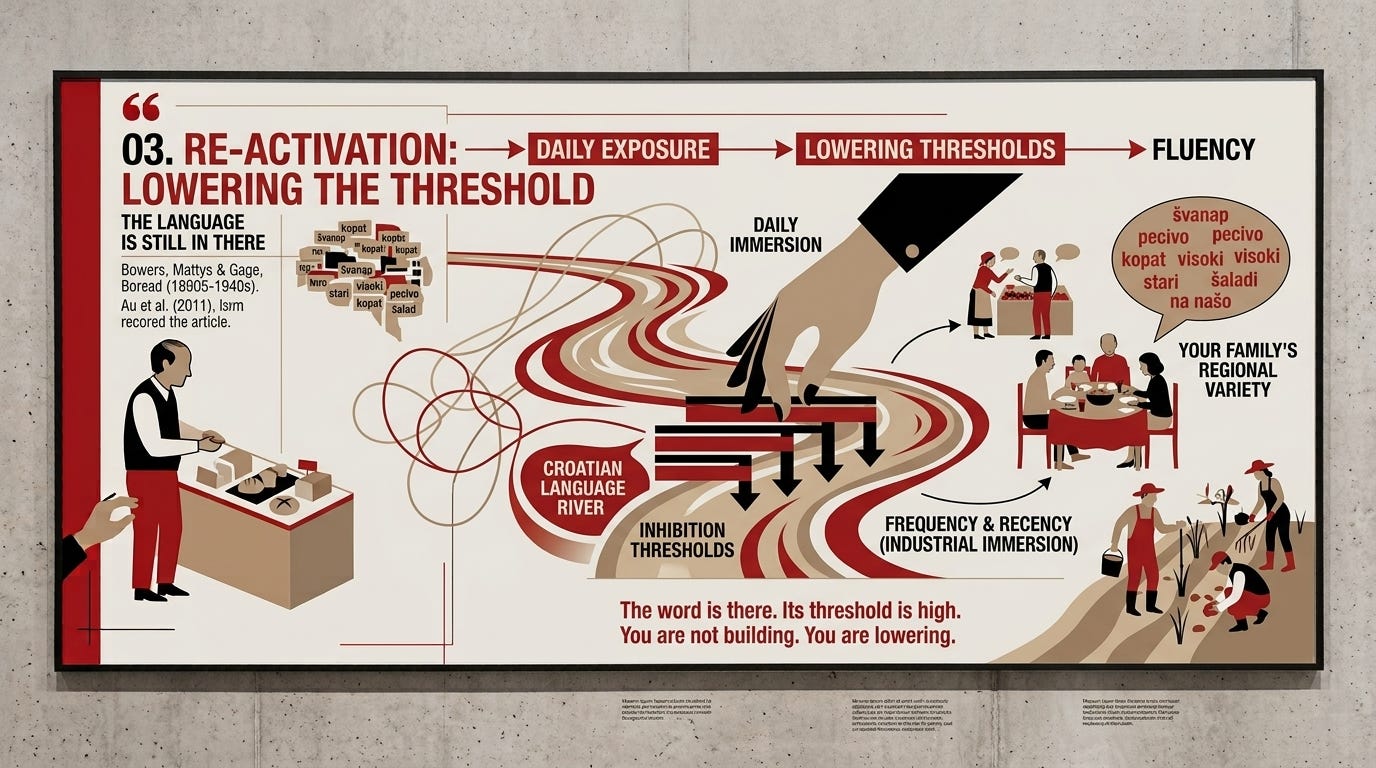
The word is there. Its threshold is high. Thresholds come down with frequency and recency, which are the two things that immersion supplies in industrial quantities and that nothing else supplies at all.
You are not building. You are lowering.
And the person in front of you at the counter has no idea that any of this is happening, and is not judging you, and has already forgotten it. Only you are keeping score.
One more thing, and then I will stop. The Croatian that comes back to you in those first weeks will be your family’s Croatian, which is to say a regional variety, because that is what most emigrants spoke and that is the model their children acquired (Hlavac and Stolac 48). It will not be the language of the news. When it arrives it may arrive sounding like a village you have never lived in.
Let it. That is not an obstacle to your Croatian. That is your Croatian, arriving.
The principle everything below is built on
You have two levers and only two. Frequency, meaning how often an item gets called on. Recency, meaning how long ago it was last called on (Schmid and Keijzer 86).
Everything in the plan below is a way of pulling one of those two levers. And everything that feels like language learning but does not pull either of them is, for your situation specifically, a waste of the most valuable months you will ever have.
Which is why I want to say something that will sound perverse coming from a person who sells a Croatian course.
Do not spend your evenings in Croatia doing grammar exercises.
Grammar exercises are for people who do not have access to the language. You have moved inside it. You are standing in the middle of the single most effective input environment that exists, an environment people pay enormous sums and cross oceans to reach, and if you spend your first six months in a room with a workbook you will have converted an immersion into a correspondence course.
There is a place for structured study and I will come to it. It is not the first six months.
The first ninety days
The one-counter method
Choose one shop. A bakery, a greengrocer, a kiosk, something with a person rather than a machine, close enough to your flat that going there is not a decision.
Go every day. At roughly the same time. Buy roughly the same thing.
This looks trivial and it is the single most effective thing I know for a returnee, and here is why. It pulls both levers at once on a small, fixed set of items. The same twenty words and four formulas, called on daily, at short intervals. That is precisely the condition under which an activation threshold falls.
And it does something the model does not describe but that everybody who has done it will recognise. By about day ten the person behind the counter knows you. They start the exchange. They fill in your gaps without making anything of it. And the fear, which is the actual obstacle, drains out of that one interaction and leaves you with a piece of ground you can stand on, and you will find yourself using that ground in other shops without deciding to.
Do not vary it for at least a month. Variety is for later. Right now you want repetition.
Talk to yourself, out loud, badly
The returnee’s particular problem, if you were an overhearing child, is not comprehension. It is production. You have decades of input and almost no output, and those are separate systems.
So produce. Narrate what you are doing while you do it, in the flat, where nobody can hear you. Name the objects. Describe the task. Say the sentence you failed to say at the counter this morning, ten times, correctly, at leisure, with nobody waiting.
This feels absurd for about three days. It works because production under no time pressure is how you build the pathway that production under time pressure will later use.
Read aloud for ten minutes
Not silently. Aloud.
Reading aloud does something neither reading nor speaking does on its own: it forces your mouth through Croatian phonology continuously while removing the burden of composing the sentence. And it drags the formal register, the one from the locked room, through your own voice, which is the only way it will ever start to feel like something you could say rather than something you can decode.
Ten minutes. A newspaper column, a page of a novel, anything with adult sentences in it.
Do not translate your social life
The most common failure I see in returnees is that they arrive, find the other Anglophones or Hispanophones within a fortnight, and build a social life in the language they came with, while telling themselves they will start with Croatian once they are settled.
You will not. The threshold does not care about your intentions.
Get one fixed weekly commitment where Croatian is the only language available. A choir, a hiking group, a language exchange, a church, a class in something unrelated, a volunteer shift. One slot a week, at the same time, with the same people. Fixed, so it survives the weeks when you cannot face it.
The three rooms that stay locked
The office
The register of institutions is not a harder version of the Croatian you have. It is a register that was never in your house at any age and in any language.
So treat it as vocabulary acquisition rather than as evidence about your fluency, because that is what it is. Before an appointment, get the ten words for that specific errand and write them on your hand if necessary. After the appointment, write down what you did not understand and look it up.
And here is a permission I would like you to take. In an institutional setting, bring somebody, or ask them to write it down, or say plainly oprostite, možete li to napisati. Nobody at a counter thinks less of you for this. The transaction is what matters and the language is a means to it, and treating a ministry appointment as a language test is how people end up avoiding ministry appointments for a year.
The telephone
The telephone is genuinely harder and it is not your imagination. There is no face, no gesture, no object to point at, no context, and often poor audio, and every one of those is a support that face-to-face conversation gives you for free.
Which is why the telephone comes later. Do not use it as your benchmark in month two. And when you do start, start with calls where you already know the script: booking an appointment, ordering something, confirming a time.
The doctor
Nobody learns the vocabulary of the body from their grandmother beyond a certain level, because a child does not discuss their kidneys.
So build it deliberately, before you need it, and make it the one piece of formal vocabulary study you do in the first six months. It is the only register where being unable to say the thing has real consequences.
Where the paid structure actually belongs
I said I would come back to this and I will be straight with you.
Structured teaching is worth an enormous amount to a returnee, and it is worth almost nothing in the first month, because in the first month what you need is volume and repetition and the lowering of thresholds, and no class can supply as much of that as the street outside your flat.
Where structure earns its keep is the third register. The written, formal, schooled Croatian that the kitchen never gave you and that the street will not give you either, because nobody speaks it at a counter. That is the one thing immersion alone will not fix, and it is the one thing a course exists to fix, and it is exactly what the state scholarships I mentioned in the free half are designed to deliver, at the faculties in Zagreb, Split, Rijeka, Osijek, Pula and Zadar, with four hundred euros a month attached (”Stipendije za učenje hrvatskog jezika”).
If you are here, or coming, look at that scheme before you look at anything private, including mine.
An honest timeline, and the two places people quit
I have watched enough people do this to be able to tell you roughly what the year looks like, and I think knowing the shape in advance is worth more than any technique, because both of the points where people give up are points where nothing is actually wrong.
Weeks one to three. Worse than you expected. The interference from your other language is at its maximum, because the inhibition machinery has not switched direction yet, and this is precisely the phase the research describes as the effort being very great at first (Schmid and Keijzer 87). People arrive expecting a warm rush of returning childhood and get a fortnight of feeling stupid at counters.
This is the first place people quit. They conclude they have less Croatian than they thought and they retreat into English for social survival, and once the social life is built in English the year is decided.
Weeks four to ten. The kitchen register comes back, and it comes back faster than anybody expects, often with the accent and dialect of the family. This is the euphoric phase. People overestimate wildly here and then hit the office and the telephone and are shocked.
Months three to six. The plateau, and this is the real test. Ordinary life is now working. Counters are fine. Friends are fine. And progress becomes invisible, because everything that is easy has become easy and everything that remains is the formal register, which improves slowly and which you do not use daily.
This is the second place people quit, and they quit by stopping rather than by deciding. The weekly commitment lapses. The reading aloud stops. And because ordinary life continues to work, nothing appears to be lost for about a year.
Months six to twelve. If the structure held, this is where the third register starts to move and where people stop translating. It is much less dramatic than the first three months and it is where the actual arrival happens.
One last thing
I have given you a lot of method, and I want to end somewhere else.
The people I have watched do this well were not the ones with the best Croatian on arrival. They were the ones who understood, early, that they were not students.
A student is building something that was not there. You are turning something back on. Those are different projects, they feel different, and they fail differently. A student who cannot produce a word has not yet learned it. You have known it since before you could read, and it is sitting behind a threshold that thirty years of a different life raised, and thresholds come down with use, and you have moved to the one place on earth that supplies use in unlimited quantities for free.
The bakery is open at six. Go and be humiliated by a bread roll, daily, for a month.
That is the whole method. Everything else is a footnote to it.
Next week: what actually happens inside a family when the language is not passed on, what the research says is lost, and how much of it can still be recovered while there is somebody to ask.
Tihana Klepač is an Associate Professor at the University of Zagreb’s Department of English and the founder of TalkTime Croatian. This letter belongs to the series The Language You Carry. She teaches the Croatian Quadrant™, a structured, culturally immersive course designed to help learners stop translating and start thinking in Croatian. Find out more at talktimecro.com.
Works Cited
Au, Terry Kit-fong, Leah M. Knightly, Sun-Ah Jun, and Janet S. Oh. “Overhearing a Language During Childhood.” Psychological Science, vol. 13, no. 3, 2002, pp. 238–43.
Bowers, Jeffrey S., Sven L. Mattys, and Suzanne H. Gage. “Preserved Implicit Knowledge of a Forgotten Childhood Language.” Psychological Science, vol. 20, no. 9, 2009, pp. 1064–69.
Čapo Žmegač, Jasna. Strangers Either Way: The Lives of Croatian Refugees in Their New Home. Berghahn Books, 2007.
Hlavac, Jim, and Diana Stolac. “Observations on Croatian as a Heritage Language Across Four Continents.” Croatian Studies Review, vol. 16–17, 2020/2021, pp. 45–72.
“Izdavanje Potvrde za hrvatske iseljenike za reguliranje boravka u RH.” Ministarstvo demografije i useljeništva, mdu.gov.hr. Accessed 15 Aug. 2026.
“Migracija stanovništva Republike Hrvatske u 2024.” Državni zavod za statistiku, STAN-2025-2-1, podaci.dzs.hr. Accessed 15 Aug. 2026.
“Migracija stanovništva Republike Hrvatske u 2025.” Državni zavod za statistiku, STAN-2026-2-1, podaci.dzs.hr. Accessed 15 Aug. 2026.
Schmid, Monika S., and Merel Keijzer. “First Language Attrition and Reversion Among Older Migrants.” International Journal of the Sociology of Language, no. 200, 2009, pp. 83–101.
“Stipendije za učenje hrvatskog jezika.” Ministarstvo demografije i useljeništva, mdu.gov.hr. Accessed 15 Aug. 2026.