

My father was from Hrvatsko zagorje, from the hills that fold one behind the other northwest of Zagreb like washing on a line, and he left them young, the way people from there have always left, for the city and then for the rest of a life. He carried those hills with him for the whole of it. When we buried him, we played “Suza za zagorske brege,” a tear for the Zagorje hills, and I have not been able to hear it since without going to pieces.
If you do not know the song, it was written in 1969, words by Ana Bešenić and music by Zvonko Špišić, first sung at the festival of kajkavian popevke, the old songs of the north, in Krapina. It is in kajkavian, and over the years it has quietly become the anthem of everyone who ever left. A man slips out of the house at first light, while the bregi, the hills, are still sleeping, a pinklec, a small bundle, on his shoulder. His old mother walks behind him without a word, her eyes on the ground. He cannot bring himself to look back. All he can do, going down past the last house in the village, is promise the hills that one day he will come home. My father made that promise to his hills, and like most people who make it, he never quite kept it, and he carried the not-keeping his whole life. That ache has a name in Croatian heavier than the English word will hold. Čežnja. The longing that sits in the body.
I am telling you this at the start because it is the truest thing I know about the subject of this letter, which is the language those hills speak. Kaj. The dialect of the whole Croatian north, from my father’s Zagorje across to the plain of Međimurje, through Podravina and Turopolje and Prigorje and into the streets of the capital. And the first thing to understand about it, the thing that should reframe everything for a heritage learner, is that it is not a broken or countrified version of the Croatian you have been trying to learn. It is a separate thing, with a thousand-year history of its own and a literature good enough that Miroslav Krleža, at the height of his fame, put the standard language down and wrote his greatest poems in it.
The three dialect groups of Croatian are each named for the way they say the word what. Štokavci say što. Čakavci say ča. Kajkavci say kaj, and their speech is named for it (Celinić 1; Lisac 527). Kajkavian is spoken across the northwest: Zagreb County, Zagorje, the Varaždin region, Međimurje, much of Podravina, Turopolje, Prigorje, and into Gorski kotar, its western edge running right along the line where Croatian shades into Slovene (Celinić 23–24). The capital itself sits on a kajkavian foundation (Celinić 23). This is not a quaint pocket of the country. It is the entire top of it.
How old is it, and whose is it? People argued that for more than a century. The great Slovene scholar Fran Ramovš thought kajkavian had begun as part of Slovene and only later drifted into Croatian. A rival camp, taking its lead from the Ukrainian Slavist Lukjanenko, who wrote the first book on the dialect, thought kajkavian had never been one thing at all, that it was a seam sewn from Slovene, čakavian and štokavian (Lončarić 15–16). It was Stjepan Ivšić who settled the question in 1936, on the evidence of the accent: reconstruct the oldest kajkavian sound system, he showed, and it is unmistakably Croatian (Lončarić 39). The picture that has held since, worked out most fully by Mijo Lončarić in the one modern book the dialect has, is that kajkavian took its own shape around the tenth century, at the very moment Slovene was pulling away on one side, and that its accent set it apart from the štokavian to its east and the čakavian to its south (Lončarić 39). Around the same time the arrival of the Hungarians cut the old chain of Slavic speech that had once run unbroken up to what is now Slovak (Celinić 24). Kajkavian has been sitting in its hills, Slovene on one shoulder and the rest of Croatian on the other, ever since.
Now the part the textbook never reaches, and the part that decides whether a person sounds like they are from the north: the music of the accent. It is worth explaining plainly, because this is where heritage speakers are most exposed and where the books are least help.
Older Croatian, the kind the standard is built on, is what linguists call a pitch language. That means a stressed syllable does not only land harder than the ones around it, the way it does in English. The voice also rises or falls across it, and that little tune is part of the word itself, as real as a vowel. The standard settled on four of these tunes, long and short, rising and falling, and it took them from the speech of the far southeast, from eastern Herzegovina, where the pattern had formed when the stress in old words pulled back a syllable and left a melody hanging behind it (Lisac 705; Pletikos Olof and Bradfield 855). Kajkavian went its own way a thousand years ago. It kept a particular rising lift, a tune scholars call the akut, on words where the standard long ago pressed the line flat, and it even carried that lift onto short words the standard never sang (Lončarić 43–47). You can still hear it in a Zagorje village as clearly as anywhere in the country (Lisac 695). And the city of Zagreb, like kajkavian generally, mostly let the tunes go: its accent is flat and stressed, far closer to English than to the four-melody standard, with the old difference between long and short vowels levelled away (Pletikos Olof and Bradfield 855; Kapović, “The Unattainable Standard” 337–62).
Which leads to something worth saying out loud, if you have worked at the standard and still feel marked the second you open your mouth: when researchers recorded people from all over the country reading in their best standard, only about a third actually produced the full four-tune system, and they came overwhelmingly from Dalmatia and Slavonia, not the capital (Pletikos Olof and Bradfield 857). Zagreb mostly does not pass the standard’s own test. You are in very large company.
There is one more thing every person reaching for this dialect should have, and it is basic enough that it belongs here and not behind any wall: the map. Kajkavian is not one accent or one speech. Lončarić, who spent a working life on it, divides it into fifteen dialects (Lončarić 146). You do not need the linguistics of how they are sorted. You need the names, because a diaspora reader can usually find their own people in them:
the central-Zagorje dialect of my father’s hills,
the Samobor one,
the Varaždin-and-Ludbreg one, t
he Međimurje one of the far north,
the Sutla-valley one along the Slovene border,
the Plješivica-Prigorje one,
the Turopolje one of the lowlands south of Zagreb,
the Vukomerić-and-Kupa one,
the two Lonja-valley ones of Moslavina,
the north-Moslavina one,
the Glogovnica-Bilogora one,
the Podravina one,
the Gorski-kotar one up in the highlands,
and the lower-Sutla one, which stands a little apart because it is kajkavian grown over an older čakavian root (Lončarić 146).
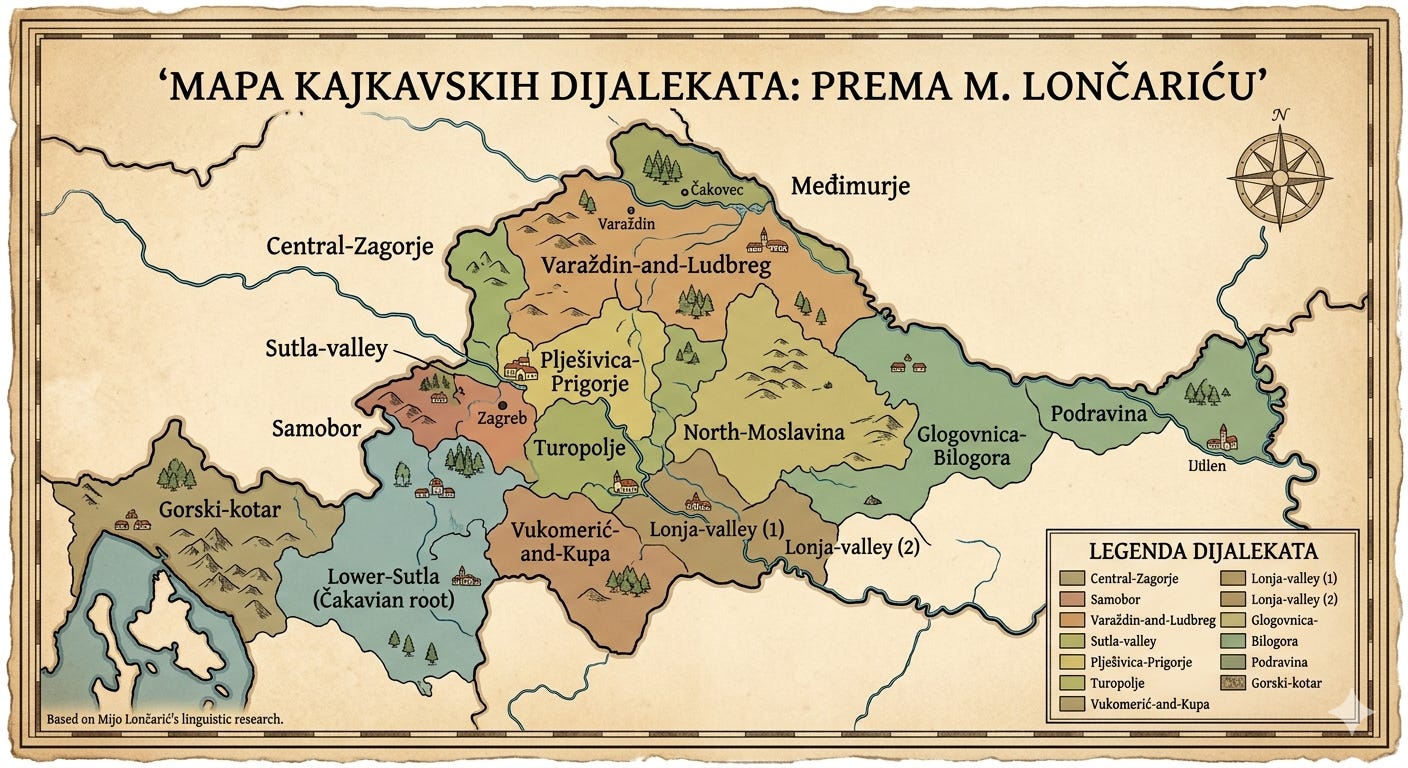
If your family came from the north, this is not a foreign dialect you are sampling. It is the speech your grandparents quarrelled and prayed and counted money in. You will not master it, and you do not need to. You can learn to place it on this map, to follow it when it comes at you fast, to keep a handful of its words close. That is the whole task, and it is reachable.
A few features will tell you within a sentence that you are hearing kajkavian, or the kajkavian under the skin of the city, and these too are basic enough to carry in your pocket from the start. The future tense is the loudest. Where the standard builds it from the verb htjeti, with ću, ćeš, će, kajkavian builds it from the verb to be, so “I will” comes out bum or bom, “you will” buš, “he will” bu (Celinić 13). Bu where the standard wants će. If a Zagreb child wants to ask you what you are going to do you may well get Kaj buš delal, three kajkavian flags in three words: kaj for what, buš for the future, delal for done. The third person plural of the present often grows a longer tail, so people vežeju and učiju and voziju where the standard has vežu, uče, voze (Celinić 13–14). A little v sprouts on the front of words that begin with a vowel, so uho, the ear, becomes vuho, and ugao, the corner, becomes vugel (Celinić 11–12). The aorist and the imperfect are gone; the supine (verb form showing action’s purpose – idem spavati), an old travelling companion of the infinitive, survives; up against Slovene in the far northwest the dual still hangs on in a few forms; and the vocative has mostly dissolved back into the nominative (Celinić 13–15). None of this is error. It is an older grammar, kept where the standard moved on and lost where the standard held, running quietly under the whole speech of the north.
What the Accent Actually Sounds Like
Let me make the accent concrete, because “a rising tune” is hard to feel without examples.
Take the hills from the song, the bregi. Across much of the north a speaker lifts the voice on a word like that in a way a Dalmatian or a standard speaker simply does not. The clearest cases are old and ordinary. A woman in Zagorje says brȃla, she picked, or orȃla, she ploughed, with a small rising lift riding the long vowel; the standard says the very same words with the line ironed flat (Lončarić 43–45). The masculine past participle does a thing the standard never does at all, so “he cut” is posekel and “he ran off” pobegel, the stress sitting exactly where a štokavian ear does not expect it (Lončarić 44). These are not exotic words. They are the words of a working day, and the tune on them is the single most reliable sign of where a person grew up.
And there is no one kajkavian accent to learn even if you wanted to, because the systems multiply as you cross the region (Celinić 25–26). Two places will surprise you most. In Podravina, along the Drava, the stress is locked onto the last two syllables of the word, a restriction found nowhere else in the entire Slavic world; you can almost feel where a Podravec is going to land before the word is out (Lončarić 141). In Međimurje, the flat northern plain, the difference between long and short vowels has been thrown out entirely, and the vowels have opened up into five separate heights to compensate, so the whole colour of the speech changes (Lončarić 144). When someone says “the kajkavian accent” as if it were a single thing, they are flattening a landscape that took a thousand years to fold.
The Lexicon
The vocabulary is where the age of the dialect shows most warmly. Kajkavian holds a deep store of archaic Slavic words, the kind linguists use to reconstruct the parent language itself; Lončarić reckons the dialect keeps on the order of three thousand words of Slavic origin (Lončarić 138). Some it shares with Slovene and almost no one else, like kaj itself, or dekla for a girl or a maid.
Some belong to a group linguists call the panonizmi, and since I have just dropped a strange word on you, let me say where it comes from. The great plain that runs from northern Croatia up across Hungary was, in Roman times, the province of Pannonia, and linguists still use “Pannonian” as a label for the old speech of that whole northern zone. The panonizmi are the words that stitch the Croatian north to its neighbours across that plain, words like vuhek for damp and vugnuti for to dampen (Lončarić 138). Name the region and you have named the words.
On top of that old Slavic base sit two thick layers of borrowing, the plain debt of having lived for centuries inside other people’s empires. The German layer is large and intimate: coprnica for a witch, coprati for doing witchcraft, vankuš for a pillow, nor for foolish (Lončarić 138). The Hungarian layer runs alongside it: beteg for an illness, jezero in the old sense of a thousand, orsag for a country or realm (Lončarić 138). The everyday speech of Zagreb concentrates the German strand so densely that it earned its own name, Agramer, after the city’s old Austrian name of Agram, and that vocabulary has been gathered into its own dictionary precisely because it is thinning out (Glovacki-Bernardi, Hölbling Matković, and Petrušić-Goldstein; Štebih 31–37). And kajkavian loves a diminutive; over much of the north the same fond little suffix makes names for men and women alike, Jožek and Štefek beside Barek and Marek (Lončarić 138).
What the official dictionaries did with all of this is itself telling. The great Academy dictionary of Croatian largely left the kajkavian vocabulary out, partly because the status of kajkavian, its place between Croatian and Slovene, was unclear to the scholars of the day, and it was only in 1984 that a dedicated dictionary of the kajkavian literary language was begun to make the omission good (Lončarić 133; Celinić 17).
A Literary Language That Stepped Aside
It would be easy, from a standard-centred vantage, to hear all this as charming residue. It is the opposite. Kajkavian is an old literary language that lost a contest, not a fallen form of the one that won.
For three centuries, from the sixteenth to the nineteenth, the northwest wrote in a kajkavian literary language. It had grammars and it had great dictionaries: the Gazophylacium of Ivan Belostenec, the Dictionar of Juraj Habdelić, the Lexicon of Andrija Jambrešić. By the eighteenth century it was a normed, fully working written standard in everything but the name (Lončarić 133; Celinić 17). Then, in the 1830s, it was deliberately set down in favour of the štokavian base, so that the Croats could have one standard instead of three, a single language to hold the dialects together (Celinić 17). The dialect lost the throne. It did not lose the gift.
Listen to what it could still do. Dragutin Domjanić, who died in 1933, wrote an anti-war poem in kajkavian called “Ciklame, krvave ciklame,” blood-red cyclamens, in which the flowers spread over a forgotten graveyard while an iron railway carries the village boys off to the front. Read its lines and you will hear, in real verse, the same grammar I laid out earlier:
Vuz reku železna je cesta,Železna tam ružiju kolaI voziju naše soldateBez broja prek brega i dola.I tam, gde su najgorši boji,Gde nigdo se smrti ne straši,I najviše gde ih pogiba,Sigurno tam budeju naši.There is the voziju ending. The dead are spoken of as budeju naši, there our boys will be, with the kajkavian bu future doing the work of grief. This is not folklore. It is a poet using the full reach of his dialect to say something the age needed said.
And then there is Petrica Kerempuh, the figure who proves the point twice over. He is the old Croatian trickster, a blind beggar-singer, the peasant who survives everything by his wit, a cousin of the German Till Eulenspiegel. Domjanić put him in a marionette play in 1921. Fifteen years later Krleža made him the voice of the Balade Petrice Kerempuha, a cycle of poems in kajkavian that many consider the summit of twentieth-century Croatian verse, in which the whole buried history of the Croatian peasant, the famine and the gallows and the black humour, is poured into the dialect because the standard could not hold it.
Nigdar ni tak biloda ni nekak bilo,pak ni vezda nebuda nam nekak nebu.I will only say that the country’s most ferocious modern intelligence – Miroslav Krleža – given every register of the standard to choose from, reached for kaj when he had something that mattered to say.
So here is where the explaining ends, and it ends back where it started, on the hills. My father could not have told you a single word of any of this. He did not know the dialect had fifteen branches or a reconstructed accent or a dictionary begun in 1984. He knew that the word for hill was breg and not brijeg, and he knew which way the voice was supposed to lift on it, and that was enough to carry a whole country inside him for fifty years in a flat I can still smell. When the song played at the end and the room went quiet, every person in it who had ever left somewhere they loved understood it to the bone, in a language most of them could not have parsed for you on paper. That is what a dialect is, in the end. Not a worse way of speaking. A door, left open behind you, into the house you came from, that you mean every year to walk back through, and that you keep promising the hills you will. Vrnul se bum, the song says. I will come back. Most of us do not, or not in time. But the language is the one part of it you can carry across any border and any number of years, intact, and hand to your children, so that when they finally do stand on those hills they will know, without being told, that they are home.
And now I am off to Mirogoj to talk to dad.
Why the Standard Was Not Built on Kajkavian
Dalibor Brozović gives a clean account of why the language of the Croatian north is not the language on the official forms.
Start earlier than you would expect. In the fifteenth century, Brozović argues, Croatian was on a normal European path to a standard language, and the dialect carrying it was not kajkavian or štokavian but čakavian, the literary speech of the Dalmatian coast, which by then sat roughly where literary Russian sat in the eighteenth century, poised to become a national language (Brozović 4). It was, he writes, only common sense to expect that a Croatian čakavian standard would form in the sixteenth century. “Ali to se nije dogodilo,” he adds. But it did not happen (Brozović 4). The Ottoman invasion happened instead, and Croatia took on what he calls the tragically irrational role of nearly four centuries as the predziđe kršćanstva, the bulwark of Christendom, a role Christian Europe never acknowledged or repaid (Brozović 4). The fruits of half a millennium of linguistic development collapsed, and in their place came a scatter of regional literacies, on čakavian, on štokavian, and at last on kajkavian (Brozović 4).
Out of that scatter, by the second half of the eighteenth century, something most heritage speakers have never been told about had taken shape. Not one Croatian written language but two. Brozović is precise: a linguistic duality, a jezično dvojstvo, in which two Croatian standard languages were being built and used in parallel, “jednoga, manjinskoga, na sjeverozapadu za kajkavske Hrvate,” one, the minority one, in the northwest for the kajkavian Croats, and the other, novoštokavian, for everyone else (Brozović 5). Both were doing the ordinary work of standard languages: literature, law, administration, schoolbooks, grammars, dictionaries (Brozović 6). For two or three generations, the Croatian north read and wrote and prayed in a kajkavian that was, in the measures of its day, a standard language in its own right. This is the dignity the textbook erases. Your grandmother’s dialect is the descendant not of a failure, but of a deposed standard.
The national revival of the 1830s decided to end the duality and build on one base. A choice had to be made between the kajkavian and the novoštokavian, and Brozović is blunt that “taj izbor nije bio težak,” the choice was not a hard one, and he lays out why (Brozović 6). The štokavian speakers were the clear numerical majority. It was felt to be easier to persuade kajkavians to accept štokavian than to persuade štokavians and čakavians to accept kajkavian. The literary prestige of the štokavian heritage, and not only because of Dubrovnik, was greater. Čakavian writing had already folded into the štokavian current, which set a precedent; and, tellingly, history knew kajkavians who had also written in štokavian, “ali nije bilo štokavaca koji bi pisali kajkavski,” but there were no štokavians who wrote in kajkavian (Brozović 6–7). And the Illyrians had their pan-Slav hopes, and could see that for most other South Slavs the štokavian offer was the more acceptable one (Brozović 7).
Brozović’s verdict is not the romantic one, and it is the more useful for that. The revival’s choice, he writes, was correct, and there is no reason to wish it had gone otherwise (Brozović 7). What there is reason to mourn, he says, is something older and larger: that history never gave Croatian the chance to become what it was becoming in the sixteenth century, on the čakavian base, before the wars (Brozović 7). The loss worth grieving is not that kajkavian lost to štokavian in the 1830s. It is that the Ottoman centuries destroyed the first standard before either of them could inherit it. He adds a quiet comparative note that puts the whole thing in proportion: in all of Europe, only two nations ever built two standard languages on two different dialect bases, the Croats and the Albanians, and the Croatian duality was resolved almost a century and a half before the Albanian (Brozović 7).
None of this required anyone to decide that the speech of Zagreb was wrong. It required a choice between two functioning standards, made for reasons that were, on Brozović’s account, sound. The dialect was not silenced. It was, by a deliberate and defensible decision, not crowned.
Where Kajkavian Comes From
The deeper history, the one that decides whether kajkavian is even Croatian, was the central puzzle of South Slavic linguistics for a century, and Lončarić’s monograph is where it is laid out most fully.
The question, in his words, came down to whether kajkavian was, at the beginning of its development, part of Slovene or part of Croatian (Lončarić 149). Two answers dominated the early literature. Fran Ramovš held that kajkavian had belonged, in its early development, to Slovene, separating only later, so that it is Croatian now but was not at the root (Lončarić 149). The other answer, known as the Belić theory but really the Ukrainian Lukjanenko’s, in the first monograph ever written on the dialect, held that kajkavian had never been a single thing, that it rested on three different bases at once, Slovene, čakavian and štokavian (Lončarić 149). As early as 1905, reviewing Lukjanenko, Vatroslav Jagić had objected that you cannot settle a dialect’s family by a handful of single sound-features, and concluded that by the totality of its features kajkavian belongs to the Croatian, not the Slovene, language, however many similarities to Slovene it carries (Lončarić 113).
It was Stjepan Ivšić, the greatest of the Croatian dialectologists, who turned the argument from impression to proof. Walking nearly the whole kajkavian territory, he showed that its wildly varied accentual behaviour reduces to a single underlying system, and that by this accentuation, in Lončarić’s summary, “po akcentuaciji hrvatska kajkavština [je] dio hrvatskoga jezika,” by its accentuation Croatian kajkavian is part of the Croatian language (Lončarić 429). With that, the reconstructed accent quietly refuted both Ramovš and Lukjanenko at once (Lončarić 155).
Lončarić’s own synthesis dates the thing. The basic kajkavian accentuation, he writes, “stvara se oko X. st.,” forms around the tenth century, and that is the moment kajkavian becomes a formed linguistic unit you can speak of with confidence (Lončarić 329, 333). It did not, at that moment, break away from Slovene, as Ramovš thought, nor from ščakavian, as others proposed. Rather, it separated from the western South Slavic parent at roughly the same time Slovene did, by its own innovations, taking its place between the western štokavian to its north and the čakavian to its south (Lončarić 333, 435). The contact features it shares with Slovene along the western border are real, but later and secondary; the accent is the deep boundary (Lončarić 333). One strand of this, associated with Junković, places kajkavian within an old Pannonian group of the western South Slavic parent and treats it as Croatian from the start, a group out of which even some present-day Slovene border dialects later grew (Lončarić 177). The Common Slavic chain that had once run north from here toward Slovak was broken only afterwards, by the arrival of the Hungarians in the tenth century (Lončarić 139).
What the Accent Is Actually Doing
The free section called the accent a kept rising tune. Here is the same thing in the terms Lončarić uses, because the detail is the dignity.
The reconstructed system has a name and an abbreviation that recur throughout the literature: osnovna kajkavska akcentuacija, the basic kajkavian accentuation, OKA for short (Lončarić 429). Before its newer accents arose, the parent system had free stress, every syllable able to be stressed, every syllable inherently long or short, with a tonal contrast available on a long stressed syllable (Lončarić 437). What makes OKA itself is a particular distribution of two newer Proto-Slavic accents, the new acute and the new circumflex, the same acute that čakavian also keeps (Lončarić 429). In the developed kajkavian system this yields three accents, a short one, a long falling one, and the long rising akut (Lončarić 565).
Two features matter most for an ear. First, the acute does not sit only where you would expect it from the oldest layer; kajkavian extended it, by sound change and then by analogy, onto words that had no business carrying it, including ordinary nouns like straža, a watch, and suša, a drought (Lončarić 475). Second, and unlike the standard, kajkavian kept its lengths before the stress. As Lončarić puts it, “u hrvatskome jeziku, dakle i u kajkavštini, prednaglasna duljina ostaje,” in Croatian, and so in kajkavian, the pre-accentual length remains, where the novoštokavian base of the standard lost it (Lončarić 295). A kajkavian speaker can still hold a long vowel in the run-up to the stress in a way the standard simply does not.
And then the variety, which is the part that defeats anyone hoping to learn a single “kajkavian accent.” In the northeast there is a reciprocal swap of acute and circumflex with a parallel in Lithuanian (Lončarić 39). In the southeast a regressive shift gives forms like posekel (Lončarić 307). In a belt of Podravina, from Koprivnica down to near Đurđevac, the stress is fixed so tightly that Lončarić can describe it as a fiksirana silina na predzadnjoj mori, a fixed stress on the penultimate mora, with the final syllable able to take it only when it is long, a restriction he notes has no equal anywhere in the Slavic world (Lončarić 141, 307). In Međimurje and the western Zagorje the tonal contrast, and then the length contrast, drop out altogether (Lončarić 307). What sounds, to an outsider, like one rustic music is in fact a dozen different settlements of an old system, each valley having made its own peace with it.
The capital, for its part, made the most radical peace of all: it kept almost none of the tunes. The Zagreb accent is a dynamic stress accent, like English, which is exactly why the standard’s four pitch-accents are so nearly impossible for someone raised on it (Pletikos Olof and Bradfield 855; Kapović, “The Unattainable Standard” 337–62).
Where the Words Come From
The lexicon chapter of Lončarić’s monograph is the place to send anyone who thinks dialect words are quaint. He estimates kajkavian holds something like fifteen hundred Common Slavic words plus another fifteen hundred of Slavic origin that are no longer found across all the Slavic languages, “najmanje oko 3 000 slavenskih riječi,” at least around three thousand Slavic words in all (Lončarić 137).
The most precious of these are what he calls arhaizmi or preživi, old Slavic lexemes that survive now only in kajkavian, on one fenced-off stretch of the Slavic continuum, which is why they matter for reconstructing the parent language (Lončarić 135). Above that sit clear bands of sharing. Words kajkavian holds only with Slovene, like kaj and dekla (Lončarić 138). The panonizmi, shared with the immediate neighbours across the old Pannonian zone, vuhek for damp, vugnuti to dampen (Lončarić 138). The slavonizmi, shared eastward into Slavonia, zdenec for a well (Lončarić 138). And telling small differences from the standard, dažd or dešč against kiša for rain, oreh against orah for walnut, or jagoda, which in kajkavian can mean both a strawberry and, older, a single grain or berry (Lončarić 137).
The two great foreign layers, Lončarić is careful to say, are not decoration but the residue of geopolitics, of “životom u istoj državi,” life lived inside the same states (Lončarić 138). The German loans come in two streams, one from spoken Bavarian-Austrian and Central German dialects, coprnica a witch, coprati to bewitch, vankuš a pillow, nor foolish, and a later one straight from written German (Lončarić 138). The Hungarian loans come the same two ways, beteg an illness, jezero in the old sense of a thousand, orsag a country or realm (Lončarić 138). And the dialect’s love of the diminutive is, he notes, a feature of living speech rather than of the system, with one striking pattern across much of the north: a single suffix building fond forms for men and women alike, Jožek and Štefek beside Barek and Marek (Lončarić 138).
That all of this was so nearly lost to the record is its own lesson. The great Academy dictionary largely left the kajkavian word-stock out, Lončarić explains, above all because of the nejasan status kajkavštine, the unclear status of kajkavian for the Slavistics of the day, its uncertain place between Croatian and Slovene; the omission began to be repaired only with the launch of the dictionary of the kajkavian literary language in 1984 (Lončarić 133). The three thousand words were always there. For a long time, the people with the authority to write them down were not sure what they were looking at.
The Library You Didn’t Know You Had
When a literary language is set aside, its books do not vanish. They wait on shelves for someone to remember they are there, and the kajkavian shelf is older and longer than almost any heritage Croatian imagines. The dialectologist Đuro Blažeka, surveying the whole tradition, sorts it into three phases, and a few of its names are worth carrying, because they are yours (Blažeka 120–21).
The first phase runs from the sixteenth century to the middle of the nineteenth, when the northwest, with Zagreb as its political and cultural centre, wrote in a shared kajkavian literary language built on the speech of the educated city (Blažeka 120). It opens with a law book. Ivanuš Pergošić’s Decretum, printed in Nedelišče in Međimurje in 1574, is the first printed kajkavian book, a translation of the great legal code of the Hungarian-Croatian kingdom, and proof from the very start that the dialect could carry the most demanding administrative prose in the country (Blažeka 120; Lončarić 133). Four years later came Antun Vramec’s Kronika, a chronicle of the world, and then his Postila, a book of sermons; the two of them anchored what scholars call the Varaždin circle, the first workshop of written kajkavian (Blažeka 120). The seventeenth century was its golden age of preachers and lexicographers, the dictionaries of Juraj Habdelić and Ivan Belostenec among them, and it kept its wit to the end in the comedies of Tituš Brezovački, still staged in Croatia today (Blažeka 120; Lončarić 133).
What matters most, against the temptation to treat all this as a closed museum, is that the literature did not stop when the literary language lost its throne in the 1830s. Blažeka’s second phase is the twentieth century, the kajkavian of Antun Gustav Matoš, Dragutin Domjanić, Fran Galović, Ivan Goran Kovačić and Nikola Pavić, and his third is the living present, the poetry of Božica Jelušić and Ernest Fišer and Božica Brkan, and the best-selling novels of Kristian Novak, written in the Međimurje kajkavian of the Sveti Martin area and adapted for the stage to full houses (Blažeka 120–21). The dialect that was set aside as a standard never stopped being a language people reach for when they have something true to say.
You do not have to read any of it in the original; much of the older work is hard going even for Croatians now. But it should change how the dialect sits in you to know the shelf is there, that the speech you half-remember from a kitchen was, for three centuries, also the language of law and chronicle and sermon and comedy, and that it is still, this year, the language of a novel someone could not stop reading.
Where the North Went, and What It Kept
This letter began with a man who left the Zagorje hills, and if you are reading it, there is a fair chance one of those leavers is the reason you exist. The geography of who went where is more tangled than the tidy stories suggest, and it is worth being honest about it. The great overseas emigration, the one that filled the ships to South America and the Antipodes, drew first and most heavily on Dalmatia and the coast, not the kajkavian interior (Hlavac and Stolac 45). But the kajkavian north has its own emigrant map, and the scholarship can point to specific places on it. Đuro Blažeka, tracing kajkavian communities abroad, names two with unusual precision: Strawberry Hill, the old Croatian quarter of Kansas City, settled at the end of the nineteenth century mostly by people from Gorski kotar, and Mildura, a winegrowing town in inland Australia, settled before the Second World War mostly from the eastern part of lower Međimurje (Blažeka 116). Whole corners of the north transplanted themselves, dialect and all, and kept it.
That phrase, dialect and all, is the part heritage families most need to hear. What an emigrant carried abroad was almost never the standard. It was the home speech, kajkavian, frozen at the year of leaving, while the language back home kept moving without them. The grandchild who now visits Croatia and feels their Croatian is somehow wrong is very often not speaking poor standard at all; they are speaking good old dialect, preserved like a pressed flower, a record of how one village sounded a lifetime ago.
The research bears this out, and it carries one more finding worth keeping. Across a study of three hundred Croatian-origin speakers on four continents, Hlavac and Stolac show that what survives longest in the diaspora, and crosses most easily between the generations, is not case endings or perfect grammar but the small, frequent, identity-bearing words, the discourse markers and greetings and turns of phrase that signal where a person is from (Hlavac and Stolac 65–66). Which is its own kind of permission. Nobody in Zagorje is grading your declensions. A single bok, or kaj, or bum, dropped at the right moment, tells them you know whose grandchild you are, more surely than a flawless standard sentence ever could.
That, in the end, is the quiet argument under this whole letter. For a century the scholars could not decide whether kajkavian was Slovene or Croatian, a language or a dialect, worth a dictionary or not. The people speaking it never had that doubt. They knew it was the word for the hills, and which way the voice rose on it, and that it was theirs.
So if you want to do more than recognise it, here is where to go. Listen to the popevke, the Krapina songs, which is where most Croatians first feel kajkavian as beauty rather than as accent. Read Domjanić or Galović aloud, slowly, and let the bu and the voziju sit in your mouth. Sit with the oldest relative you have left and write down the words of theirs that are not in any standard dictionary, because those words are data from a thousand-year-old language and they are leaving with that generation. And if you ever stand in Krapina in the autumn while the hills go gold and somebody starts to sing about leaving them, you will not need a single thing in this letter explained to you again. You will just know, the way my father knew, the way the whole room knew, that this was the first language of a place that is, in some stubborn and unkillable way, still yours.
Tihana Klepač is an Associate Professor at the University of Zagreb’s Department of English and the founder of TalkTime Croatian. This letter belongs to the series The Language You Carry. She teaches the Croatian Quadrant™, a structured, culturally immersive course designed to help learners stop translating and start thinking in Croatian. Find out more at talktimecro.com.
Works Cited
Bešenić, Ana, and Zvonko Špišić. “Suza za zagorske brege.” Festival kajkavskih popevki, Krapina, 1969.
Blažeka, Đuro. “Gatherings of the Kajkavian Dialect: Past, Present and Future.” Croatian Studies Review, vol. 14–15, 2018–2019, pp. 115–140.
Brozović, Dalibor. “Hrvatski štokavski dijalekti – razvoj i stanje.” Hrvatski dijalektološki zbornik, vol. 14, 2008, pp. 3–12.
Celinić, Anita. “Kajkavsko narječje / Kajkavian.” Hrvatski dijalektološki zbornik, vol. 24, 2020, pp. 1–37.
Domjanić, Dragutin. “Ciklame, krvave ciklame.” Kipci i popevke, 1917.
Glovacki-Bernardi, Zrinjka, Lara Hölbling Matković, and Sanja Petrušić-Goldstein. Agramer: Rječnik njemačkih posuđenica u zagrebačkom govoru. Novi Liber, 2013.
Hlavac, Jim, and Diana Stolac. “Observations on Croatian as a Heritage Language across Four Continents.” Croatian Studies Review, vol. 16–17, 2020–2021, pp. 45–72.
Kapović, Mate. “The Unattainable Standard: Zagreb Dialect Meets Standard Croatian Accentuation.” Slověne, vol. 7, no. 1, 2018, pp. 337–362.
Krleža, Miroslav. Balade Petrice Kerempuha. 1936.
Lisac, Josip. Hrvatska dijalektologija 1: Hrvatski dijalekti i govori štokavskog narječja i hrvatski govori torlačkog narječja. Golden marketing – Tehnička knjiga, 2003.
Lončarić, Mijo. Kajkavsko narječje. Školska knjiga, 1996.
Pletikos Olof, Elenmari, and Julian Bradfield. “Standard Croatian Pitch Accent: Fact and Fiction.” Proceedings of the 19th International Congress of Phonetic Sciences (ICPhS 2019), Melbourne, 2019, pp. 855–858.
Štebih, Barbara. “Germanizmi u zagrebačkom govoru.” Kaj: časopis za književnost, umjetnost i kulturu, vol. 35, no. 5–6, 2002, pp. 31–37.