

Watch closely, the next time you are at a Croatian table, what happens when a guest tries to refuse a third rakija. Not the first glass, which is simply hospitality, and not the second, which is still ordinary. The third. The one the guest waves away with a hand half over the rim, saying ne, hvala, stvarno ne mogu više, no thank you, really, I can’t have any more. Watch what the host does with that sentence. The host pours it anyway.
And the guest, if the guest is from Croatia, is not surprised, because the guest never expected the ne to be the end of anything. The ne was not a refusal. It was the opening line of a small negotiation that both people already know the shape of, the host insisting ma daj, samo malo, oh come on, just a little, the guest protesting, the host pouring, the protest softening into e, pa dobro, ali stvarno zadnja, well, alright, but really the last one, everyone satisfied, the glass full. Nobody taught either of them that script. They have simply always known it, the way you know how to fall asleep, which is to say without any idea of how you do it.
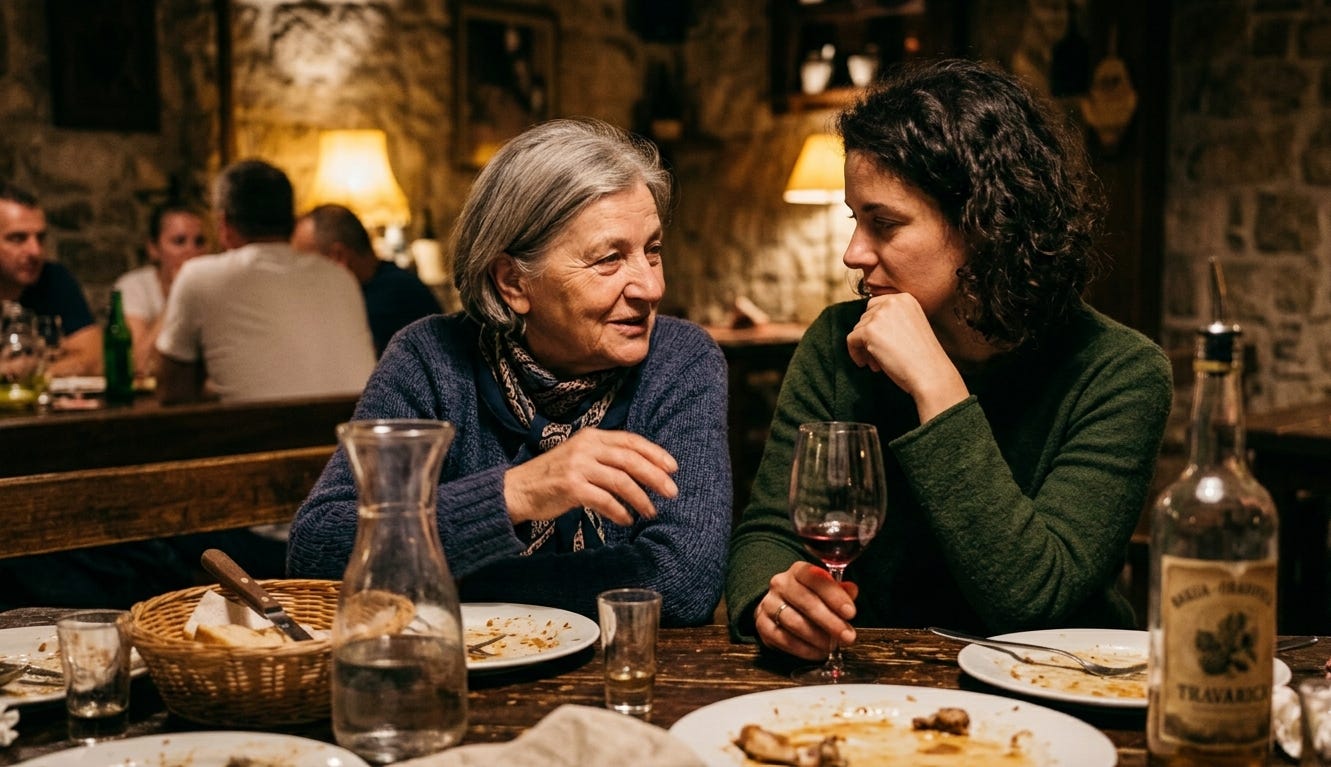
Let me tell you about a doctor I have recently seen, Croatian Canadian, who came to Croatia with her young family fifty years after her grandmother left for Canada. Her Croatian was better than that of half the people waiting at any Zagreb tram stop. Her cases were clean. Her vocabulary was wide and slightly old-fashioned in a way I found lovely, full of words her grandmother had carried out of the country decades ago and kept like preserves. She told me that the first time she sat at a table like the one I have just described and said, correctly, carefully, politely, ne, hvala, ne mogu više, the table heard, in the space of three words, that she was not from here. She had reached for the right words. She had made the wrong move. She had treated a ritual as if it were a question, and answered it.
This is the subject of today’s letter, and it is the one I have been most reluctant to write, because it is the part of the language I cannot hand you cleanly. Everything I have written about so far in this series, the standard, the dialects, the accent, sits on top of grammar, and grammar can be studied. You can open a book to the genitive and close it knowing more than you did. What I want to talk about today lives underneath grammar, in a layer the books mostly do not reach, because the people who could write those books are native speakers, and native speakers do not know they are doing it.
Linguists call this layer pragmatics. It is the study of what language does rather than what it says: the social meanings folded into the smallest words, the unwritten rules about who speaks when and how, the conventionalised shapes that everyday exchanges quietly follow (Ivanetić, Uporabni tekstovi), the difference between the sentence and the move the sentence is making. In my own head I have always thought of it as the language of fatigue, the part that only comes out when nobody is performing, when the table is sticky and the guests have gone and the sentences belong only to the people still in the room. It is the last thing you acquire, and the first thing that goes when a language starts to slip away.
The Words That Carry No Meaning and All the Meaning
Start with the smallest pieces, because they are where you are most exposed, and because they are, against all intuition, the heart of the whole matter.
Croatian speech is held together by a handful of tiny words that mean almost nothing on their own and almost everything in place. Pa, eto, evo, ono, znaš, daj, ma, aj, joj, uf, ionako, kao. You will not find them in the vocabulary lists, because they are not vocabulary in the way bread and house are vocabulary. They do not point at things in the world. They point at the conversation itself. Linguistics has a name for them: discourse markers, the small elements that Deborah Schiffrin’s foundational study set apart as the things that bracket and steer talk rather than carry its content (Schiffrin), what Croatian scholarship calls diskursne oznake (discoursive markers) (Nigoević 121), and what Neda Pintarić, in the first contrastive study of these forms in Croatian, treats as pragmemes, the smallest carriers of pragmatic meaning, the exact point where a gesture hardens into a word (Pintarić). I will take each one of them apart in the paid section below, slowly, one by one, because every single one does several jobs at once and not one of them survives a dictionary. For now it is enough to know what they are as a class: the connective tissue of real speech, the sounds that soften a disagreement, that signal you are still listening, that buy a half-second to think, that mark a kind of resigned acceptance, or quietly warn the other person that what you are about to say is not to be taken entirely at face value. The Croatian linguist Nada Ivanetić, in the first full study of speech acts written in Croatian, places all of this inside what she calls, in her opening pages, the pragmatic turn, the moment linguistics stopped asking only what a sentence means and started asking what a person is doing with it (Ivanetić, Govorni činovi). These small words are that doing, made audible.
If you want to hear evo — and words like it — spoken in real Croatian, my YouTube channel has free lessons covering exactly this kind of ground: how to learn Croatian, what to say when someone dies, the words you need at the beach, how to talk to your grandparents, how to describe your neighbourhood. Language as it is actually lived, not as the textbook presents it. The Ćakula Café podcast is there too. You will find everything at youtube.com/@TalkTimeCro.
Here is what should reframe everything for you. When a Croatian family abroad begins, generation by generation, to lose the language, this layer is not the last to erode. It is among the very first (Hlavac and Stolac 53). The most thorough account we have of how Croatian actually sounds in the diaspora, Jim Hlavac’s study of a hundred Croatian-Australian speakers, shows that these little connective words are where the home language gives way earliest, displaced so gently by their English equivalents that the speaker never notices it happening (Hlavac, “Bilingual Discourse Markers” 1896). The da that affirms gives way to yeah. The pa and the tako da that should carry a thought from one clause to the next give way to so (Hlavac, “Bilingual Discourse Markers” 1896). This is the process Gisle Andersen calls pragmatic borrowing, the quiet importing of another language’s interactional habits, one marker at a time (Andersen 17). And the reason it happens, Hlavac shows with real precision, is not laziness or forgetting. It is that the English word can do more jobs. Yeah in his data appears five and a half times more often than its Croatian counterpart da, not because the speakers have forgotten da, but because yeah is a tool that affirms and fills a pause and ends a turn and holds the floor all at once, where da in homeland Croatian does only the first of those things (Hlavac, “Bilingual Discourse Markers” 1884). The more flexible tool wins, slot by slot, until one day the small Croatian words are simply gone, and the speaker, asked to produce them, reaches and finds so, finds like, finds you know, sitting where the Croatian used to be.
There is a real tenderness in his findings, if you sit with them. He records speakers who say znaš and you know in the same breath, one chasing the other, the Croatian word produced almost as an apology, a way of showing the homeland interlocutor that they still have it, even as the English one comes out first and easiest (Hlavac, “Bilingual Discourse Markers” 1890). The Croatian particle becomes, in his lovely phrase, a kind of face-saving gesture, proof of belonging offered alongside the foreign form that has quietly taken its place (Hlavac, “Bilingual Interjections” 45). That double sound, the znaš you know, is the sound of someone standing in the doorway of the konoba with one foot still outside. It is not broken Croatian. It is a coherent, patterned, internally consistent variety, one that works beautifully in a room where everyone shares it. The trouble is only ever what happens when that room meets a different room.
Ti and Vi, and the Wall the English You Cannot Build
Then there is the choice you make every time you open your mouth to another person, before you have said anything at all: whether to call them ti or Vi.
English speakers are told this is the formal-and-informal you, like French tu and vous, and then they relax, because that sounds like a rule you can learn. It is not a rule. It is a reading of the entire social space between you and another human being, taken in an instant, and revised continuously, and freighted with the possibility of giving offence in both directions. Use ti with the wrong person, an elder you have just met, a professor, a clerk behind a counter, and you have been presumptuous, overfamiliar, slightly coarse. Use Vi with a peer your own age in a relaxed setting and you have built a small wall where none was wanted, you have held someone at a distance they did not ask to be held at. The Croatian word for using the respectful form even has its own verb, persirati, and the act of moving from Vi to ti is a real social event, governed by an unwritten rule that the older or more senior person is the one who offers it, usually with a sentence like možemo na ti, can we move to ti. To reach for that intimacy before it is offered is a small trespass. To refuse it when it is offered is a small wound.
I want you to feel why this is genuinely hard, and not merely fussy, and for that it helps to step outside Croatian for a moment. The linguist Anna Wierzbicka spent a career showing that English is not, as English speakers tend to assume, the neutral baseline against which other languages are more or less polite (Wierzbicka, Cross-Cultural Pragmatics). In her study of Polish against English she demonstrated that English is in fact the unusual one among European languages, the one that has built an elaborate machinery of indirectness, of would you mind and I was wondering if and perhaps we could, around a deep cultural assumption that every individual is an island whose autonomy must not be trespassed upon (Wierzbicka, “Different Speech Acts” 149–50). And she noticed, almost in passing, something that cuts to the bone of what I am describing: the English you, that great democratic word, the same for the Queen and the postman, cannot do what Vi does. It cannot carry courtesy, because it makes no choice. It keeps everybody, she writes, at exactly the same distance (Wierzbicka, “Different Speech Acts” 170). Croatian makes you choose that distance, freshly, every time, and the choice is itself the message.
This is why the diaspora learner, trained without knowing it on the English assumption that warmth means a single uniform friendliness offered equally to all, finds the ti and Vi system not just difficult but somehow unfair. There is no neutral option. Silence about the relationship is not available to you. You must decide, and in deciding you say something about how you see the person and how you see yourself in relation to them, and you say it before you have said hello.
How We Refuse, How We Complain, How We Ply With Food
And then there is the largest and least teachable thing of all, which is the shape of the moves themselves: how a Croatian refuses, complains, disagrees, presses food on a guest, shows affection. These have specific local forms, and the textbooks miss almost every one of them, because the textbooks are written in the standard and this lives below the standard.
Wierzbicka’s work on Polish is, again, a useful mirror, because what she found there holds recognisably for Croatian, and the recognition is the point. She showed that the bare command, the imperative that English has all but banished from polite speech and that English ears hear as bossy or even brutal, is in Polish one of the softer, warmer options, a sign of closeness rather than force (Wierzbicka, “Different Speech Acts” 154). The same is true here. When a Croatian grandmother says jedi, eat, flat imperative, no hedging, she is not ordering you. She is loving you in the grammar. When she heaps your plate over your protest and says moraš, you must, she is performing exactly the hospitality Wierzbicka describes in the Polish host who will not take no for an answer, who assumes your refusal is mere politeness and is therefore to be lovingly overridden (Wierzbicka, “Different Speech Acts” 148). The refusal and the overriding are both part of one warm choreography, and the guest who refuses only once, and means it, and is believed, has not been treated coldly. They have been, very slightly, not welcomed all the way in.
The English-speaking learner, meanwhile, arrives carrying the opposite reflex. They have been raised to hedge, to soften, to say I think maybe I might not where a Croatian would simply say neću, I won’t, or ne valja, that’s no good. And so two things happen, both painful, and both are precisely the cross-cultural misfires Wierzbicka warned of: the migrant who speaks plainly is heard as rude, and the one who fails to decode the elaborate indirection is heard as cold or slow (Wierzbicka, “Different Speech Acts” 176). When the learner hedges in Croatian, layering on the sort of and the I was wondering, the directness-loving Croatian ear hears not politeness but evasion, a strange reluctance to simply say what one means, even a kind of insincerity. And when the Croatian speaks plainly back, stating an opinion as a flat fact, to je glupo, that’s stupid, the way one states an opinion as readily as one states the weather (Wierzbicka, “Different Speech Acts” 160), where the learner expected I’m not sure that’s the best idea, the learner flinches, and reads rudeness where none was intended, because in their other language only an aggressive person would say it that way. Nada Ivanetić mapped the Croatian repertoire for exactly these moves, the whole field of disapproval, the reproach and the recrimination and the open expressive criticism, the ways we tell each other, often quite directly, that something is not right (Ivanetić, Govorni činovi). None of it is in the beginner’s book. All of it is in the room.
Here is the part I most want you to keep. The directness is not a deficiency of manners, and your own inherited directness, if you have it, is not bad Croatian. The mistake is to measure either against an English idea of politeness and find it wanting, and that mistake has a name. Cliff Goddard and Anna Wierzbicka call it terminological ethnocentrism, the error of taking English categories, polite, direct, imposition, request, and treating them as if they were neutral, universal measuring sticks rather than the local property of one particular culture (Goddard and Wierzbicka 158). English, they insist, is not culture-neutral. It carries as much cultural baggage as any other language on earth. Croatian directness is not a failure to be English. It is the surface of a different settlement between people, one that prizes warmth, spontaneity, and a kind of unguarded closeness, and that finds the English wall of indirectness, in its turn, a little cold, a little lonely. Two rooms. Each warm in its own way. Each slightly chilled by the other’s draught.
What This Means for You
I told you at the start that I could not hand this layer to you cleanly, and I have to be honest about why. The small words and the choreography of the ti and the refused rakija and the plainly stated opinion are not knowledge that transfers in a lesson, because the people who own them do not hold them as knowledge. They hold them as instinct, laid down before memory, the way the body learns a rhythm before the mind can name it. This is the one part of the language that genuinely waits for you in the konoba and almost nowhere else.
But awareness is not nothing. Awareness is, in fact, the whole of what study can give you here, and it is more than it sounds. To know that the third ne is the opening of a ritual and not the closing of a door changes how you sit at the table. To know that Vi is a courtesy the older person will lift when they are ready changes how you wait. To know that the grandmother’s jedi is affection in the imperative changes what you hear. You stop translating the moves into English and finding them rude. You start, slowly, to feel the logic under them, and once you feel the logic, the moves stop being a wall and become what they always were, which is a door, standing open, with the people you love on the other side of it, waiting to see whether you will learn to walk through the way they do.
That doctor I told you about, the one whose perfect Croatian gave her away at the table. She is far better at this now, not because her grammar improved, it was always fine, but because she stopped hearing the language with an English ear. The last time she refused a rakija, she refused it three times, and laughed, and let the host pour it anyway, and the table did not register her as a stranger. It registered her as someone who finally knew the song.
The Small Words, One by One
None of these can be translated as a unit, because each one does several jobs at once, which is exactly why they survive so badly in the diaspora and matter so much to the ear. This is what Pintarić means by the pragmem: a place where an affective gesture has become a word (Pintarić). Learn them as gestures, not as definitions.
Pa. The great softener and opener. Pa at the start of a sentence takes the edge off whatever follows, the way a hand on the arm does. Pa dobro, well, alright. Pa nisam znala, well, I didn’t know. Pa što sad, well, what now. It can carry mild reproach (pa gdje si ti, well where have you been), gentle resignation, or just the social warmth of not beginning too bluntly. A sentence that starts with pa is a sentence that has already reached toward the listener.
Eto. The settling word. Eto is the sound of something coming to rest, often with a small sigh of acceptance inside it. Eto, tako ti je to, there, that’s just how it is. Eto vidiš, there, you see. You use it to close a little story, to hand a conclusion gently to the other person, to mark that there is nothing more to be done. It carries a faint, fond fatalism that is very Croatian.
Evo. The presenting word, eto‘s forward-facing twin. Where eto sets something down, evo holds something out. Evo me, here I am, I’m coming. Evo, odmah, here, right away. Evo ti, here, take it. Hand someone a coffee with evo and the word is doing the giving as much as your hand is.
Ono. The hesitation that buys you a thought. Literally that, but in speech it is closer to you know, like, the placeholder you drop in while you find the next word. Ono, ne znam baš, like, I don’t really know. Bilo je, ono, čudno, it was, you know, strange. Overused it marks young, urban, casual speech, but used lightly it is simply the texture of real talk.
Znaš. You know, and the single most important solidarity word in the language. Znaš invites the listener to agree, to share the ground you are standing on, to nod along inside the sentence. Znaš kako je, you know how it is. The formal version is znate. In the diaspora this is the word that does not so much vanish as double: Hlavac records znaš and its English twin you know produced in the same breath, side by side, the Croatian form held onto even as the English one arrives first (Hlavac, “Bilingual Discourse Markers” 1890). It is the one most worth defending, because it is the sound of including the other person in what you mean.
Daj. Literally give, but as a particle it means something between come on and please and oh stop it. Daj, molim te, come on, please. Daj to ovamo, give that here. Doubled or stretched it pleads or protests: ma daj, oh come on, you can’t be serious. It is the word you reach for to urge, to coax, to wave away something you don’t believe.
Ma. The most expressive small word we have, and almost untranslatable. Ma dismisses, contradicts, exclaims, and softens, depending entirely on what follows and how you say it. Ma ne, oh no, or, depending on tone, nonsense. Ma daj, oh come on. Ma kakvi, no way, not a chance. Ma pusti, oh forget it. To deploy ma correctly is one of the surest signs that the language lives in you and not just on your tongue, because it cannot be reasoned out, only felt.
Aj. The casual hinge word, short for ajde, itself from hajde, come on, let’s go. Ajde, come on. Aj bok, okay, bye then. Ajde, vidimo se, alright, see you. It moves things along, ends a phone call, nudges a group out the door. Warm, quick, everyday.
Joj. Pure feeling, the word the body says before the mind catches up. Joj carries dismay, sympathy, ache, delight, exhaustion, all of it sorted by tone alone. Joj, ne mogu, oh, I can’t. Joj, kako lijepo, oh, how lovely. Joj, jadan, oh, poor thing. When something lands on a Croatian, joj comes out first.
Uf. The exhale. Effort, relief, heat, dread, the weight of a thing, all breathed out in one syllable. Uf, što je vruće, ugh, it’s so hot. Uf, ne znam, oof, I don’t know. Uf, napokon, phew, finally. It is the sound of a feeling too big or too tired for a word.
Ionako. Anyway, in any case, the word that waves away a whole line of argument as beside the point. Ionako ne idem, I’m not going anyway. Ionako je kasno, it’s late anyway. It carries a shrug inside it, a setting-aside of everything that came before in favour of the plain fact at the end.
Kao. Like, as if, and a hedge all at once. Kao, ne znam, like, I don’t know. Kao da me briga, as if I care. It softens a claim, flags that you are approximating, sometimes marks quiet scepticism about the very thing you are saying. And here is the surprise, against everything you would expect of a small Croatian word meeting its English rival: kao does not give way to like. It outnumbers it, many times over, and holds its ground precisely because it is even more flexible than like, doing more jobs and so resisting replacement (Hlavac, “Bilingual Discourse Markers” 1897). The more a word can do, the longer it survives. Kao can do a great deal.
Ti and Vi: The System Nobody Diagrams For You
Here is the working machinery, as plainly as I can set it down.
Ti is for those inside your circle: family, friends, children, peers in relaxed settings, anyone with whom closeness is assumed. Vi, written with a capital when you mean one respected person, takes the plural verb form and is for strangers, elders, figures of some authority, anyone older than you whom you do not know well, and any situation where respect or distance is the right first note. When in doubt with an adult you do not know, begin with Vi. It is far easier to be invited down into ti than to climb back up out of an over-familiar ti you should never have used.
The crucial unwritten law is the warming-up rule, and it runs by seniority. The move from Vi to ti is offered by the older or more senior person, not requested by the younger. They will say something like možemo na ti, we can switch to ti, or hajdemo na ti, let’s go to ti, and from that moment the relationship has changed and you do not go back. If you are the younger one, you wait. Reaching for ti before it is offered, to a professor, to a friend’s mother, to a man twice your age, is the small social trespass I described above. Among people of roughly the same age meeting casually, ti tends to arrive on its own, almost immediately; among strangers across a counter, in an office, on the phone with an institution, Vi holds.
Address compounds with this, and the combinations are their own fine instrument. Gospodine (sir) and gospođo (madam) with Vi are the formal default with strangers. Gospođa or gospodin followed by a surname is formal and a little distant. Gospođa followed by a first name, gospođa Marija, is a particular Croatian warmth, respectful and familiar at once, the register you might use for a neighbour you have known for years but never quite moved to ti with. The Croatian linguist Branko Kuna has shown how finely these naming formulas signal exact degrees of social closeness, how much is encoded in the choice between a title with a surname and a title with a first name (Kuna 78). It is a dial, not a switch, and Croatians turn it constantly without thinking.
The error to avoid above all is the one that comes from English instinct: do not offer or assume ti with an older person to seem friendly. In English, dropping formality reads as warmth. In Croatian, dropping it before you have earned or been offered it reads as a lack of odgoj, of upbringing. Wait to be invited. The waiting is itself a courtesy, and it will be noticed.
How to Refuse the Third Rakija
The choreography I opened with, written out as a thing you can actually do.
The first offer of a drink you may accept or decline simply. By the second, and certainly the third, you have entered ritual, and the ritual has rules. A single flat ne will not be honoured, because it is not meant to be; the host’s job is to press, and a host who gives up at the first ne has not been hospitable. So the refusal, if you genuinely want to stop, must be performed, repeated, and given a reason the host can accept without losing face.
The dance sounds like this. The host: ma daj, samo još jednu, oh come on, just one more. You: ne mogu stvarno, hvala, I really can’t, thank you. The host, pouring regardless: ej, samo malo, neće ti ništa biti, just a little, it won’t hurt you. You, if you mean it, reach for the reason that ends it cleanly: vozim, I’m driving, or ujutro radim, I have work in the morning, or stvarno ne mogu, prejako mi je, I really can’t, it’s too strong for me. A reason the host can respect lets both of you out of the ritual with dignity. Without one, your ne will keep being overridden, and the overriding is not rudeness, it is the host doing their part.
And know this: if you let yourself be talked into the glass, laughing, with a e pa dobro, ali zadnja, well alright, but the last one, you have not been weak. You have played your part in a small warm exchange whose real subject was never the rakija. It was the bond. The glass is only the language the bond is spoken in.
How Croatians Complain, and Why It Is a Kind of Closeness
There is a move that baffles newcomers, and it is worth naming because you will meet it daily. Ask a Croatian kako si, how are you, and a very common answer is not fine, thanks. It is ma ne pitaj, oh, don’t ask, followed by a fond, fluent catalogue of everything currently going wrong, the weather, the back, the prices, the government, the neighbour. This is jadanje, a companionable lamenting, and it is not depression and not rudeness and not oversharing. It is intimacy. To complain to someone, in Croatian, is to treat them as close enough to be told the truth, to drop the performance of being fine. Ivanetić’s whole map of how we voice dissatisfaction, the reproach, the criticism, the open complaint, describes speech acts that in this culture do social work, that bind people by the honesty of the grievance shared (Ivanetić, Govorni činovi). The learner who answers kako si with a bright, sealed dobro, hvala, and nothing more, is being perfectly correct, and is also, very slightly, keeping the door shut. The small complaint is an offering. Learn to make one, and to receive one, and you are halfway into the konoba.
How Affection Hides in the Small and the Worn-Down
The last thing, and the warmest. Croatian carries tenderness in its diminutives, in the habit of making a thing small as a way of making it dear, and this has no real equivalent in English, where shrinking a word mostly just makes it childish. A coffee offered to someone you are fond of is rarely kava. It is kavica, little coffee, the ica doing the affection. The rakija pressed on you is a rakijica. The soup a grandmother ladles out is juhica. None of these are literally smaller. The smallness is emotional. It says: this is a small kindness, take it, it is a good thing, between us. Wierzbicka noticed exactly this in the Slavic world, the diminutive and the warm command working hand in hand in the cordial business of feeding someone you love, the little form softening the imperative the way a smile softens an instruction (Wierzbicka, “Different Speech Acts” 167).
And then the address words that go straight past the wall: dušo, from duša, soul, a tenderness with no clean English match, and srce, heart, and the worn-soft draga and dragi, dear. They are not romantic, mostly. A shopkeeper, an aunt, a friend will call you dušo and mean only that you are, for this moment, held. To be called dušo by a stranger in a market is to be folded, briefly, into a warmth that English keeps for intimates and Croatian spends more freely. When you can hear that word and feel held rather than startled, something in you has come home.
Where You Will Actually Learn This
I will not pretend a letter can give you instinct. What it can give you is the ear, and the ear comes first. So this is the work, and it is not grammar work. Stop translating the moves into English before you judge them. When someone pours over your ne, hear the ritual, not the disregard. When someone says to je glupo to your face, hear the closeness that permits it, not an attack. When a grandmother commands you to eat, hear the love in the imperative. Sit in real conversation, the faster and stickier the better, and listen for the pa and the ma and the joj, and let them sit in your mouth unused for a long while before you try them, because the small words punish the speaker who deploys them too early and too neatly. They are meant to fall out of you, not to be placed.
And the rest of it, the part no page holds, is waiting where it has always waited, at a table, late, after the official sentences are spent and the real ones begin. You have spent this whole series learning to get yourself to that table. The small words are how you will know, when you finally arrive, that you are no longer being heard as someone from somewhere else. One ma daj at the right moment, one rakija refused three times and accepted with a laugh, one kako si answered with ma ne pitaj, and the room will stop registering your speech as marked, and simply talk to you, the way it talks to its own.
Tihana Klepač is an Associate Professor at the University of Zagreb’s Department of English and the founder of TalkTime Croatian. This letter belongs to the series The Language You Carry. She teaches the Croatian Quadrant™, a structured, culturally immersive course designed to help learners stop translating and start thinking in Croatian. Find out more at talktimecro.com.
Works Cited
Andersen, Gisle. “Pragmatic Borrowing.” Journal of Pragmatics, vol. 67, 2014, pp. 17–33.
Goddard, Cliff, and Anna Wierzbicka. “Cultural Scripts: What Are They and What Are They Good For?” Intercultural Pragmatics, vol. 1, no. 2, 2004, pp. 153–166.
Hlavac, Jim. “Bilingual Discourse Markers: Evidence from Croatian–English Code-Switching.” Journal of Pragmatics, vol. 38, no. 11, 2006, pp. 1870–1900.
Hlavac, Jim. “Bilingual Interjections: Evidence from Croatian–English Code-Switching.” Monash University Linguistics Papers, vol. 3, no. 1, 2003, pp. 39–50.
Hlavac, Jim, and Diana Stolac, editors. Diaspora Language Contact: The Speech of Croatian Speakers Abroad. De Gruyter Mouton, 2021.
Ivanetić, Nada. Govorni činovi. Zavod za lingvistiku Filozofskoga fakulteta Sveučilišta u Zagrebu, 1995.
Ivanetić, Nada. Uporabni tekstovi. Zavod za lingvistiku Filozofskoga fakulteta Sveučilišta u Zagrebu, 2003.
Kuna, Branko. “Morfosintaksa i pragmatika hrvatske imenske formule ženskih osoba.” Fluminensia, vol. 26, no. 2, 2014, pp. 71–90.
Nigoević, Magdalena. “Neka načela određivanja diskursnih oznaka.” Rasprave Instituta za hrvatski jezik i jezikoslovlje, vol. 37, no. 1, 2011, pp. 121–145.
Pintarić, Neda. Pragmemi u komunikaciji. Zavod za lingvistiku Filozofskoga fakulteta, 2002.
Schiffrin, Deborah. Discourse Markers. Cambridge University Press, 1987.
Wierzbicka, Anna. Cross-Cultural Pragmatics: The Semantics of Human Interaction. 2nd ed., Mouton de Gruyter, 2003.
Wierzbicka, Anna. “Different Cultures, Different Languages, Different Speech Acts: Polish vs. English.” Journal of Pragmatics, vol. 9, no. 2–3, 1985, pp. 145–178.