

Every few weeks somebody sends me a photograph of a letter.
It is always the same kind of photograph. Taken on a kitchen table, slightly at an angle, the corner of a hand holding the paper flat. The handwriting is small and sloped and the ink has gone brown, and the sender writes something like: this was in my father’s things, I do not know what it says, would you mind.
And I read it. And I write back.
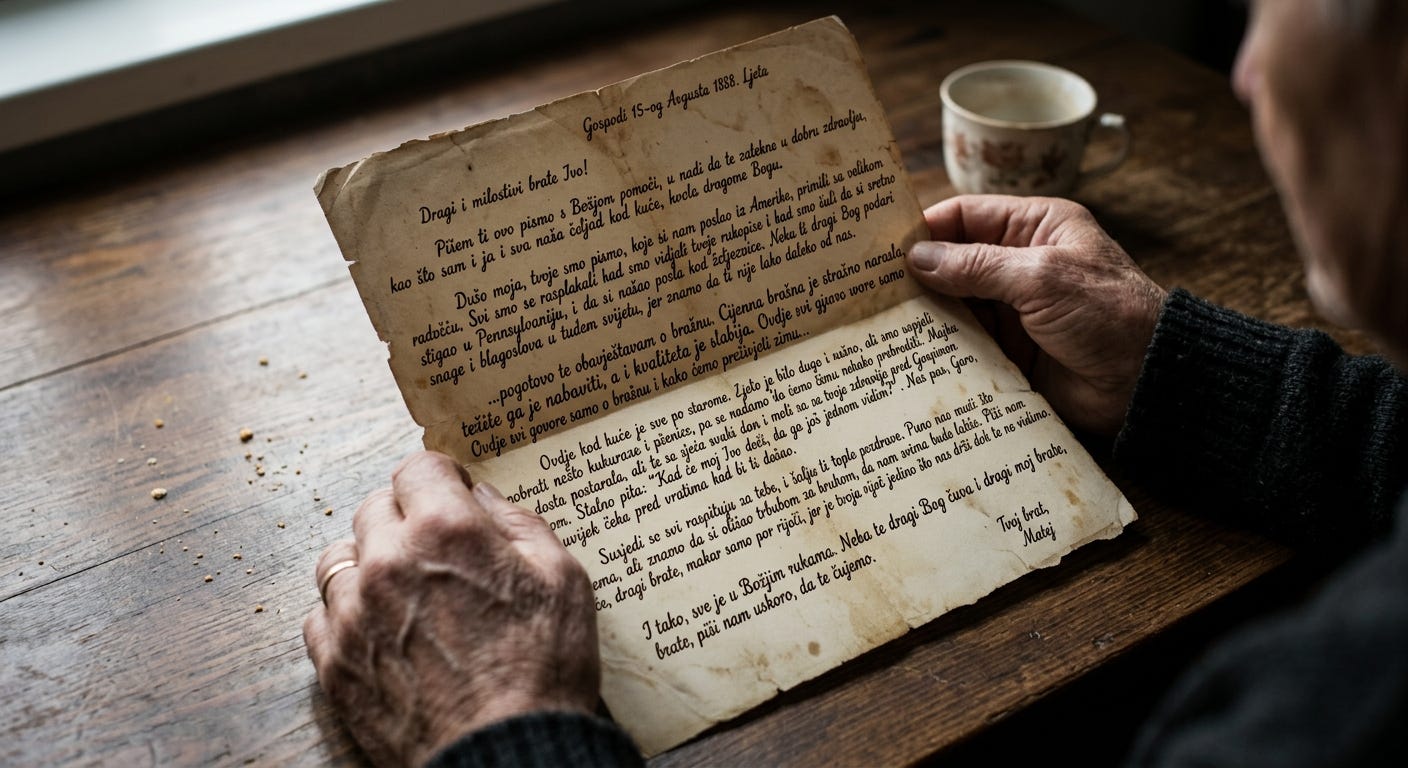
And here is what I want to tell you about those letters, because it took me a long time to understand it myself. They are almost never dramatic. In nineteen years I have translated perhaps forty of them and I can count on one hand the ones that contained a secret. What they contain is the price of flour. A cousin’s cough that has gone on too long. Whether the cow was sold. Somebody asking, at the end, in a formula that has not changed in a hundred years, that God keep you and that you write soon.
People brace themselves for a revelation and receive a Tuesday.
And that is the loss. Not a secret. A voice. The ordinary daily sound of a person thinking about flour, which is what a person mostly is, and which is the exact thing that does not survive when a language is not handed on.
I have been putting this letter off for weeks. It is the hardest one in the series and I am not going to be able to make it comfortable.
Three shapes
The loss arrives in three shapes and you will recognise at least one of them.
There is the story you can follow only halfway. Your grandfather is telling something long at a table, and you are getting the nouns and losing the joints, the little words that hold the clauses together, and you can see the shape of the thing without its content, and at some point somebody at the table makes a small sound of recognition and you understand that the point has just gone past you.
There is the letter you cannot read. In a drawer, in a box, in a folder your mother kept. It has been there for decades and it will still be there when you die, unless you do something about it.
And there is the joke that dies in the air. Somebody says a sentence, the table breaks, and there is a fractional pause before you laugh, and everybody knows.
Those three are not the same size and I want to take them seriously in order.
What the research says is actually happening
Start with the story, because the science here is more precise and more painful than most people expect.
Viorica Marian and Ulric Neisser ran two studies on autobiographical memory in Russian-English bilinguals, testing a hypothesis that sounds obvious once you hear it and that almost nobody applies. They proposed that memories become more accessible when the linguistic environment at retrieval matches the linguistic environment at encoding (Marian and Neisser 361).
In plain words: what you remember depends on which language you are being asked in.
Their bilingual participants, interviewed in Russian and in English, recalled more experiences from the periods of their lives that matched the language of the interview. Ask in Russian, and the Russian years come. Ask in English, and a different set arrives.
Sit with what that means for your grandmother.
Her childhood happened in Croatian. The village, the mother, the war, the leaving, the boat, the first winter, all of it was laid down in Croatian, in a mind that had no other language to lay it down in. And for the last fifty years you have been asking her about it in English.
You have not been getting a translated version of her memories. You have been getting a different, smaller set of them. The ones that the English question could reach.
Aneta Pavlenko, reviewing the research on how emotion words behave in a bilingual mind, notes that first-language emotion words appear to be linked to more autobiographical memories and thus more elaborately encoded and more readily contextualised, and therefore better recalled, than the corresponding words in a language learned later (Pavlenko 99).
Which is the same finding arriving from another direction. The words that carry feeling in a first language are tied into a denser web of actual remembered life. Their translations are not tied into anything like as much.
So when the story comes out in English, it is not the same story rendered in different words. It is a thinner story, retrieved through a thinner net, by a woman who is doing you the courtesy of speaking your language.
That is the first loss and it has been happening in your family for decades in complete silence, at every Sunday lunch, invisibly, while everybody was being perfectly nice to each other.
What it feels like from inside
Eva Hoffman emigrated from Kraków to Canada at thirteen and wrote the book that everybody in my field reaches for when the science runs out.
She describes what happened to the world when her Polish stopped being the language that named it. The process, she writes, works in reverse as well: when she sees a river now, it is not shaped, assimilated by the word that accommodates it to the psyche. The river, she says, remains a thing, absolutely other, absolutely unbending to the grasp of her mind (Hoffman 106).
And on the effort of feeling in a language that arrived late: when her friend Penny tells her that she is envious, or happy, or disappointed, Hoffman writes that she tries laboriously to translate not from English to Polish but from the word back to its source (Hoffman 106–07).
From the word back to its source. That is the labour, and it is invisible, and it is what a great many of you are doing all day without a name for it.
I put Hoffman here rather than in a footnote because she gives you something the psychology cannot. The psychology tells you that a different set of memories comes out. Hoffman tells you what it is like to be the person standing in a world that has stopped being named properly.
And now why it happened, which is not what you think
The last piece of research I want to give you is the one that will change where you put the blame, and I would like you to put it down.
Joshua Fishman spent a career on the question of how languages are lost and whether the loss can be reversed, and he built a scale of the stages at which a shrinking language can be supported. Schools. Media. Government. Work. All the things people reach for when they want to save a language.
And he was blunt about which stage matters. Stage six, family, neighbourhood and community reinforcement, constitutes, in his words, the heart of the entire venture (Fishman 20). Because the bulk of language socialisation, identity socialisation and commitment socialisation generally takes place through intergenerationally proximate, face-to-face interaction, and generally takes place relatively early at that (20).
And then the sentence that decides everything: if that stage is not satisfied, all else can amount to little more than biding time, at best generation by generation (Fishman 21). Attaining it, he writes, is a necessary though not sufficient condition for any of it to work (21).
So here is where your family’s language was actually lost. Not in a policy. Not in a school. Not in anything anybody would recognise at the time as a decision.
It was lost at a kitchen table, in the ordinary give of a tired woman answering her child in English because the child had answered her in English, and because it was faster, and because there was dinner to get on. Over and over, across a decade, until the direction of the household had changed and nobody could say when.
Fishman’s whole point is that this is where it happens and this is the only place it can be stopped, and I find that both merciless and consoling. Merciless, because it means no institution was ever going to save it for you. Consoling, because it means nobody in your family did anything wrong. They were tired, in a country that did not want the language, at the end of a shift.
The part I cannot fix
I promised at the start of this series that I would not sell you a flattering country, and I am not going to sell you a flattering account of this either.
Some of this does not come back.
The jokes you were not in the room for are gone. Humour is the last thing a person acquires in a language and the first thing that stops being shared, because it depends on speed and on a hundred references that were never explained to anybody. You will learn Croatian well enough to be told what the joke meant. You will not, in most cases, get to laugh on the beat.
The person your grandmother was in her own language is somebody you will never meet. She existed. People who knew her in Croatian have described her to me in words that did not match the woman her grandchildren describe. That is not a tragedy exactly, because everybody has more than one self and children never meet most of their grandparents’ selves. But it is a real absence and I will not talk you out of it.
And some letters get read too late. I have translated letters for people whose parents died the year before, containing the answer to a question they had spent thirty years asking, and there was nothing to be done with it except to have it.
I am telling you this because I think the honest naming of what cannot be recovered is what makes the rest of it bearable, and because the alternative, the encouraging version where everything can be repaired if you just start today, is not true and you would know it was not true.
And yet
And here is the other half, which is also true and which is why there is a second half to this letter.
Most of what you think is gone is not gone. It is unretrieved, which is a different condition, and the difference is that unretrieved things have an address.
The letters are still in the drawer, and they can be read, and the reading is not difficult for somebody who does it often.
The people are still alive, some of them, and they know a very great deal more than they have ever been asked, and nobody has ever asked them properly because everybody has been asking in the wrong language and about the wrong things.
And there is a technique, which comes directly out of the memory research I gave you above, which is so simple that I hesitate to call it a technique, and which changes what comes out of an old person’s mouth.
I will give it to you in the second half of this letter, along with everything else I know about how to do this while there is still somebody to do it with.
But I want to end the free half here, with the photograph of the letter on the kitchen table.
Because the thing that moves me about those photographs is not the letter. It is that somebody kept it. Through a war, an emigration, a crossing, four house moves and a death, in a language nobody in the house could read, somebody kept a piece of paper about the price of flour.
They did not know what it said either. They knew what it was.
Ask in Croatian
This is the whole of it, and everything else in this letter is a footnote to it.
If you want your grandmother’s Croatian memories, you have to ask in Croatian.
Not fluently. Not correctly. Not in a way that would satisfy anybody. The finding in Marian and Neisser is that memories become more accessible when the language at retrieval matches the language at encoding (361), and there is nothing in that finding that requires the retrieval language to be well formed. It requires it to be present.
So ask badly. Ask in four words. Ask in a sentence you rehearsed in the car. Baba, kakva je bila kuća? And then let her answer at length in Croatian while you understand perhaps sixty per cent of it, and do not interrupt to check, and do not translate, and above all do not switch to English to clarify, because the moment you switch you have closed the door you just opened.
You are not asking in Croatian in order to practise. You are asking in Croatian because the question is a key and the English key does not fit that lock.
And record it, so that the forty per cent you missed is not lost. You can understand it later. You cannot get it again later.
I want to be honest that this will be uncomfortable in a specific way. You will be worse at Croatian than she is at English, and she will know it, and she may try to switch to English to make it easier for you, because she has spent fifty years making things easier for you. You will have to gently not let her. That is the actual difficulty of this method, and it is social rather than linguistic.
Do not ask chronologically
The second thing, and the reason most family interviews produce three sentences and a long silence.
Chronology is the worst possible way in. Tell me about your childhood is not a question, it is an assignment, and it produces the summary the person has given a hundred times: it was hard, we had nothing, we were happy anyway. That summary is a wall, and it has been standing there for decades precisely because people keep asking the question that builds it.
Ask about objects, rooms, routes, days and smells instead.
Where did the water come from. Who slept in which bed. What was the first thing you did when you woke up. Walk me through the house from the door. What was the route to school and what did you pass. What did the kitchen smell like on a Thursday. What was on the table on an ordinary day, not a feast day. What did your mother wear to work in. Where was the radio and who was allowed to touch it.
These questions work because they are small enough to have an actual answer and because sensory detail is where episodic memory is stored. Ask about a route and you will get four stories, because the route had things along it and each thing has somebody attached to it.
And a handful of harder ones, once the small ones have been running for a while.
What did you think was going to happen to you. What were you frightened of when you were nine. Who did you miss most in the first year. What was the last ordinary day before you left. What did you take that you did not need and why.
That last question has produced more crying in my experience than any other and I use it rarely and never first.
When the answer is a shrug
Some people will not do this, and I want you to be prepared for it rather than wounded by it.
There are elderly people in every diaspora who will not discuss the leaving, and there are reasons for that which have nothing to do with you. Sometimes it is war. Sometimes it is politics that were dangerous to hold and were not discussed even at home. Sometimes it is shame about poverty, which is more common than the political reasons and much less talked about. And sometimes it is simply that the person made a decision fifty years ago not to look back, and has kept it, and considers your interest an intrusion into an arrangement that has been keeping them upright.
Take the no. Ask about something else. Come back to it in a year or never.
There is a version of this project that is extractive, where a grandchild arrives with a phone and a list and treats a person as a repository, and everybody involved can feel it. The point is the relationship, and the archive is a by-product. If you find yourself disappointed in your grandmother for not producing better material, put the phone down and go for a walk with her.
The box of letters
Now the practical part, because a great many of you have a box.
The letters will be harder to read than you expect and easier than you fear, and the difficulties come in a predictable order.
The handwriting will be the first obstacle and it is usually the only real one. Handwriting taught in village schools in the first half of the twentieth century has conventions that have since disappeared, and a reader who knows those conventions moves through a page in minutes while you stare at a single word for an hour.
The formulas will be the second. Old Croatian correspondence has an architecture: the opening address, the health of the writer, the health of the recipient, the news, the requests, the greetings passed on to a list of named people, the closing formula. Once you know the architecture you can read the whole letter faster, because most of any given letter is architecture.
And the abbreviations and the dates will be the third, and are a matter of five minutes with somebody who knows.
Where to get help. In order of cost: an older relative who reads them easily and has never been asked; a Croatian teacher or student, for whom this is an hour’s pleasant work; a parish or diocesan archive if the letters are older or if there is Latin in them; and a genealogical or heritage society in your own country, which almost certainly exists and almost certainly has somebody who does this for the joy of it.
And one instruction that matters more than any of the above. Photograph every page, front and back, before you do anything else, and put the photographs somewhere that is not your phone. Paper of that age is at the end of its life. I have watched a letter come apart on a table.
About the jokes
I said in the free half that the jokes largely do not come back, and I meant it, but there is something you can do that is better than nothing.
Do not ask for the joke. A joke explained is a corpse and everybody at the table feels the failure.
Ask for the story around it. Who used to say that. When did people say it. What happened the time it went wrong. What you are actually after is not the punchline but the world the punchline assumed, and the world is transmissible even when the timing is not.
And be patient with yourself about the half-second. Comic timing in a second language is the last thing to arrive and it arrives without announcement, usually years in, usually when you are not attending to it. I have watched people who thought they would never get there get there.
When the person is already dead
Many of you are reading this too late for the person you actually wanted, and I am not going to pretend that a method fixes that.
But the archive is wider than one person, and here is where it still exists.
The siblings and cousins of the person you lost, who are often overlooked because they were not your grandparent, and who were in the same rooms.
The people from the same village who emigrated to the same city, because chain migration means your family almost certainly landed among their neighbours, and there is very often a club, a parish or a burial society with a membership list and a filing cabinet.
The community organisations themselves, whose archives are frequently uncatalogued, at risk, and open to anybody who asks. Croatian clubs across four continents are full of boxes nobody has opened, and the people who hold the keys are usually delighted to be asked.
The recorded material, because you are not the first person to think of this. Linguists, ethnographers and local historians have been recording diaspora communities for decades, and some of those recordings are in university collections and some of them contain your relatives.
And the parish books, in Croatia, which are the deepest continuous record this country has and which will tell you where the family was and when, if not what they thought about it.
And then, the part that is about you
I want to close the practical half with something that is not a method.
Everything above is about recovering what a previous generation did not hand over. But you are standing in the same position they were standing in, at a different table, with somebody younger in the room.
Fishman’s finding was that the whole thing turns on face-to-face interaction between generations, early, at home (Fishman 20). It was true of your grandmother and it is true of you, and no amount of grief about what she did not pass on has any effect on what you are currently passing on.
You do not have to be fluent to change the direction of a household. You have to be present in the language, imperfectly, in front of a child, often enough that the child files it as something people in this family do.
That is the whole mechanism. It is not a high bar and it is not a metaphor.
One last thing
I keep coming back to that photograph on the kitchen table. The corner of a hand. The brown ink. The price of flour.
Somebody carried that piece of paper across an ocean and kept it for sixty years without being able to read it, or kept it after the person who could read it had died, which is the same thing.
And then their grandchild found it in a box, and did not throw it away either, and photographed it, and sent it to a stranger in Zagreb.
Whatever else has been lost in your family, that is not nothing. Two generations of people who could not read a letter refused to let go of it. That is not sentimentality. That is somebody holding a door open with their foot for sixty years, in the hope that eventually somebody would come through it.
You are the one who came through it.
Tihana Klepač is an Associate Professor at the University of Zagreb’s Department of English and the founder of TalkTime Croatian. This letter belongs to the series The Language You Carry. She teaches the Croatian Quadrant™, a structured, culturally immersive course designed to help learners stop translating and start thinking in Croatian. Find out more at talktimecro.com.
Works Cited
Fishman, Joshua A. “What Is Reversing Language Shift (RLS) and How Can It Succeed?” Journal of Multilingual and Multicultural Development, vol. 11, nos. 1–2, 1990, pp. 5–36.
Hoffman, Eva. Lost in Translation: A Life in a New Language. Penguin, 1989.
Marian, Viorica, and Ulric Neisser. “Language-Dependent Recall of Autobiographical Memories.” Journal of Experimental Psychology: General, vol. 129, no. 3, 2000, pp. 361–68.
Pavlenko, Aneta. Emotions and Multilingualism. Cambridge UP, 2005.