

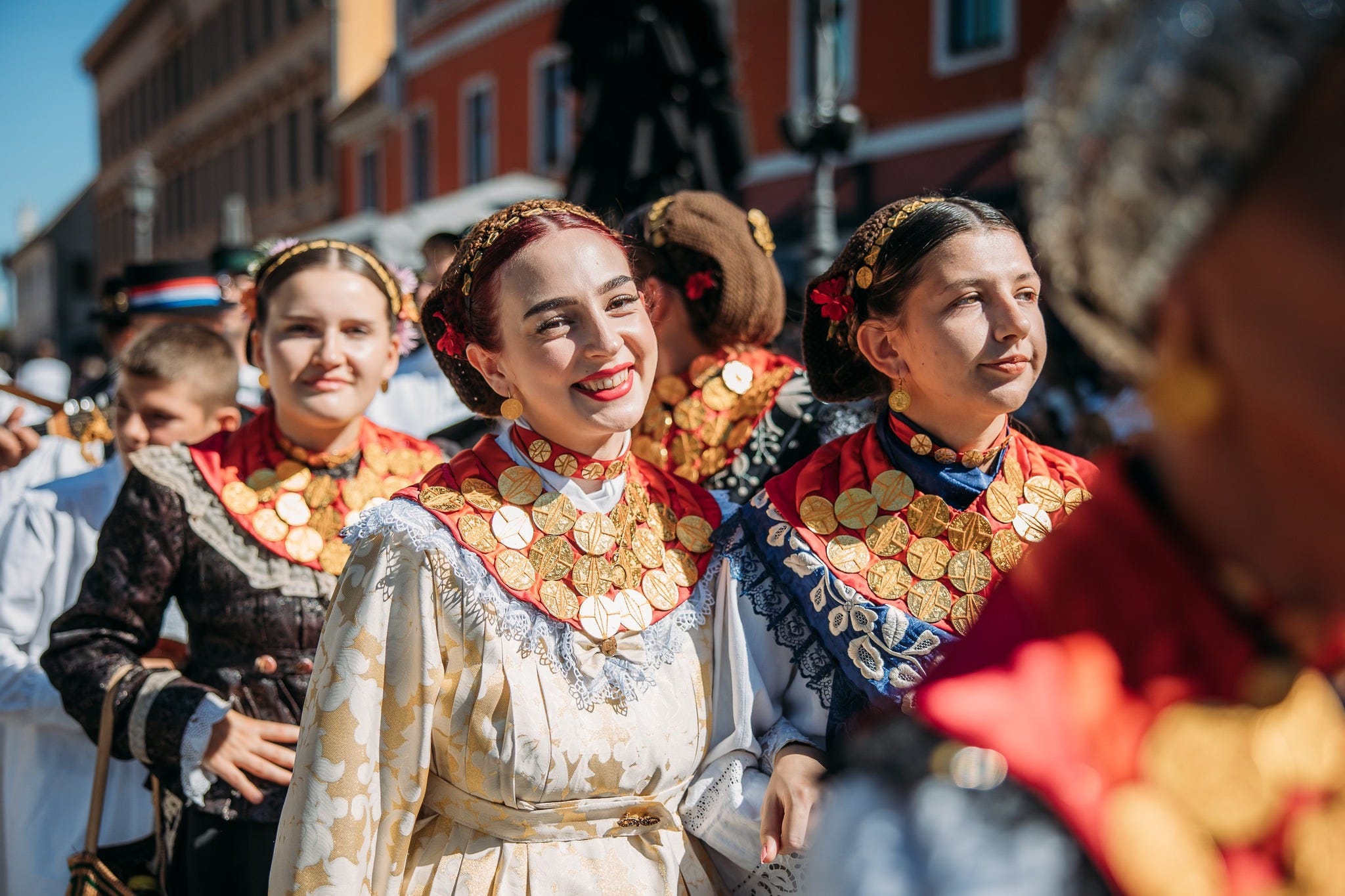
Vinkovačke jeseni folk costume procession. Source: vinkovackejeseni.hr.
Martin Jakšić spent years collecting the words of eastern Slavonia before they disappeared. He was a retired medical technician from Stari Mikanovci, not a professional linguist, and he knew what he was racing against. In the preface to his lexicon Divanimo po slavonski, published in 2003, he wrote that he feared his generation might be among the last who could save the local divan from final oblivion — and that most of the words had come back to him not from books but from childhood, flooding in from his years in Stari Mikanovci, from schooldays in Vinkovci, from the particular sound of a particular place (Jakšić 7–9).
Divan. In Standard Croatian the word means beautiful, wonderful. In Slavonian speech — and in Turkish before it arrived here — it means talk, conversation, the exchange of words between people who know each other well. Jakšić’s title carries both meanings at once: Divanimo po slavonski. Let us talk Slavonian. Let us do the beautiful thing.
That double meaning is, in miniature, what this letter is about. It is about Slavonia and its speech. About why the region that most people associate with flat fields and paprika holds within its villages a form of Croatian closer to the medieval source than anything spoken in Zagreb, Split, or even most of Dalmatia. And about why, if your family roots run east, toward Osijek, the Posavina, the Drava plain, the hills above Požega, or across into Baranja, you are standing closer to the gateway of Standard Croatian than you may have realised.
The three great dialect groups of Croatian — štokavian, čakavian, kajkavian — each say the interrogative what differently. Štokavci say što. Čakavci say ča. Kajkavci say kaj. As I described in the last letter, the standard language is built on the novoštokavian base, on the speech of eastern Herzegovina and the patterns it carried west, and the country’s great dialect triangle maps roughly onto its geography: štokavian across most of the inland south and east, čakavian along the coast and islands, kajkavian in the northwest around Zagreb and Zagorje.
What the standard dialect maps do not immediately show, what often gets overlooked in the textbook description, is that within the štokavian group, one variety stands apart. A remnant, linguistically speaking. The one that did not travel.
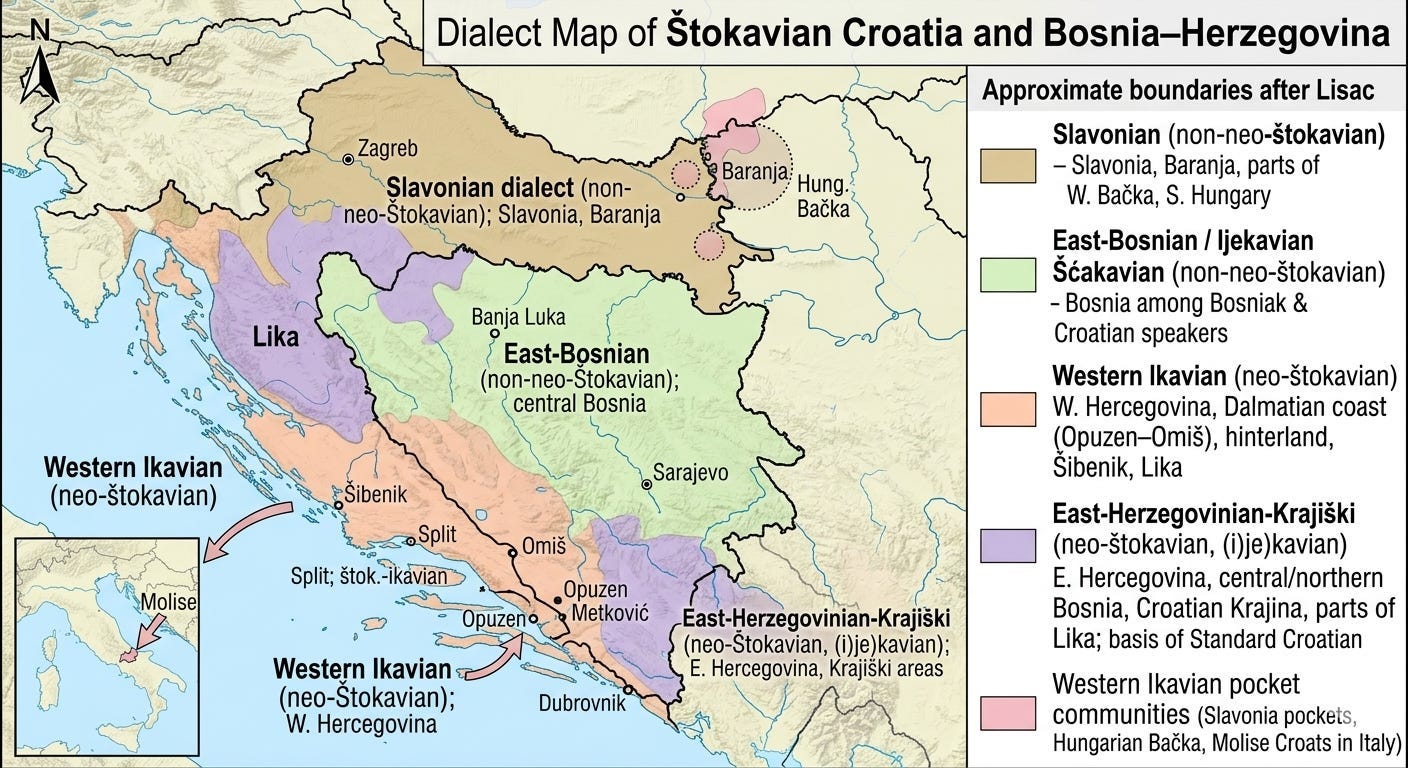
The Slavonian dialect, slavonski dijalekt, is the old štokavian. The linguist Ljiljana Kolenić, in her comprehensive description of the dialect published in Croatica in 1997, puts it plainly: the Slavonian dialect preserves the oldest state of Croatian štokavian (čuva najstarije stanje hrvatske štokavice) (Kolenić 113). It is the štokavian that did not fully undergo the retraction, the innovations, the levelling that turned eastern Herzegovina’s speech into the template for the national standard. It sat in its river valleys and its oak forests and kept things that the rest of the štokavian world had already changed. That conservation is both what makes it linguistically remarkable and what makes it, for a diaspora learner who comes to it from Standard Croatian, far less foreign than it might look on a map.
Let me explain what I mean by old, because the oldness here is not romantic vagueness. It is structural and specific.
The first thing that marks the Slavonian dialect as archaic is its accent system. In the letter about the four accents, I described how the standard four-accent system - the two rising and two falling tones that make Croatian a pitch-accent language - emerged from a historical moment when stress shifted leftward in the medieval štokavian dialects, leaving a tonal trace on the syllable the stress moved away from. That shift created the rising accents. The new system spread and became the standard.
The Slavonian dialect did not go all the way. Or rather, it went its own way. What the dialect preserved instead is the zavinuti naglasak, called by some the akut, a fifth tone that exists nowhere in the standard system. Ivšić identified it as the defining feature of the entire Posavian speech area in his 1913 monograph: “Posavskim govorom zovem ja čitav niz govora u Slav. i Donjoj Bos. Posavini, gdje se nalazi osobit akcent ~” (“I call the entire sequence of speech in the Slavonian and Lower Bosnian Posavina where this particular accent ~ is found the Posavian speech”) (Ivšić, Rad 196: 128, as cited in Kolenić 102). That tilde-marked symbol represents something the standard never developed: a rising pitch that climbs sharply and suddenly, different in quality from both the standard’s rising accents and its falling ones.
Most varieties of the Slavonian dialect operate with a five-accent system: the standard four plus this akut. Some of the oldest sub-varieties, recorded in settlements around Vrpolje and parts of the Posavina, still operate with a three-accent system that Milan Moguš classified as stara hrvatska akcentuacija - the old Croatian accentuation, the same system preserved in the most conservative čakavian varieties of Istria and the coastal highlands. Kolenić maps this out across four sub-groups, ranging from varieties that have barely moved from the oldest stage to varieties where the five-accent system is well established but the akut remains a regular feature (Kolenić 102–103).
None of this exists in the standard. The akut is a dialect feature, not a standard one. But here is what matters for a diaspora learner: the rest of the Slavonian accent system is, as Kolenić shows, structurally closer to the standard four-accent system than the kajkavian of Zagreb, which has no tonal distinctions at all. A Slavonian speaker approaching Standard Croatian is working within the same pitch-accent family. A Zagrepčanin is building that family from scratch.
The second archaic marker is šćakavizam. Standard Croatian and most štokavian dialects are štakavski: the old Slavic consonant clusters *skj and *stj became št. You say štedjeti, štitica, kršten. The Slavonian dialect says šćedjeti, šćitica, kršćen. That šć instead of št is one of the most immediate things you notice in Slavonian speech, and it is a preservation of what Ivšić argued was the original form: Kolenić notes his view that “Stjepan Ivšić drži da su svi štokavci najprije bili šćakavci. Kasnije se zbog razjednačavanja šć počelo izgovarati kao št” (“Stjepan Ivšić holds that all štokavci were originally šćakavci. Later, through dissimilation, šć began to be pronounced as št”) (Kolenić 107). The štakavism spread. The Slavonian dialect kept the older form.
Šćakavizam is shared with čakavian and kajkavian — it is, Kolenić notes, a feature of all three dialect groups (Kolenić 107) — which points to the deeper structural relationship between Slavonian štokavian and its neighbours. The Slavonian dialect and kajkavian are, as the linguist Dalibor Brozović put it in a formulation cited in Alemko Gluhak’s study of the very name “Slavonia”, relatively the most closely related of the štokavian dialects to kajkavian (Brozović 1988: 91, as cited in Gluhak 114). The Ottoman migrations separated them geographically, but the linguistic kinship is older than the separation.
The third archaic marker is in the vowels. The Slavonian dialect does not have the ijekavian reflex of the old Slavic jat vowel that the standard uses. Depending on the sub-region, it has: ikavian (long and short jat both give i: mliko, dite, brig); ikavian-jekavian (long jat gives i, short gives je: dite but djeca); ekavian (jat gives e in both positions: mleko, dete, breg); ikavian-ekavian (long gives i, short gives e: dite, deca); and in a few localities around Gradište and the Našice region, what Finka and Šojat documented as the preserved jat itself, a vowel that has not resolved in either direction (Kolenić 103–106). Each of these is old. None is the standard.
What is absent is the standard ijekavian. You will not hear mlijeko, dijete, brijeg in a Slavonian village. What you will hear depends on which Slavonia: Posavian settlements along the river corridor tend to ikavian and ikavian-jekavian speech; the Podravian settlements along the Drava in the north are largely ekavian; Baranja, the triangle of land north of Osijek between the Drava and the Danube, uses ikavian-ekavian, with two villages, Batina and Podolje, going fully ikavian and Semartin carrying a jekavian variety brought by Bosnian settlers early in the eighteenth century (Kolenić 103–106). Stjepan Sekereš, who documented the Croatian speech of southern Baranya settlement by settlement in his monumental study, found that the older accentuation is well preserved in the majority of the region’s villages — Batina, Bodolje, Draž, Topolje, Branjin Vrh — while three settlements, Kašad, Petarda, and Semartin, shifted to the newer accentuation under the direct influence of Bosnian settlers who arrived around 1700 and gradually imposed it on the pre-existing population (Sekereš 327–328).
This is one of the most striking details in the dialect’s history: you can see, in the geography of the accent, the precise moment when an outside population arrived and changed the sound. The rest of Baranya held on.
The fourth archaic marker is morphological, and here the Slavonian dialect is extraordinarily conservative. Where Standard Croatian has simplified the plural case system, the dialect preserves older endings: the dative plural of feminine nouns often ends in -am (snajam, ćeram); the locative plural in many varieties retains the older -a from an earlier -ah ending, which dropped because the dialect does not carry the consonant h (o poklada, na njiva); the instrumental plural uses the older -i ending (s konji, na ledi, u stari koli); the genitive plural still shows in some localities the old zero ending (kolac, Semeljac, volov). The infinitive regularly drops its final -i (gledat, radit, poginit). The negative imperative is neka, nekate, where Standard Croatian uses nemoj (Kolenić 108–112).
These are survivals. The Slavonian morphological system is closer to medieval Croatian than the standard is. Kolenić observes across several pages that in genitive, locative, and instrumental plural, the dialect shows an older state that the standard has replaced with more recent forms, and that this conservatism appears at every level of the morphological system (Kolenić 108–112).
For a learner coming from Standard Croatian, this morphological conservatism means something specific and practically useful: the forms you encounter in Slavonian speech are often recognisably related to the standard forms, just older. They are the same declension system at an earlier stage, and once you understand that, the dialect opens.
There is a fifth dimension to the Slavonian dialect that no purely structural description captures, and that is its lexicon. The word ićardija I began with — that word of stubborn, unselfconscious nerve — is one instance of a vocabulary layer that carries the history of the region in its nouns and verbs more directly than any accent pattern does.
Slavonia was under Ottoman administration for nearly two centuries, from the 1530s until the gradual Habsburg recovery in the late seventeenth century. Two centuries is a long time. Long enough for a language to absorb not a few curiosities but a structural layer of new vocabulary, particularly in the domains of material culture, domestic life, animal husbandry, and conflict. Marta Andrić’s study of Turkish loanwords in the rural speech of Slavonia, working from Josip Lovretić’s monumental village monograph on Otok near Vinkovci and Luka Lukić’s monograph on Varoš near Slavonski Brod, shows that Turkish loanwords form the largest and most important layer of borrowed vocabulary in Slavonian rural speech (najmnogobrojniji i najvažniji sloj usvojenoga stranog leksika) (Andrić 17).
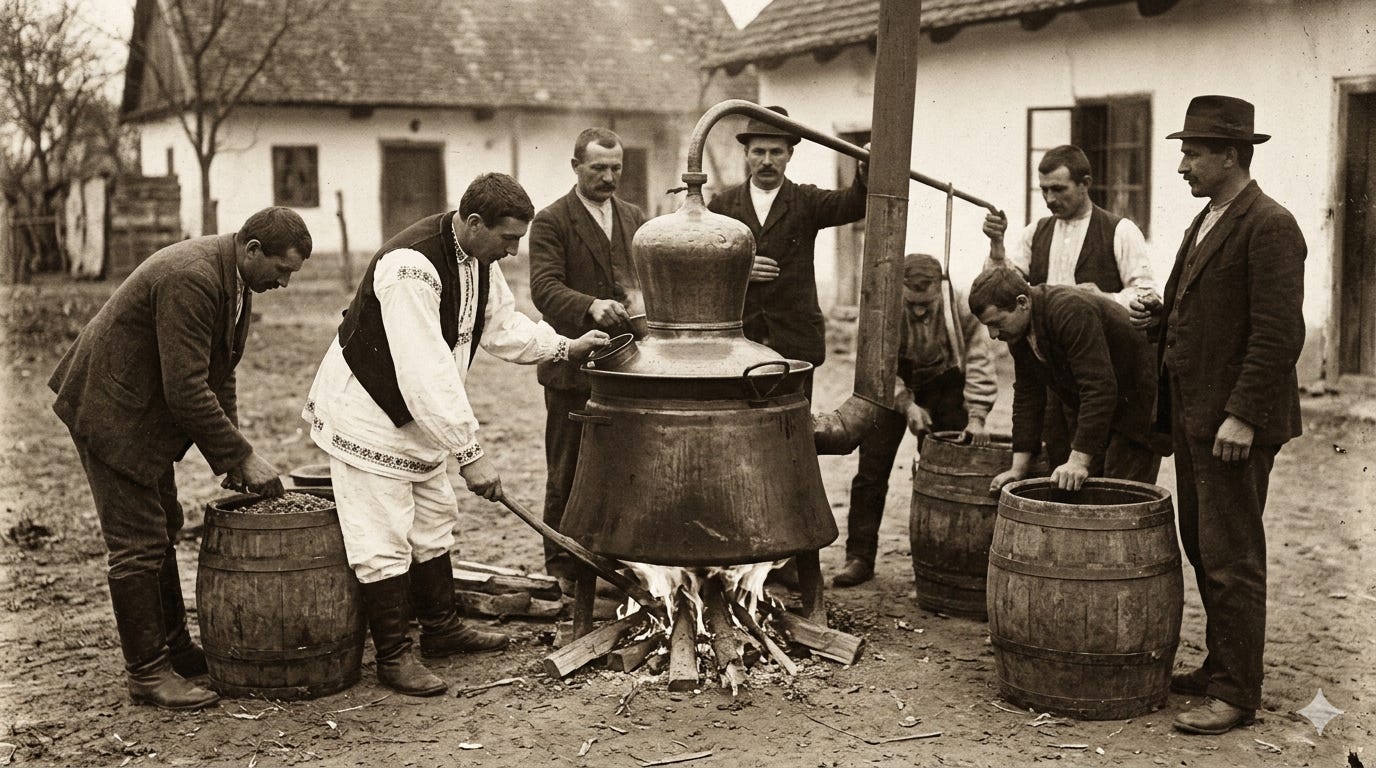
A traditional copper kazan for distilling rakija — one of dozens of Turkish loanwords still in everyday use in Slavonian villages.
The domains are specific and vivid. In the orchard and garden: bašča for the kitchen garden, bostan for the melon and watermelon plot, pekmez for the cooked fruit preserve (Andrić 21). In distilling and drinking: rakija, kazan for the still, lula for the pipe, čibuk for the long pipe, duvan for tobacco — Andrić cites the observation that the Ottomans were responsible for spreading two types of drink that became central to Balkan cultural life, of which rakija is first, the word itself Arabic-Turkish in origin (Andrić 21). In horses and their equipment: alat (chestnut horse), dorat (bay), kulaš (dun), češagija (curry comb), ular (halter), mamuza (spur) (Andrić 22). In clothing: šamija for the headscarf — Lovretić documents the lively trade in Turkish headscarves across the Sava, merchants travelling as far as Istanbul and Salonica to bring back the luxury goods Slavonian women wanted — and džep for the pocket, now so naturalised into Croatian that most speakers do not register it as a loanword at all (Andrić 20). In conflict and human difficulty: galama (uproar), kavga (quarrel), inat (spite, stubbornness), zulum (oppression, domestic violence), dušman (enemy) (Andrić 23).
The Turkish layer coexists with a German layer and a Hungarian layer, both of comparable significance. Sekereš documents around one hundred German words in southern Baranya’s Croatian speech, concentrated in crafts, trade, and military vocabulary — the domains where Habsburg administration made its presence felt — and well over one hundred Hungarian words, entering the language through centuries of shared market days, military service, and administrative contact (Sekereš 326).
Martin Jakšić, in his Divanimo po slavonski — a lexicon of the speech of the Osijek-Baranya and Vukovar-Srijem counties, compiled from memory of his childhood in Stari Mikanovci and fieldwork he knew was happening at the edge of the dialect’s living memory — notes that even within the same village, ikavian and ekavian forms can coexist: in Mikanovci, Cerna, Gradište and others, you hear srida and sredina, posilo and poselo in the same street (Jakšić 8). The internal variation is the dialect’s honest record of the migrations and settlements that produced it.
This lexical heterogeneity is the dialect’s biography. German, Hungarian, Turkish, Slavic substrate, occasional trade vocabulary preserved in children’s games — Lovretić records a children’s counting rhyme in Otok that runs Jek, duj, trin, štar, panč, šan, elfta, ohto, inja, deš, which Andrić identifies as closely resembling Persian numerals one through ten, transmitted through the Ottoman world (Andrić 24). The children of Otok in 1900 were counting in something that descended from Persian, without knowing it, because the counting game had outlasted its origins by generations.
There is something else about Slavonia that belongs in this letter, and it is the thing most often missing when Croatian dialects are described from Zagreb. Slavonia is the underdog region. Enormous and fertile, it produced writers, scholars, and a distinctive literary tradition - slavonski pisci who wrote in the local vernacular in the eighteenth century, and yet it receives, in the national cultural imagination, less than its weight.
The name itself, Gluhak’s etymological study demonstrates, is a Latinate refraction of the original Slavic self-designation. The people called themselves Slovini, Slovinci - in the old sense, people of the land od Sutle na istok, east of the Sutla river. The Latin scribes recorded them as Sclavonia, which came back into Croatian as Slavonija and was not fully official until the mid-eighteenth century, when Maria Theresa’s administration joined Slavonia administratively to Croatia. As Gluhak notes: “Ime Slavonije zapravo nije izvorno hrvatsko, slavensko - ono je od slavenskog imena prošlo kroz latinski filter, i za nas je ono zapravo latinizam” (“The name Slavonia is in fact not originally Croatian, Slavic - it passed from a Slavic name through a Latin filter, and for us it is in fact a Latinism”) (Gluhak 115). The word the Slavonians used for themselves became a Latinate label someone else imposed. And the dialect Brozović described as the štokavian variety most closely related to kajkavian was, before the Ottoman incursions pushed the two groups apart geographically, connected to it in ways the current dialect maps no longer make visible (Gluhak 114).
The dialect is called šokački by its speakers. Šokac is an identity, not just a dialectal label. It carries the particular weight of a regional culture that survived Ottoman occupation, Habsburg regimentation, Yugoslav standardisation pressure, and the most recent war’s population displacements, Kolenić’s 1997 article notes, with the plainness of someone writing in the immediate aftermath, that the peaceful reintegration of eastern Slavonia is not yet complete and that many speakers are still displaced from their villages (Kolenić 113). The dialect’s survival is not incidental. It is the outcome of people holding on.
The diaspora stream that ran north to America from this region in the late nineteenth and early twentieth centuries - the coal miners of Pennsylvania, the steelworkers of Ohio and Indiana, many of them from Slavonian and Baranian villages - carried this dialect with them. Hlavač and Stolac’s study of Croatian heritage speech across four continents documents how first-generation speakers in the American corpus integrated English vocabulary into the phonological system of the Croatian variety they had brought from home (Hlavač and Stolac 54–55). That speech is still there, in family memories, in the idiolects of very old speakers if you are lucky enough to have them in your life. It is the oldest Croatian in North America.
Kolenić closes her survey with this sentence: “Možemo zaključiti da slavonski dijalekt pripada štokavskom narječju i da čuva najstarije stanje hrvatske štokavice” (“We can conclude that the Slavonian dialect belongs to the štokavian group and preserves the oldest state of Croatian štokavian”) (Kolenić 113). What that means in practice is that when a linguist needs to reconstruct what štokavian sounded like before the medieval retraction, before the innovations that spread west and became the standard, they look east. They look at Baranya. They listen to the Posavina.
The oldest Croatian is in the east. That is the gateway. And if your family came through it on their way to Osijek, to Vinkovci, to Pittsburgh, to wherever they ended up, then the language you are reaching for has been waiting exactly where they left it.
Jakšić was right to be in a hurry. But the language did not disappear. It is still there. Still alive in the river valleys and the oak forests, in the mouths of people who never stopped divaniti.
What the Sub-Dialects Sound Like in Practice
Kolenić divides the Slavonian dialect into three sub-dialects: Posavian (southern), Podravian (northern), and Baranian (Kolenić 113). The differences between them are real enough that a speaker from one might hesitate to claim they sound the same as a speaker from another. The structural family resemblance holds, but each sub-dialect has its own character.
The Posavian sub-dialect, running along the Sava corridor from west of Nova Gradiška east to the borders of Srijem, is predominantly ikavian and ikavian-jekavian. You hear mliko for milk, dite for child, brig for hill. In the ikavian-jekavian zone, the rule is: long jat gives i, short jat gives je - dite but djeca, lip but ljepota (Kolenić 104-105). This rule is old. Ivšić called these varieties poluikavski, semi-ikavian, noting that they are structurally closer to fully ikavian speech than to jekavian, and that the archaic akut accent appears regularly in these varieties, particularly in the Posavian heartland (Ivšić, Rad 196: 59, as cited in Kolenić 105). The Baranian text Kolenić includes at the end of her article - a woman from Draž remembering Christmas Eve traditions - gives you the flavour of the ikavian-ekavian speech directly: mi deca, kruva, suva riba, pevale, polnoćka, the long jat going to i, the short to e, the vocabulary still carrying Turkish (sanduk) and archaic forms (potlje for afterwards) in the same breath as words any Croatian speaker would recognise at once (Kolenić 114).
The Podravian sub-dialect, north along the Drava from Virovitica east past Osijek, is ekavian: long and short jat both give e, consistently, in both root and ending. Mleko, dete, breg. And in the comparative: noveji, stareji, tužneji - a comparative ending in -eji from the old -čji that Kolenić notes is shared with čakavian (Kolenić 111). The Podravian varieties also have particular verbal forms: the third person plural present ending in -iju or -eju (kradeju, vežeju, nosiju, moliju) - longer endings than the standard -u or -e, by analogy with the -aju of the first conjugation (Kolenić 111). These forms are distinctive. You hear them and you know immediately: this is the Drava plain.
Baranian speech is ikavian-ekavian in most settlements, with the Sekereš-documented split between the area of older accentuation, which covers the majority of settlements, and the three settlements that shifted to newer accentuation under Bosnian immigration. Sekereš worked through the accent types systematically in his 1977 study, showing which words carry which accent pattern and where the differences lie between settlements separated by only a few kilometres. In Gornja Baranja, to the north, the newer accentuation brought by Bosnian settlers in the early eighteenth century has become dominant; in southern Baranya, the older accentuation, including the akut, is still well preserved in most villages (Sekereš 330).
The Lexical Layers for a Diaspora Learner
When Jakšić assembled Divanimo po slavonski, he was doing something ethnographic as much as linguistic: collecting the vocabulary of a world before it vanished. The words he gathered from his childhood in Stari Mikanovci and his subsequent fieldwork across the Osijek-Baranya and Vukovar-Srijem counties are a lexical record of the Turkish-German-Hungarian-Slavic accumulation that the Slavonian dialect embodies (Jakšić 7-9).
For a diaspora learner working from Standard Croatian, this lexicon divides into roughly three categories.
First, words that Standard Croatian also has, possibly in slightly different form, and that cause no difficulty. The Turkish inat (spite, stubbornness), for example, has passed into Croatian generally; galama (uproar), kavga (quarrel), rakija are all familiar (Andrić 23, 21). Džep for pocket is standard Croatian; most speakers don’t know it’s Turkish (Andrić 20). Bašča for garden, pekmez for the thick fruit preserve, kazan for a large copper pot or still — these are words a learner encounters in Standard Croatian contexts too, especially in literature, recipes, older registers (Andrić 21).
Second, words that are Slavonian-specific, but whose structure or sound is close enough to something in Standard Croatian that they click into place quickly. Ićardija is harder - it requires context - but potli and potlam (meaning afterwards, related to potom), the address system like strin-Maru or snaj-Poljet that names someone by their relationship to a named person, the verbal forms poginit and osvanit and metit instead of metnuti - these are variations on morphological patterns already familiar (Jakšić 9; Kolenić 111). They are the same system, abbreviated or conserved differently.
Third, words that are genuinely opaque unless you have been immersed in the culture. Jušika for the wild onion of the fields. Češagija for the curry comb used on horses (Andrić 22). The counting rhyme that runs Jek, duj, trin in Persian-derived numerals, preserved in a children’s game whose origin the children no longer knew (Andrić 24). These require the living context to make sense - the kitchen where the word was used, the field where the thing it names grew.
What the Turkish Layer Sounds Like in Living Speech
Andrić’s conclusion is worth sitting with: the Turkish layer in Slavonian rural speech is the largest stratum of borrowed vocabulary, concentrated in specific semantic fields - textiles, gardens, distilling, horses, domestic interiors, conflict. But it is also a layer in the phase of forgetting. The objects disappear; the words that named them thin out. What remains in active use has, for the most part, been naturalised so completely that the Turkish origin is invisible (Andrić 24).
For a diaspora learner, this means the Turkish layer is less a barrier than it might seem. What you will encounter are specific words for specific things - particular to the material culture of Slavonia, particular to the domestic and agricultural world that the villages preserved through the twentieth century, and when you do not know them, you can ask. The explanation will carry in it the history of the place: this word came from the Turks, those merchants crossing the Sava, those traders who walked from Sarajevo to Istanbul and brought back silk and headscarves and borrowed speech.
A Structured Path into the Slavonian Dialect
The sequence that the evidence supports, and that I have seen work, is this.
Standard Croatian first and solidly. The standard is the reference system that makes the dialect’s conservatism legible, when you know the four accents, you understand what the akut is doing differently; when you know the standard morphology, you can hear which Slavonian endings are older versions of the forms you know; when you know the standard jat reflex, you can track the ikavian and ekavian and ikavian-jekavian forms against a known axis. Without that reference system, the dialect is just interesting regional sound. With it, it opens.
From that foundation, exposure to Slavonian speech through recordings and, where possible, living speakers. The Croatian Radio Regional Centre in Osijek has archived material. There are folk music recordings from the Slavonian tradition: the bećarac, a quick-witted competitive song form that dates back through the Ottoman period, texts full of local vocabulary and quick wit, that carry the dialect into the ear in the most natural possible way. The Slavonian literary tradition, from the slavonski pisci of the eighteenth century through the contemporary writers who work in or near the dialect, gives you the written form.
And then the kitchen. The table. The conversation. Whatever fragment of this world is still in your family’s memory: a word, a phrase, a story about how something was called differently in the old house is worth writing down. It is data from the oldest Croatian štokavian still spoken.
The šokački word for the dialect is divan. In Standard Croatian, divan means beautiful, wonderful. In this dialect, and in Turkish before it came here, it means talk, speech, conversation. Jakšić called his lexicon Divanimo po slavonski: Let us talk Slavonian. That double meaning, beauty and speech collapsed into the same word, feels right for a dialect that is, among other things, a kind of grammatical memory.
Next week: the Dalmatian dialects. The coast. The islands. Where the čakavian strand of the Croatian language meets the sea it grew up beside, and what the bura and the Màrȉja of Split have to do with the oldest pre-retraction prosody in Croatian.
Tihana Klepač is an Associate Professor at the University of Zagreb’s Department of English and the founder of TalkTime Croatian. This letter belongs to the series The Language You Carry. She teaches the Croatian Quadrant™, a structured, culturally immersive course designed to help learners stop translating and start thinking in Croatian. Find out more at talktimecro.com.
Works Cited
Andrić, Marta. “Turcizmi u seoskom govoru Slavonije.” Migracijske i etničke teme 19.1 (2003): 17–27.
Gluhak, Alemko. “Ime Slavonije.” Migracijske i etničke teme 19.1 (2003): 111–117.
Hlavač, Jim, and Diana Stolac. “Observations on Croatian as a Heritage Language Across Four Continents.” Croatian Studies Review 16–17 (2020/2021): 45–72.
Ivšić, Stjepan. “Današnji posavski govor.” Rad 196 (1913): 124–254; Rad 197 (1913): 9–138.
Jakšić, Martin. Divanimo po slavonski. Pergamena, 2003.
Kolenić, Ljiljana. “Slavonski dijalekt.” Croatica 45–46 (1997): 101–116.
Lisac, Josip. Hrvatska dijalektologija 1: Hrvatski dijalekti i govori štokavskog narječja i hrvatski govori torlačkog narječja. Golden marketing – Tehnička knjiga, 2003.
Sekereš, Stjepan. “Govor Hrvata u južnoj Baranji.” Hrvatski dijalektološki zbornik 4 (1977): 323–484.