

A colleague from Canada asked me, at my own kitchen table, what čežnja meant. I said longing. Then I sat through the rest of that dinner knowing I had lied to her, and knowing also that there was nothing else I could have said, because the alternative was to stop the conversation for twenty minutes and give her a paragraph instead of a word, and nobody does that over blitva and a second glass of wine. So I said longing, and she nodded, and the word went across the table and arrived as something smaller and thinner than the thing I had sent.
I have thought about that evening for quite some time, and not because of my colleague, who is a good linguist and would have listened if I had asked her to. I think about it because it is the smallest possible version of a much larger failure, one that a great many of you have lived through in kitchens on the other side of the world, with people you love more than you have ever loved a colleague. The mother trying to explain to a grown son why she cannot simply be pleased that he is happy in Perth. The woman trying to tell her husband, who is kind and attentive and Canadian, what her grandmother meant when she said a particular sentence about the house in Sinj. The father who wants his daughter to feel one word, one single word, and who watches it land in English as something almost embarrassing, sentimental, a bit much.
You did not fail because your English is poor. Most of you have better English than I do. You failed because of something that happens in the structure of the thing itself, and today I want to take that structure apart, because I think the failure is more dignified than you know.
The dictionary is lying to you, and it knows it
Start with the honest admission that lexicographers themselves make, quietly, in prefaces nobody reads.
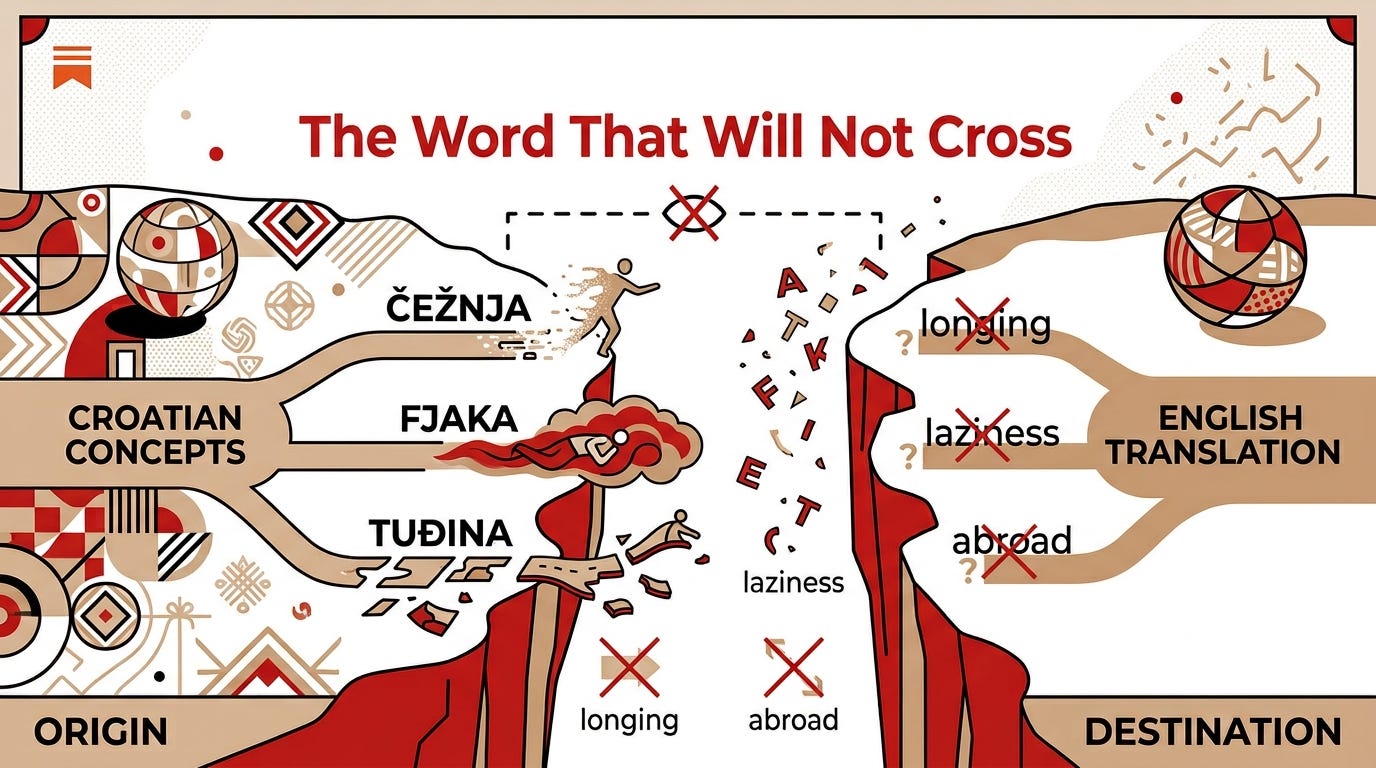
Anna Wierzbicka, who has spent a working lifetime on precisely this problem, puts it unusually bluntly: the meanings of words from different languages, she writes, “don’t match (even if they are artificially matched, faute de mieux, by the dictionaries)” (Wierzbicka, Understanding Cultures 2). Faute de mieux. For want of anything better. The dictionary is not describing an equivalence it has discovered. It is performing one it needs, because a bilingual dictionary that admitted the truth would be unusable, a book in which every entry was an essay.
So čežnja gets longing, and fjaka gets laziness, and tuđina gets abroad, and the transaction closes. What has actually happened is that a word has been swapped for the nearest object in another language’s inventory, in the way you might hand someone a fork when they asked for a škaf, because a fork is a thing for handling, and it is what you have.
The deeper claim, and the one I want you to carry out of this letter, is Wierzbicka’s account of what a culture-specific word actually is. Such words, she argues, are “conceptual tools that reflect a society’s past experience of doing and thinking about things in certain ways; and they help to perpetuate these ways” (Understanding Cultures 5). Read that twice. A word of this kind is not a label stuck onto a feeling that exists independently and universally, waiting to be named by whoever gets there first. It is a tool, shaped by a particular history of being used, and the shape of the tool goes on shaping the hand.
Which means that when a word will not cross, the reason is not that the other language is poorer. It is that the other language has not had the same centuries, and has therefore not needed the same tool.
I want to be firm about something here, because this territory attracts a kind of writing I find hard to bear. There is an entire small industry of illustrated lists of beautiful untranslatable words, the kind of thing that gets shared with a photograph of a fjord and a caption about how Danes have a word for cosiness. That work is not wrong so much as it is idle. It treats untranslatability as a charming decorative fact about foreigners, a curiosity to be admired for four seconds and forgotten. What is actually going on is far more serious, and it has consequences that some of you have felt in your own families, at your own tables, in the specific silence that follows a word that did not arrive.
English is not a neutral place to stand
Before I take the three words apart, one more piece of ground has to be laid, because without it the whole argument reads as special pleading for Croatian.
The temptation, when you notice that a Croatian word will not go into English, is to conclude that Croatian is exotic and English is normal. English feels like the plain case, the default, the language in which things are simply said. It is not. It is a language like any other, carrying its own history in its own vocabulary, and the words that feel most transparent to you are often the most local.
Wierzbicka makes this point about the very terms scholars use to describe other people’s speech. Words like impose and relevant, she notes, “have no equivalents in other languages,” and to claim that speakers of those languages are guided by principles which happen to be expressible only in English “means to give English a curiously privileged position in humankind’s mental world” (Cross-Cultural Pragmatics xix). Cliff Goddard has a name for the habit: terminological ethnocentrism, the practice of describing a culture with tools borrowed from a different one and then reporting the mismatch as a property of the culture described (Goddard and Wierzbicka 159). English, they conclude, “is by no means a culture-neutral language. On the contrary, it carries as much cultural baggage as any other” (158).
This matters to you personally and not only intellectually. It means that when your word will not go into English, the deficiency is not on your side of the table. It is not that you have a strange word and your husband has the normal one. You have two tools, made in two places, for two histories, and neither of them is the ruler by which the other is measured.
Now the words.
Čežnja: the longing that is also a disappearing
English longing is built out of length. It comes from the same root as long, and its logic is the logic of stretched time and stretched distance, of a thing far off toward which the self extends. It is a spatial word. You reach.
Čežnja is not built that way at all. It is a noun made from the verb čeznuti, and čeznuti comes down from Proto-Slavic and Old Church Slavonic čeznǫti, whose relatives in the other Slavic languages carry an entirely different meaning. Russian dialect čéznut’ means to disappear (Hrvatski jezični portal, “čeznuti”). You will recognise the same root without help, because it is sitting inside a Croatian word you already know: iščeznuti, to vanish, to be gone without trace.
So the Croatian word for longing is built on the root for vanishing.
Sit with what that does. In English, the one who longs is intact, standing still, reaching outward toward the absent thing. In Croatian, the one who čezne is being consumed by the reaching. The grammar agrees: you čezneš za someone, with za and the instrumental, the preposition of going after, of being behind and in pursuit. The word describes a person who is diminishing in the direction of what they want.
That is not longing. Longing is a posture. Čežnja is an event happening to you, and the event is a slow subtraction.
Now consider that this is the word your grandmother used, or would have used, about the place she left. Not a decorative sadness. A word whose own family history says that the person doing it is disappearing. And consider what happens when you say to your English-speaking child, she really missed Croatia, and hear how little of it survives the crossing. Missing. As though something had been misplaced.
Fjaka: the state that catches you
Now something lighter, and no less exact.
The dictionary gives fjaka as a regional word for “stanje oslabljene aktivnosti, pospano stanje; usporenost”, a state of weakened activity, a drowsy state, slowness, and it traces the word to Italian fiacca (Hrvatski jezični portal, “fjaka”). Along the coast this is the Venetian sediment doing what it always does, which is to leave the best words behind after the empire has gone.
The gloss is not false. It is simply useless, in the specific way that dictionary glosses are useless, because it describes the symptom and misses the entire cultural apparatus around it. Everyone in the world gets drowsy on a hot afternoon. Not everyone has a noun for it that carries dignity, permission, and a faint moral superiority.
The evidence is right there in the dictionary’s own example sentence, and it is grammatical rather than sentimental. Uhvatila me fjaka. The fjaka caught me. Fjaka is the subject of that sentence. You are in the accusative. You are the thing it happened to.
English cannot do this. Lazy is an adjective, and adjectives attach to people and stay there. To be lazy is to be a certain kind of person, and the word arrives carrying a small verdict. Fjaka attaches to nobody. It arrives like weather, it settles over a person the way heat settles over a courtyard at two in the afternoon, and when it lifts, it takes its opinion of you with it. A man in fjaka is not a lazy man. He is a man currently occupied by a condition, and the condition is understood by everyone present, and the correct response is to leave him alone and possibly to join him.
Try handing that to a Dutch son-in-law as laziness and watch what you have just told him about your uncle.
Tuđina: the word your family used for the country you were born in
And now the one that costs.
Croatian has domovina, homeland, built transparently out of dom, home. English has homeland too, so nothing much is lost yet. But Croatian also has the opposite, and English does not.
Tuđina. The dictionary gives two senses. The first is ordinary: “tuđa, strana zemlja; inozemstvo”, a foreign country, abroad. The second is the one that will stop you where you sit: “tuđe mjesto u kojem nema svojih”, a foreign place in which there are none of one’s own (Hrvatski jezični portal, “tuđina”).
Not a place where you do not have citizenship. Not a place where they speak another language. A place in which there are none of yours.
English simply has no word here. Abroad is a holiday word, cheerful and administrative, a word for a stamp in a passport. Exile is too grand and too political, and it belongs to poets and dissidents rather than to a man who left Imotski in 1968 to lay bricks. Foreign parts is archaic and faintly comic. There is no plain English noun for the country you live in that is not yours, and the reason there is no such noun is that English is largely the language of the receiving countries, and receiving countries do not need a word for the ache of the people they receive. They have words for arrival. We had to invent a word for the other side of it.
Look at what the adjective underneath is doing. Tuđ means, in the dictionary’s own formulation, that which belongs to another, and then, in its second sense, that which differs from another in feelings, understandings, customs, that which has little in common with the other; strange. Its ancestry runs back through Proto-Slavic tjudjь, with relatives in Old Church Slavonic štuždь, Russian čužoj, Polish cudzy, and the dictionary traces it back to Germanic, to the Gothic thiuda, people or nation (Hrvatski jezični portal, “tuđ”). That derivation is not settled, and I want to be accurate rather than poetic: Saskia Pronk-Tiethoff, in her study of Germanic loans into Proto-Slavic, explicitly lists tjudjь among the words she does not consider certain Germanic borrowings (9). But if the traditional account is right, then the Slavic word for foreign was made out of a neighbouring people’s word for the people, which is to say that our word for not-ours began life as somebody else’s word for us.
Here is the part I have been circling. For most of you, the country in the second sense of that entry, the place where there were none of ours, is the country you were born in. It is the country whose passport you carry, whose schools you went to, whose accent you speak with. Your grandmother had a word for your entire life, and the word was tuđina, and she did not use it to hurt you. She used it because it was accurate to her experience and there was no other word for what she had done to herself by leaving.
The Croatian dictionary illustrates the word with a line of poetry: noć me stigla u tuđini, night overtook me in a foreign land, and it attributes the line to Preradović. There is a symmetry there worth noticing. Petar Preradović finished the military academy at Wiener Neustadt, and he began writing in Milan, in German, under the influence of Schiller and Byron. The poem that marks his actual beginning as a Croatian writer, Zora puca, bit će dana, he wrote in Zadar, for Zora dalmatinska, in 1844, when he was already a grown man and an imperial officer (”Preradović, Petar”). The man our dictionary quotes on the subject of the foreign land is a man who came to his own language late, from the outside, after a career conducted in somebody else’s.
You are not the first. You are not even the first in the canon.
What can cross, and how
So the word will not go. Does that mean the concept is sealed, that čežnja is available only to those born inside it, that you cannot give your daughter anything of it at all?
No. And the reason is the most useful piece of linguistics I know, so I will spend the last part of this letter on it.
Wierzbicka and Goddard’s whole research programme rests on a finding that took twenty-five years of cross-linguistic work to establish: that beneath the vocabularies which do not match, there is a small set of meanings which do. About sixty of them. Simple, indefinable concepts which appear to surface as words or word-like elements in every language that has been examined: someone, something, people, say, words, true, do, think, want, know, feel, good, bad, big, small, before, after, because, if, not, very, more (Goddard and Wierzbicka 154–55). They call it the natural semantic metalanguage, and the point of it is precisely the problem I have been describing. If you cannot translate a word, you can still explicate it, using only the words that everybody already has.
The anthropologist Roy D’Andrade, who had no stake in the theory, described what this offers as “a potential means to ground all complex concepts in ordinary language and translate concepts from one language to another without loss or distortion in meaning” (qtd. in Goddard and Wierzbicka 156).
Read that against everything I have just told you, and you get the shape of the real situation, which is a both and rather than a defeat. The word will not cross. The concept will, if you are willing to spend more than one word on it.
This is why my failure at that dinner table was a real failure and not an inevitable one. I had a paragraph available to me and I chose a noun, because a noun is what the conversational moment could hold. Nobody hands over a world between the main course and the fruit. But your children are not a dinner guest. You have years with them. You have the long, slow, unglamorous format that a concept actually requires, and you have been trying to do it in the format that cannot possibly work, which is the single English word, delivered once, and watched as it fails to land.
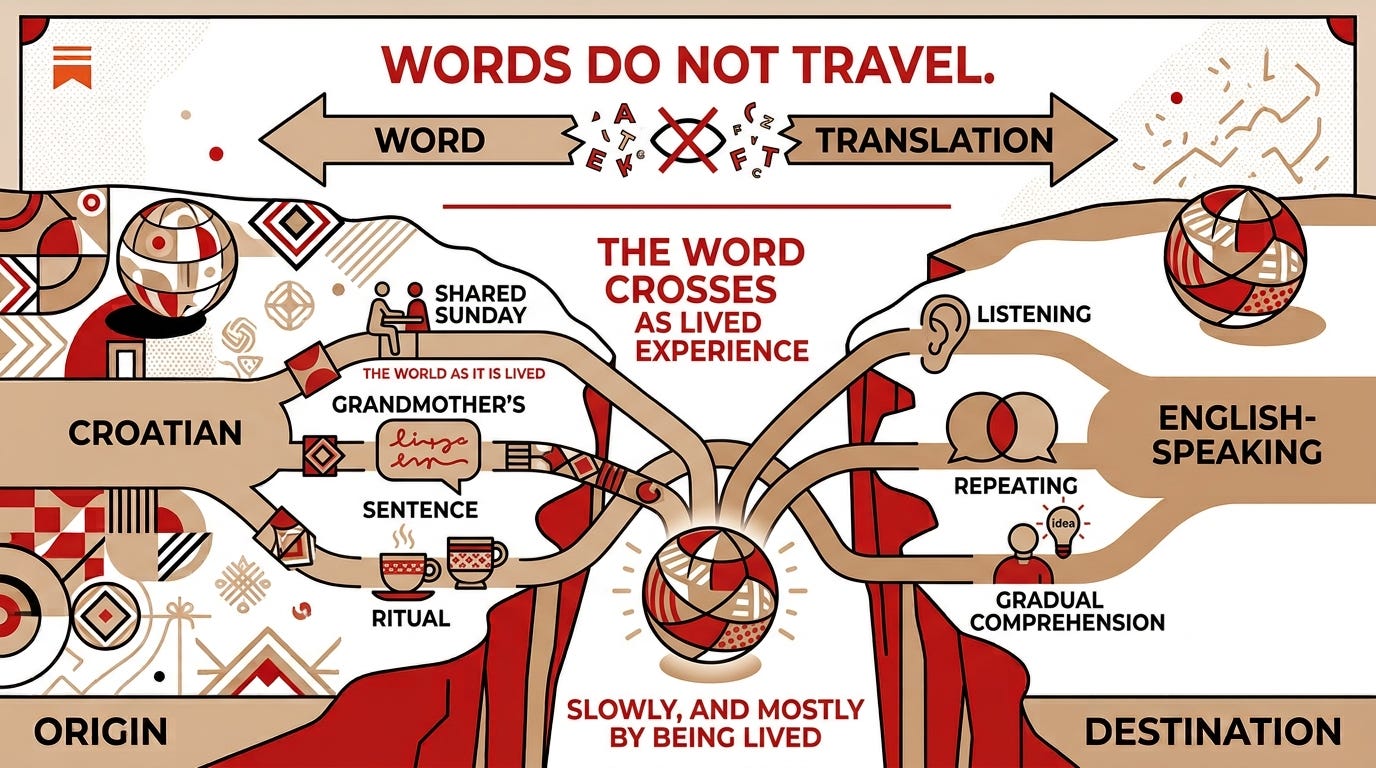
The thing you could not give your husband in one evening, you can give your daughter over ten.
Not the word. The word will always be čežnja, and it will always be untranslatable, and one day, if she goes far enough into the language, she will feel the vanishing inside it and understand why her grandmother’s face did what it did. What you can give her before that, and what you can start giving her this week, is the world in which the word makes sense. The occasions. The situations in which people say it. The particular quality of a Sunday afternoon in a house where somebody is not present.
Words do not travel. Worlds do, slowly, and mostly by being lived in front of somebody.
Svako dobro ljudi
The four words behind the paywall
The three words in the free half were chosen because they are the ones you feel. The four below are the ones that operate on you, which is a different thing, and harder to see from inside.
Naš
The most powerful word in the Croatian social vocabulary is a possessive pronoun, and this is not a metaphor. Naš, naša, naše. Ours.
English has ours and it is inert. It answers a question about property. The Croatian word, used of a person, is not about property at all. It is a verdict of membership, and it is issued without a procedure, and it is close to irreversible in either direction. On je naš does not mean he belongs to us. It means the question of whether he belongs has stopped being asked.
I ended the last series on this word, with the old man on the island who refilled a woman’s glass and said naša je. I want to add the part I left out, because it belongs here. There is no verb for the act. Croatian cannot say I accepted her, in that sense, because acceptance of this kind is not something anybody does deliberately. It is something that turns out to have already happened, and the possessive pronoun is how it is reported afterwards. The whole social machinery of belonging in this country runs through a word that English uses for coats.
Apply Wierzbicka’s own test for a cultural key word here, which is worth learning because you can run it yourself: is the word common, does it sit at the centre of a phraseological cluster, does it turn up in proverbs, sayings, songs and titles (Understanding Cultures 15–16). Run it on naš and watch what comes up. Naški. Naši ljudi. Kod nas. Naše more. A whole grammar of the inside, built from one pronoun, and every one of those phrases is a wall with a door in it.
Domaći
The adjective that English translates as homemade, and which is nothing of the sort.
Homemade is a claim about a production process, and in English it is mildly commercial, the sort of word a café puts on a chalkboard. Domaći is a claim about provenance and therefore about trust. Domaća rakija is not rakija made at somebody’s home rather than a factory. It is rakija whose entire chain of custody is known to the speaker, which is to say rakija that came from inside the circle, and the word is doing the same work when it is applied to cheese, to eggs, to a builder, to a doctor, to a person. It is naš in the form of an adjective, extended to objects, and it carries the entire moral weight of the noun it came from.
Which is why, when a Croatian says of something that it is not domaće, they have not made a remark about manufacturing.
Jal
Now one that does damage.
Jal, and its adjective jalan, is often glossed as envy, and it is not envy. Envy in English wants what the other person has. Jal does not particularly want it. Jal would prefer that the other person did not have it, and is prepared to be no better off itself, and this is a different mechanism entirely. It is the emotional physics behind the sentence you have heard your relatives say about somebody who did well, in that flat tone, with that small pause before it.
You need this word if you are ever going to understand the family stories properly. A great deal of what happened between your grandmother and her sister, or between the two branches of the family after the house was divided, is not explicable in the English emotional vocabulary of jealousy and resentment, which assumes a wanting. Some of it only makes sense in a language that has a noun for the specific wish that a neighbour’s roof would fall in.
I am not saying this is a Croatian characteristic. I am saying Croatian has a word for it and English has to build one out of a phrase, and the presence of the word changes how visible the thing is, how easily it is named at a kitchen table, and therefore how it circulates.
Sram
And the one that has probably done the most quiet work on you.
Sram is glossed as shame, and shame in contemporary English has become almost entirely pathological, a thing therapists help you unlearn. Sram is not pathological. Sram is, in the older Croatian sense that your grandparents still carried, a social sense organ. To have sram was to be capable of registering the presence of other people. Nemaš srama was not a diagnosis, it was an accusation of blindness. And sramota is not an internal state at all but an event, something that happens in front of witnesses and attaches to a family rather than an individual.
Consider what happens when a person raised in one system is described in the vocabulary of the other. Consider how many of you have spent years working on your shame in English, in a therapeutic frame that treats it as an injury to the self, when the thing your family transmitted to you was a completely different instrument with a completely different purpose. You have been trying to heal a word that was never the word you were given.
How to carry a concept across when the word will not go
Here is the method. It comes out of the research programme I described in the free half, and it is not difficult, but it is slow, and it will not feel like language learning while you are doing it. Nothing worth having in this field feels like language learning while you are doing it.
Stop asking what it means and start collecting when it is said. The question what does dert mean produces a gloss, and the gloss is faute de mieux and you already know what that is worth. The question that produces knowledge is: tell me about a time somebody said this. Wierzbicka’s own criteria for identifying a cultural key word are frequency, position at the centre of a phraseological cluster, and presence in proverbs, sayings, songs and titles (Understanding Cultures 15–16). All three are things you can observe from where you are sitting, without a linguist and without a course. Every time you hear the word, write down what was happening in the room.
Then write the explication, in the smallest words you own. This is the part that will feel absurd for about ten minutes and then will change how you think. Take a word and define it using only simple, universal vocabulary: someone, something, people, want, feel, think, know, good, bad, happen, before, after, because. No abstract nouns, no Latin, no synonyms from the same emotional family. Goddard and Wierzbicka warn that the metalanguage “may be easy to read, but it can be difficult to write” (160), and they are right, and the difficulty is the entire point, because the difficulty is you discovering that you did not actually know what the word meant, only how to use it.
Here is čežnja, roughly, in that register, so you have a model:
Someone thinks about someone else, or about a place, for a long time. This someone is not here now. This someone cannot be here now. When this person thinks like this, this person feels something. This person feels something bad, and at the same time something good, because thinking about it is like being near it. This person cannot stop thinking like this. Because of this, something in this person is becoming less.
Now show that to your English-speaking daughter. She will not have the word. She will have the thing.
Ask where in the body. When Panayiotou studied bilinguals and their untranslatable emotion terms, she asked them not only to translate but “to explain where in their body they felt this emotion”, and the untranslatable terms turned out to differ from their supposed equivalents in exactly that dimension, along with their causes and their appraisals (Pavlenko 103). This is a question your elders can answer even when they cannot define anything. Where do you feel it. Croatian answers tend to arrive fast and physically, and they will teach you more than any dictionary.
Refuse the single-word gloss when the stakes are high. Pavlenko’s survey of the research literature identifies the standing methodological sin of emotion research as “the tendency to translate local emotion terms with single-word English glosses” without any discussion of whether the concepts are equivalent at all (13). If professional researchers get this wrong in published work, you are permitted to get it wrong at dinner. What you are not permitted to do, if you actually want the thing transmitted, is to keep using the one-word method after you know it does not work. Give the paragraph. Bore them. They will remember the paragraph.
Give the occasion before the word. This is the one I would ask you to start with this week, and it is the least linguistic of all of them. A concept is learned from repeated situations, not from definitions, which is how you learned every word you own in your strongest language. If you want your child to have fjaka, you do not explain fjaka. You have a Sunday in which nothing is achieved and nobody apologises for it, and at some point you say the word, once, without commentary. If you want them to have čežnja, you let them see you playing the same song for the fourth time and not explaining why.
What you were actually trying to give them
I have been arguing all letter that the word will not cross, and I want to end by saying what I think you were really doing in that kitchen, when you tried to hand it over and it failed.
You were not trying to teach vocabulary. Nobody grieves over a failed vocabulary lesson, and some of you have grieved over this. What you were trying to do was to make somebody you love able to stand inside a room you have been standing in alone, sometimes for forty years, and the word was the only door you could see.
It was the wrong door. Or rather, it was a door that opens only from the inside, and you were trying to use it as an entrance.
The other way in is longer and it is available. It is made of occasions, repetitions, songs played too many times, food eaten at the wrong hour, a grandmother’s sentence quoted exactly rather than translated, a paragraph offered where a word was expected. It takes years and it works, and the evidence that it works is that this is precisely how you got the words in the first place. Nobody defined čežnja for you either. Somebody lived it in front of you until the word had somewhere to land.
Next week: one word taken all the way down to the bottom, the most self-destructive and most beloved concept in the South Slavic emotional vocabulary, and the reason your grandfather did the thing that made no sense to anybody. Inat.
Tihana Klepač is an Associate Professor at the University of Zagreb’s Department of English and the founder of TalkTime Croatian. This letter belongs to the series The Language You Carry. She teaches the Croatian Quadrant™, a structured, culturally immersive course designed to help learners stop translating and start thinking in Croatian. Find out more at talktimecro.com.
Works Cited
Goddard, Cliff, and Anna Wierzbicka. “Cultural Scripts: What Are They and What Are They Good For?” Intercultural Pragmatics, vol. 1, no. 2, 2004, pp. 153–66.
Hrvatski jezični portal. Novi Liber and Srce, hjp.znanje.hr. Entries “čeznuti,” “fjaka,” “tuđ,” and “tuđina.” Accessed 15 Aug. 2026.
Pavlenko, Aneta. Emotions and Multilingualism. Cambridge UP, 2005.
“Preradović, Petar.” Proleksis enciklopedija, Leksikografski zavod Miroslav Krleža, proleksis.lzmk.hr/42607. Accessed 15 Aug. 2026.
Pronk-Tiethoff, Saskia. The Germanic Loanwords in Proto-Slavic. Rodopi, 2013.
Wierzbicka, Anna. Cross-Cultural Pragmatics: The Semantics of Human Interaction. 2nd ed., Mouton de Gruyter, 2003.
---. Understanding Cultures through Their Key Words: English, Russian, Polish, German, Japanese. Oxford UP, 1997.